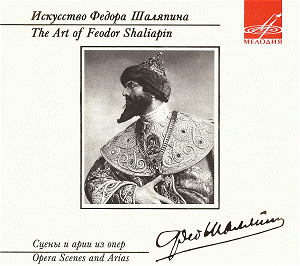
Ask many opera-lovers who were the greatest opera singers and
a small coterie of names occur regularly. Pavarotti and Callas
will be frequently named. Add the caveat of great singing actors
and most will fall back on Callas, with a few remembering the
likes of Tito Gobbi. Certainly Callas and Pavarotti made plenty
of newspaper headlines. But the definition of ‘great singing
actors’ must surely mean great as singers and equally great
as actors. Both Callas and Gobbi were great actors on the operatic
stage. On stage they were singers who lived the roles they were
portraying. But, I would suggest that neither, in terms of absolute
vocal quality, deserves the accolade of ‘great’. In her relatively
brief career Callas made many recordings, some with Gobbi. In
my survey of her complete studio recordings (see review).
I include many caveats as to her vocal qualities whilst frequently
admiring her characterisation. The same is true of Gobbi, who
I was privileged to see in the theatre. A superb actor he lived
the part he was singing. But in the cold light of listening
to his recordings I cannot help but note the odd raw patches
in his tone (see reviews of Gobbi as Rigoletto,
Falstaff
and Scarpia).
Go back a generation to the first half of the twentieth century
and two names stand out, Enrico Caruso and Fedor Chaliapin (1873-1938).
Both made many recording in the 78rpm era. Without doubt Caruso
was the finest tenor of his generation, in both the spinto and
lyric fachs, when the species was far more proliferate than
today (see review).
But the name that stands out among both commentators and colleagues,
as one of the real all-time great singer-actors is that of Chaliapin.
Born in 1873,
Chaliapin is far and away the best remembered of a magnificent
quartet of rival contemporary Russian basses. It was not just
his powerful and flexible vocal quality but also the magnetic
power of his personality, the acuteness of his musical interpretations
and the vividness of his performances. All these factors raised
him above his contemporaries and are evident in these recordings.
Famous colleagues such as Rosa Ponselle said of him he
was unrivalled as a singing actor in his age or any subsequent
one. She also said If a colleague gave him an inch,
he would steal an entire scene. He was so artful about it
that one wouldn't realize what was going on until it was too
late. His powerful and flexible bass voice was employed
in conjunction with a mesmerizing stage presence and superb
acting ability. He is generally considered one of the supreme
performers in the history of opera and is often credited with
establishing the tradition of naturalistic acting.
He made records
from the early 1900s to his death including live occasions
such as his performances of Boris at Covent Garden in 1931.
Boris remains his most famous role. He first sang it in 1898
at the Private Opera in Moscow and three years later at the
Bolshoi, always in the Rimsky-Korsakov edition. It was an
interpretation he repeated in Milan, Paris and New York as
well as London. Just why he was so famous in this role can
be heard in the four major extracts that extend from the Prologue
(tr.11) to the Farewell and Death of Boris (tr.14)
reflecting the various moods of the guilty monarch. Perhaps
the best illustration of Chaliapin’s capacity to convey in
his voice the character and words he is singing can be heard
in Pimen’s Monologue (tr.9) and Vaarlam’s brief roistering
song from the same opera (tr.10). Pimen’s Monologue was recorded
in 1910 with the other Boris excerpts from the period
1925-1928. They also show the consistency of his vocal qualities
across his long career. Most importantly these extracts, and
others in this collection, achieve a remarkable acoustic standard.
Another role that
Chaliapin made his own was the Miller in Dargomishky’s Rusalka,
a role he sang to acclaim at the Lyceum Theatre, London in
1931 at the time of the recordings here (trs. 3 and 4). His
performances of Khan Konchak in Borodin’s Prince Igor
were another memorable feature of that season. His singing
and expression are full of detail (tr.7) as are the subtly
different tonal qualities in his rendition of Galitsky’s song
and Igor’s aria from the same opera (trs. 5 and 6). Like the
Dargomishky arias, the second two appear to be from a London
recording. They have appeared from EMI previously (References
CDH 76 10092 issued in 1988). There is greater aural clarity
in this collection than on the earlier EMI Classics disc.
This perhaps reflects the improvements in technology in the
intervening years as well as access to pristine shellac and
extends to the orchestral accompaniments. The fact that no
recording details are given in this collection, allied to
Chaliapin’s extensive discography, makes it very difficult
to relate this collection to others.
Chaliapin possessed
a high-lying bass voice with an unmistakable timbre that recorded
well. He cut a prolific number of discs beginning in Russia
with acoustic recordings made at the dawn of the 20th Century,
and continuing through the early electrical (microphone) era.
This collection of his favourite Russian bass roles in good
recordings is thoroughly recommendable to connoisseurs and newcomers
alike. As well as the track-listing, there is a very brief biography;
both are in Roman and Cyrillic alphabets.
Robert J Farr