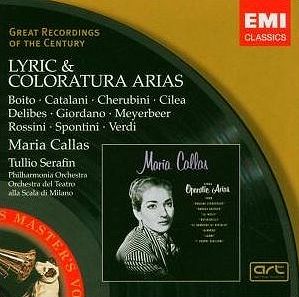
By now, so much ink, actual and virtual, has been spent arguing
pro and con Maria Callas that there's little point
in prolonging the discussion. So this review will offer the not-quite-random
thoughts and reactions engendered and provoked by this album -
which, by the way, I enjoyed immensely.
The voice was huge. One understands this intellectually if one knows
the history - how Serafin convinced Callas to step into Puritani
while she was in Italy to sing the Walküre Brünnhilde.
Since recording engineers compress the sound of big voices,
to avoid overloading, record listeners have to take the size
and amplitude of Callas's voice somewhat on faith. For the
alert listener, it's the color changes that give the game
away. The sense of a sudden upsurge of overtones as the soprano
reaches the top of the staff - which happens only with large,
well-produced voices - is almost visceral, even heard through
the monaural recording. The downward transition, into the
chest voice - and it is a real transition, not the squawking
register break perpetrated by some would-be spintos
- brings a subtler but still striking enrichment and darkening
of the tone.
And Callas did know how to sing. This shouldn't
need to be spelled out, but one finds
the opinion circulating in various quarters
that the rapid erosion of the voice
was caused by poor technique. Lord knows
that's so, frequently enough, but in
this case, the Délibes and Meyerbeer
arias - sung by Callas in Italian translation
as listed above - should put paid to
that idea. It isn't just the way she
sails through the coloratura, moving
fluidly in and out of the topmost range
with ample reserves of tone, though
that's wonderful enough. Listen to her
dynamic control, alternating fortes
and firmly supported pianos for
the echo effects of Ombra leggera,
attacking the Bell Song's first note
strongly and diminishing to a gentler
mix. The CD is worth having, I think,
just for the two French pieces.
Yes, there were technical irregularities, not yet full-blown problems
in 1954. One wonders at the busy vowel formations; Callas
pulls some bright "e" and "i" vowels into
a dark "pocket," which doesn't particularly help
either with intelligibility - Callas's is generally excellent
- or with maintaining a consistent legato. Then there's that
peculiarly bright, lifted "ah", particularly on
sustained tones in the upper-middle, perhaps intended to keep
the tone light. I suspect it was this formation - which tends
also to lift the voice off its physical support - that would
ultimately lead to the wiry, "flapping" high notes
of later years, such as we hear in the 1955 recordings here.
There's some unsteadiness, too, in the earlier recordings,
and not on the highest notes. The top A-flat on "atroce"
in Adriana Lecouvreur's first aria, the first "mai
più" (a G) in La Wally, the high As in L'altra
notte all betray varying degrees of unsteadiness; but
the full-voiced climactic high Bs of the Chenier and
Wally arias are firm.
Even admirers of Callas's acting didn't always realize how much the
music of each role was the vehicle for her stage persona.
More than most singers, Callas understood how the music complemented
and extended the sense of the bald text, so that her musical
discipline enhanced the dramatic side of her performances.
The recitatives and arioso passages, where one can't
hide behind a beautiful melody, make this more clearly evident
than the arias, though you can sense the same involvement
there. She brings immediacy to the opening lines of La
mamma morta, simply by pacing them naturally, in the narrative
rhythms of Italian. Similarly, the single recitative line
that sets up Adriana Lecouvreur's first aria is spacious:
not self-indulgent in the "aimless diva" manner
of some students - and some divas! - but weighting the statement
with care.
And Callas was more versatile than her renown in the big, tragic roles
might suggest - she could play comedy, and she could sing
"Classically." The care and musicianship she brought
to her dramatic roles stood her in equally good stead for
comedy, as this Una voce poco fa reveals. She sings
the aria in Rossini's original mezzo key of E major, where
most leggiero sopranos transpose it up. In this slightly
lower range, the soprano's full timbral palette comes into
play, making for a substantial character: the descending runs
suggest, not a merely foxy Rosina, but a formidable one.
The Cherubini and Spontini performances, despite the occasional strain
- the Medea lies a bit high for Callas's full voice
- are models of how to realize the expressive capacity of
music built on formal, contained structures and emotional
reserve. (We get some of this in the Rossini as well, which
after all isn't that far removed from the Classical style.)
And, where the reserve itself is the point - as in the gently
rocking pastoral rhythms of Caro oggetto - it is impeccably
rendered.
Serafin's conducting is mostly excellent, save for the inexplicably
droopy interlude in Una voce poco fa. The sound is plausible.
There's a grainy tone to the Philharmonia in mono, especially
noticeable when they play out. But Callas's voice reproduces well,
only occasionally threatening to overwhelm the equipment, as it
did in the Puccini aria recital.
Stephen Francis Vasta