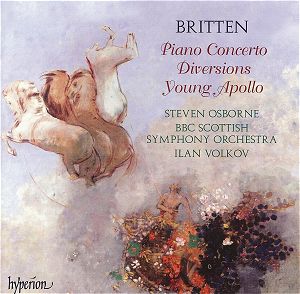
I first heard this
new CD in HMV Oxford Street. I was
browsing under the letter ‘B’ when
I suddenly became aware of hearing
a superb performance of the opening
‘Toccata’ of Britten’s Piano
Concerto. It was one of the
best renditions that I had ever
heard – in spite of the noise in
the shop and the sounds of less-challenging
music percolating into the ‘classical’
section. I was brought up on Sviatoslav
Richter’s fine performance of this
work on the ‘old’ Decca recording
with Mark Lubotsky and the English
Chamber Orchestra. In addition,
I have Joanna MacGregor’s notable
release on Naxos. However, what
I was hearing in the record-shop
had a pizzazz about it that I found
thrilling and thoroughly impressive.
I went over to the assistant and
asked him who was playing. He looked
at me and said "Britten"
– I was tempted to make remarks
about ‘still in diapers’ etc. but
I forewent sarcasm, smiled sweetly
and said, "No, who is playing"?
He found the cover and told me,
"Steven Osborne". Then
the penny dropped: I remembered
that Len Mullenger was sending me
this disc for review. Now, I could
not wait. Fortunately I still had
a deal of browsing to do, so I heard
the rest of the Concerto,
Young Apollo and the first
few Diversions – until my
mobile went and my friend asked
me where I was and when would I
be arriving at The Gluepot!
The Piano
Concerto in D major was the
first extended orchestral piece
that Britten had written – although
he was later to compose fine concertos
for cello and for violin - there
is also the beautiful ‘juvenile’
Double Concerto penned in
1932.
The composer wrote
that the Piano Concerto
was conceived "with the idea
of exploiting the various important
characteristics of the piano, such
as its enormous compass, its percussive
quality, its suitability for figuration;
so that it is not by any means a
symphony with piano, but rather
a bravura concerto with orchestral
accompaniment."
There is no doubt
that this is one of most exuberant
piano concertos in the repertoire.
Yet it is relatively little played,
and although there are some ten
recordings of this work currently
in the catalogue it hardly compares
to, say, Prokofiev’s Third Concerto,
which has in excess of fifty!
In spite of a certain
‘New York’ feel to this work, it
was actually composed before Britten
went to the United States. It was
written in the spring of 1938 when
he was living in the Suffolk village
of Snape. At this time he was sharing
accommodation at the Old Mill with
Lennox Berkeley. Britten himself
was the soloist at a performance
of this work at the ‘Proms’ in the
same year: Henry Wood was the conductor.
It was not too
well received in some quarters –
one reviewer suggesting that the
composer’s cleverness had got the
better of him. Yet nowadays we would
be much more inclined to agree with
F. Bonavia writing in the New York
Times where he notes a variety of
qualities including interest, jollity,
wit, good humour and jest. Surely
this is a masterpiece that ought
to be both popular and an essential
part of the concert pianist repertoire?
In 1945 Britten
decided to withdraw the third movement,
which originally was a ‘recitative
and aria’ and to replace it with
the present Impromptu. Interestingly,
in the ‘new’ movement, Britten used
material from some incidental music
he had written for a BBC play, King
Arthur and also incorporated
some references to the first and
second movements. Fortunately both
‘third’ movements are on this CD
and allow and interesting insight
into the composer’s style and mindset
at this time.
Young Apollo
is probably the least well known
of these three pieces- perhaps because
the composer suppressed it in 1939.
It was not played again until an
Aldeburgh Festival concert in 1979.
Additionally, Britten wrote it for
the relatively unusual combination
of soloist, string quartet and string
orchestra. The work was commissioned
by the Canadian Broadcasting Corporation
and was first performed in that
country in 1939. The composer was
the soloist.
Its inspiration
is imagery from John Keats’ poem
‘Hyperion’. The old order of the
Gods has ended. Saturn, Hyperion
and many others have to make way
for the gods of light, youth, beauty
and laughter. Mnemosyne, the former
goddess of memory, charges Apollo
to be the new god of beauty. His
mortal form is abandoned and he
is revealed in his true glory –
"He stands before us - the
new, dazzling Sun-god, quivering
with radiant vitality." However,
the listener is left wondering if
the true hero of this piece is Britten
himself?
A number of works
were written for the Austrian pianist
Paul Wittgenstein. Perhaps the most
famous of these is the Concerto
by Maurice Ravel.
However, there were other works
by Erich Wolfgang Korngold, Richard
Strauss, Bohuslav Martinů and
Franz Schmidt. Moreover, the story
of Prokofiev’s Fourth
Concerto is well known: when
presented with the score of the
new piece, Wittgenstein handed the
work back to the composer saying
– "… thank-you for the concerto,
but I do not understand a single
note and I shall not play it."
Another composer who wrote a concerto
for the pianist was Norman Demuth.
He is not a name that is on the
tip of every listener’s tongue,
with virtually no recorded music,
yet somehow I feel that this piece
would make an interesting discovery?
Paul Wittgenstein
approached Britten’s publishers
in 1940 with a proposal that he
should write him a piece. Arrangements
were finalised between the "somewhat
imperious" pianist and the
composer over dinner. Britten wrote
to his sister, "I’ve been commissioned
by a man called Wittgenstein – a
one armed pianist - to write him
a concerto. He pays gold so I’ll
do it." By October 1940 it
was more or less complete: it was
premiered on 16 January
1942.
A superficial hearing
would hardly suggest that the works
was written for ‘left-hand’ alone.
Britten stated that there is an
emphasis on the ‘single-line approach’.
The programme notes rightly point
out that this feature has more in
common with Prokofiev than Ravel.
Ravel managed to give the soloist's
part an ‘aural illusion’ of being
written for two hands. Yet Britten
has obviously given much thought
to the technical possibilities and
limitations of playing with one
hand. As such, it manages to sound
both complex and satisfying. This
is no soft touch for the soloist!
And do not forget to look out for
some intimations of Peter Grimes
– particularly in the fifth and
tenth variations.
It is a mystery
to me why these ‘early’ works by
BB are relatively little known.
Surely, the Concerto or the
Diversions would impress
orchestral audiences everywhere.
However, I suppose the diet of ‘Rach
and Tchaik and Chop’ will continue
to prevail.
It is not my intention
to mark this CD ‘out of ten’ – or
to try to rate it against other
versions that are still in or out
of the catalogue: for one thing,
it is always difficult to relinquish
a cherished favourite recording
for a new production. Yet there
are three things that would make
me consider this present disc as
a ‘first choice’ (after Richter!)
Firstly, Osborne is quite simply
brilliant. Even a superficial hearing
of this work will reveal dazzling
playing and a totally convincing
response to what is largely positive
and often exhilarating music. Each
work has different charms and challenges
and Osborne responds to them all.
These are great works, which show
optimism, ability and sheer technical
brilliance. Secondly, this CD presents
all of Britten’s ‘concertante’ works
for piano and orchestra, so it is
a fine conspectus of this music.
Lastly it is good to have the ‘discarded’
third movement of the Concerto.
Britten enthusiasts will be delighted
at being able to recreate this work
in a variety of incarnations. I
know that this movement was also
issued on the Naxos recording.
The programme notes
by Robert Matthew-Walker are detailed,
informative and very readable. This
is a great CD: for all enthusiasts
of Britten it is essential. For
music-lovers in general it is a
fine introduction to some of the
composer’s earlier scores.
John France

























 Steven Osborne (piano)
