These are iconic recordings
from the early 1970s originally issued
on that wonderful Argo label and since
snapped up by Lyrita. These represent
the early Birtwistle: an especially
radical figure it seems now, but that
may be because everything was so new
and unexpected at the time.
When listening to Birtwistle
one must remember two things. The first
is that his inspiration comes from a
sense of ancient ritual and procession.
The second is his obsession with the
Orpheus legend illustrated here in works
composed when he was in his late thirties
and beginning to make a reputation.
These pieces were at the cutting edge
of contemporary music at the time. Here
they are in extraordinarily convincing
and momentous performances by one of
the greatest of all singers, Jane Manning.
She is joined by the amazing London
Sinfonietta and Matrix under Alan Hacker.
Hacker, it will be remembered, was a
contemporary of Birtwistle and Peter
Maxwell Davies in Manchester. This music
still has the power to create an impact.
The first work on the
disc is the shortest. It is a good example
of Birtwistle’s pagan processional mood.
It is all based on one idea, one sound-world,
at which he beavers away for over nine
minutes. As if to back up my statement
I will mention that in his book ‘British
Composers of the 1980s’ (Faber, London,
1985) Paul Griffiths was told by Birtwistle
"I’ve always thought of my pieces
as starting from germs". Paul Conway
in his exemplary booklet notes writes
that ‘The Fields of Sorrow’ "unfolds
in one broad progressive span sharing
with ‘The Triumph of Time’ a strong
processional element". The text
which is in Latin and is translated
in the booklet is by Decimus Ausonius
(c.310-395). It comes from Virgil describing
the souls of two lovers drifting through
the forest of Avernus. The otherworldly
quality of the text is evident in music
which itself reflects the mood "among
slender reed and heavy poppies"
(translated by Helen Waddell).
The instruments are
set out in the stage in an especially
‘dramatic’ manner. For example at the
front of the stage are four separate
three-part choirs of various woodwinds
with pianos left and right. Setting
up the stage before the music begins
is also a feature of the acerbic and
tight-lipped masterwork ‘Verses for
Ensemble’. Paul Griffiths’ says in his
now sadly out of print book "If
you take ‘Verses for Ensembles’… there
are some brass ritornellos in four parts
which can be played in many, many different
ways". So there is a chance element
to the music. The version you hear on
this recording is only one possible
way of "viewing the object from
every possible angle" - like looking
at a sculpture from every aspect. The
work which falls into twenty-six obviously
short sections is remarkable in the
variety of ways that Birtwistle uses
his material and keeps thinking of new
sonorities. One can equate the piece
to an Elizabethan ‘Fantasia’ in form
and in fecundity of ideas. Paul Conway
goes through the piece as you listen
in a very helpful way from its "arresting
opening" to its "final vehement
chord".
‘Nenia’ is an Orpheus
legend-inspired piece with an especially
written text by Peter Zinovieff. He
wrote the text for Birtwistle’s Orpheus
opera and also founded the EMS Company
which invented the VCS 3 Synthesizer
in 1968. His text is perfect, succinct,
full of images. Representing a conversation
between Orpheus and Eurydice, it carries
just the right sense of drama without
falling into theatricality. It however
carries the subtitle: a ‘dramatic scena’.
Only a singer of virtuosity, élan
and versatility could tackle a piece
such as this. Many vocal techniques
are employed: ‘Sprechstimme’, screaming,
speech, use of very low register, and
differing voices for the two characters
as well as the narrator. The instrumentation,
including a prepared piano and three
bass clarinets creates and accentuates
a sense of dark hysteria.
Of the three pieces
offered here, the first ‘The Fields
of Sorrow’, is a distinct and moving
masterpiece. The second, ‘Verses for
Ensembles’ is fascinating and brilliant
but the third ‘Nenia’ now sounds mannered
and dated. That has become my view on
re-acquaintance with these early pieces.
However you are unlikely ever to hear
these works live so if you want to get
to know what made Birtwistle tick in
the 1960s then snap up this CD. The
performances, as I have indicated, are
miraculous, and the analogue recordings
show little sign of age, although they
do not have the kind of stereophonic
spacing one expects nowadays - something
which would have been especially helpful
in ‘Fields of Sorrow’. You catch these
musicians at the time of their very
best work when this was avant-grade
music, dangerous and exciting, new and
provocative. The mood of the time is
superbly captured when audiences and
record buyers were prepared to be shocked
and be taken on a unique musical journey.
There was a great sense of adventure
and daring. It has all comes back to
me and it probably will to you when
you hear these recordings.
Gary Higginson
See also review
by
Rob Barnett and Ewan
McCormick
























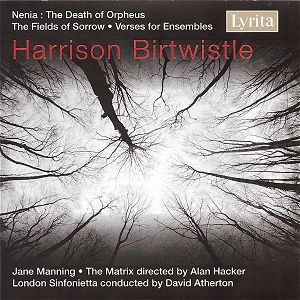
 Jane Manning (soprano) ****
