Now that Lyrita appear
to have reissued the majority of their
own archive, it’s gratifying to see
that they are turning their attention
to some old Decca/British Council releases
from the 1960s and 1970s that would
otherwise be languishing in the vaults.
The Decca Headline series contained
some classic performances of then avant-garde
works by contemporary composers; it
featured works by international figures
such as Messiaen, Lutoslawski and Henze
in addition to home-grown talent such
as Birtwistle, Bedford and Musgrave.
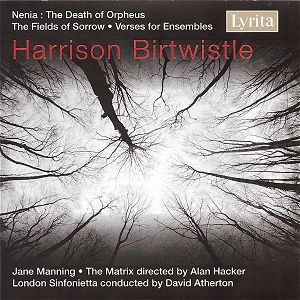
The present CD is a straight reissue
of HEAD 7 and contains three key works
by Birtwistle from the late 1960s/early
1970s. It offers a useful snapshot of
the composer’s style as he moved from
the harsh expressionism of his early
works (typified by the opera Punch
and Judy) to his increasing fascination
with the Orpheus legend, itself reflected
in a softer-grained, relatively lyrical
approach. On this CD The Fields of
Sorrow and Nenia represent,
broadly speaking, the latter approach;
Verses for Ensembles contains
elements of the more angular, rigorous
Birtwistle.
Jane Manning joins
the London Sinfonietta and Chorus for
The Fields of Sorrow; word setting
is unconventional, being divided across
the forces, often syllabically. The
performers are also distributed across
the sound-stage, creating together with
the bell-like sonorities a ghostly,
disembodied effect. This effectively
reflects the mediaeval poem which Birtwistle
sets, depicting the journey of two souls
through a gloomy forest in Hades.
By contrast with Verses
for Ensembles we have what marks
perhaps a culmination of his early,
expressionist years. Hieratic brass
and woodwind writing, contrasted with
ebullient percussion, throw us immediately
into a very different sound-world. The
work encapsulates many characteristics
of Birtwistle’s "early" period;
his use of verse and refrain forms as
a structural device, his fascination
with procession or ritual, and a deployment
of contrasting instrumental resources
as a way of articulating the structure
for the listener. The instrumentation
is set into sharp relief by the composer’s
spatial distribution of his forces on
stage. Thus two woodwind groups sit
to the left and right of the stage,
with brass and percussion towards the
rear. Birtwistle also requires players
to move physically to key positions
on stage at significant moments in the
piece. The sounds themselves contrast
harsh, aggressive brass and woodwind
writing with softer passages. Verses
for Ensembles is by no means an
easy work to assimilate, but as ever
with Birtwistle the music repays repeated
study. The performance, by the forces
for which it was written, is everything
we could wish for. Perhaps one or two
extra tracking points on the CD might
have helped those unfamiliar with the
music to find their bearings more clearly.
The final work on the
CD, Nenia – The Death of Orpheus,
was composed the year after Verses.
The title refers to a Roman funeral
dirge and the goddess invoked; Orpheus
and Euridice are the subjects of the
ritual. Birtwistle now groups his instrumental
forces according to timbres, rather
than the contrasting sounds he created
in Verses. The instrumental music
is dominated by the sound of bass clarinets.
The structure of the piece, the instrumental
forces, and the vocal style Birtwistle
requires of his soloist - Jane Manning
again - are immensely fluid, and immensely
challenging, but at all times dictated
by the text. Once again the performances
are astonishing in their virtuosity.
As the composer in
his early years moved from one set of
preoccupations to another, reflected
by a development in his actual compositional
style, it’s misleading to suppose that
each compositional phase is entirely
self-contained, without reference to
what came before or after. Birtwistle
himself felt that each of his pieces
consisted of "layers" reflecting
both previous interests and pointing
the way forward to future developments.
On first hearing the extreme dissonance
of Verses for Ensembles may appear
to contrast sharply with the softer-grained
approach of The Fields of Sorrow;
but the composer’s spatial distribution
of his forces in both works provides
a stylistic link. Nenia, as we
have seen, contains the preoccupations
with ritual that characterised many
of his earlier works. What comes across
very clearly - and here I echo a word
Paul Conway uses in his excellent booklet
notes - is the composer’s stylistic
integrity right across his output.
Ewan McCormick
see also review by Rob
Barnett
























 for details
 Jane Manning (soprano); London Sinfonietta/David
Atherton; The Matrix/Alan Hacker (Nenia).
Jane Manning (soprano); London Sinfonietta/David
Atherton; The Matrix/Alan Hacker (Nenia).

