Imbuing the text of Bach’s secular cantatas
with character can create many a delight that further distinguishes
them from the sacred cantatas’ more somber tone. The disadvantage
of successfully groaning lines like “…er brummt ja wie ein
Zeidelbär” (“…he groans like a honey bear”) with a genuinely
ugly tone is that they sound, well … ugly. Paul Agnew, in
the opening recitative of the famous “Coffee Cantata” (Schweigt
stille, plaudert nicht” BWV 211) goes for some sort of expressive
realism and comes up with authentic unpleasantness. A very
limited success, indeed – but fortunately passed by quickly
enough to ignore.
Klaus Mertens
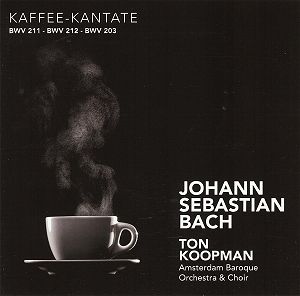
and Anne Grimm meanwhile act the rest of this domestic ‘coffee
vs. future husband’ drama out very nicely – and they remind
me why I so loved this recording when it first came out in
the mid-1990s as part of Ton Koopman’s complete Cantata series.
Now re-issued at high mid-price, several famous couplings
are available on single discs – including the Coffee- and
Peasant Cantatas, the Marian Feast Cantatas, and four out
of five Wedding Cantatas.
BWV 211, charming
though it is and despite my early listener's allegiance to
it, cannot compete with Helmut Rilling’s version for the
singing alone. Christine Schäfer and Thomas Quasthoff are
simply easier on the ears. And if it need be an original
instrument recording, Masaaki Suzuki has equally fast tempos
to offer and, though Mertens is preferable to Stephan Schreckenberger,
an impeccably delightful soprano in the stupendous Carolyn
Sampson.
BWV 212 – “Mer
hahn en neue Oberkeet” – with Els Bongers and Mertens does
not call better versions to mind: Mme. Bongers’ soprano is
stylish and the playing fleet. Fleeter, indeed, than one
might expect from a Peasant Cantata. Koopman’s harpsichord
and Jaap ter Linden’s cello provide the expert support for
Mertens in the short, three-movement “Amore traditore” BWV
203 that fills this disc out to a reasonably generous 65
minutes. Less generous – especially at that price – is the
absence of a libretto, the on-line availability of which
not being an adequate substitute.
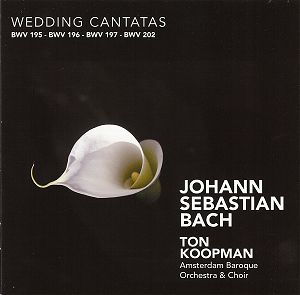
A much better
example of the great virtues of the Koopman Cantata Cycle
- formerly Erato, now Challenge Classics - is the disc with
the Wedding Cantatas. The Amsterdam Baroque Orchestra and
Chorus get to shine and Johannette Zomer, Sandrine Piau,
Annette Markert, James Gilchrist and, again, Mertens are
a line-up that leaves nothing to desire in “Dem Gerechten
muss das Licht” BWV 195. Like “Gott ist unsre Zuversicht” BWV
197, this cantata is split in Pre- and Post-Copulationem.
Since the liner-notes are trimmed versions from Koopman’s
and Christoph Wolff’s originals and don’t bother to explain,
this might well give rise to humorous confusion: a Bach chorale,
instead of a cigarette? Alas, "pre-" and "post-copulationem" is
more likely indicative of which part is sung before and after
the actual marriage pronunciation … and that kiss I imagine
having been no less part of tradition then, than it is now.
Barbara Schlick
and Guy de Mey (“Der Herr denket an uns” BWV 196 – its chorus
appropriately one-voice-per-part), Bogna Bartosz (BWV 197)
and Lisa Larsson (in the solo cantata “Weichet nur, betrübte
Schatten” BWV 202) continue along the same high level with
performances that only make me think of Bach, not alternative
recordings. There is plenty heft and oomph in the choruses
while all the drive expected from HIP recordings is retained.
Or try listen to Marcel Ponseele’s oboe part in BWV 202 without
closing your eyes enraptured. For a disc of Wedding Cantatas
- only BWV 210 is not included among the complete extant
Wedding Cantatas - this makes a very fine choice. As an introduction
to Koopman’s Bach it would be even more recommendable with
more generous liner-notes or at a lower price.
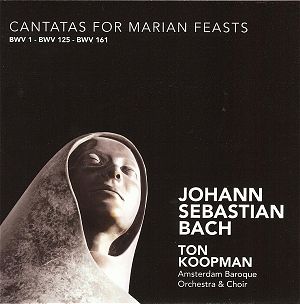
The disc with
Cantatas for Marian Feasts contains “Wie schön leuchtet der
Morgenstern” BWV 1, “Mit Fried und Freud ich fahr dahin” BWV
125, and “Komm, du süße Todesstunde” BWV 161. Soprano Deborah
York (1), altos Bogna Bartosz (125) and Elisabeth von Magnus
(161), tenors Jörg Dürmüller (125) and Paul Agnew (1, 161),
and of course Klaus Mertens (1, 125) offer singing at a high,
if not exalted, level throughout. In BWV 1 Masaaki Suzuki
(volume 34 of the Cantata Cycle on BIS) brings
a greater sense of crispness and bloom and cleaner horns
to
the grand
opening than does Koopman. I love Carolyn Sampson’s aria
for Suzuki, but Mme. York’s voice, a more pointed instrument,
has a very nice ring to it, too.
The tempos of
both conductors are more or less similar, but wherever Suzuki
takes a few seconds longer, I find his choice more convincing
and Koopman ever so slightly rushed. Only notable in direct
comparison, but notable all the same – not the least in the
concluding chorale “Wie bin ich doch so herzlich froh”, where
the orchestra and continuo harpsichord is weighed equally
on the BIS recording but recessed and dominated by the Amsterdam
Baroque Choir in Challenge Classics recording.
Suzuki’s volume
32 (see
review)
allows for comparison between his and Koopman’s BWV 125.
The biggest difference here is the alto aria “Ich will auch
mit gebroch’nen Augen” in which Koopman leaves mezzo/alto
Bogna Bartosz much more time than the quicker Suzuki allows
his counter-tenor Robin Blaze. Even if I liked Blaze’s voice
more than I do, my choice would still be Bartosz here, just
as I prefer the more nimble tenor-bass duet “Ein unbegreiflich
Licht erfüllt” under Koopman.
Similar reasons
might make Elisabeth von Magnus’s opening aria “Komm, süße
Todesstunde” in BWV 161 more attractive than Michael Chance’s
with the otherwise splendid Purcell Quartet recording (Chandos
CHAN0742 - see review), while the large tenor aria (“Mein
Verlangen is den Heilan zu umfangen”) is in good hands with
either Michael Chance (Purcell) or Agnew (Koopman). Because
this
cantata
is sparsely
orchestrated, there is much less difference between the two
contrasting HIP styles of the radical one-voice-per-part
("OVPP") Purcell Quartet (with minimal orchestral
forces; four strings, two recorders and obbligato organ here)
and Koopman’s, who is among the least dogmatic original instrument
Bach conductors.
The difference
is obvious again with the chorus and concluding chorale.
Four voices for a chorus are not much to begin with – but
for a chorale they are downright skimpy. As well as the voices
of the singers on the Chandos recording blend, at least the
chorale could have used a bit more heft. Koopman uses his
small choir, seemingly unchanged, for both chorus and chorale
and takes them at a much quicker clip. Altogether a satisfying
disc, especially for anyone who hasn’t yet added these cantatas
to their collection.
Jens F. Laurson

























 Amsterdam
Baroque Orchestra and Choir/Ton Koopman
Amsterdam
Baroque Orchestra and Choir/Ton Koopman 
