Were you to see the
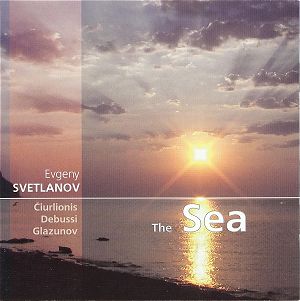
cover booklet placed the right way around
in its jewel case, you would discover
that this CD’s title is apparently "Mope".
But don’t be alarmed – this isn’t 70-odd
minutes of music aimed at manic depressives.
The four letters of the word "Mope",
it turns out, are actually in Cyrillic
script (pronounced "mor-yeh")
and form the Russian word for "the
sea". In any case, I imagine that
if you get to see this disc in your
local dealer’s shop, he’ll have sensibly
turned the booklet around so you’ll
see its English language back cover
instead – just as illustrated here.
In fact, the music
encompasses a far, far wider range of
moods than just moping. As composers
have long realised, the sea - volatile,
kaleidoscopic, ever-changing in its
scale and its moods and, perhaps above
all, intensely rhythmic - offers some
wonderfully descriptive musical subject
matter. "Sea music", as a
result, can be hypnotic or terrifying,
pulsating or becalmed, consoling or
epic.
This CD puts together
a neat programme showing how three composers,
writing in the late 19th
and early 20th centuries,
chose to depict the same theme. And
it turns out that they did so in markedly
different ways.
The earliest of these
pieces, Glazunov’s orchestral fantasy,
is perhaps the least musically interesting.
Even at the time of its composition,
the composer’s mentor Rimsky-Korsakov
considered it unoriginal and derivative.
Glazunov’s own attached programme explains
that the music depicts what is seen
by a man looking out from the shore
over a vast seascape: the woodwinds-driven
first third and last third of the piece
depict bright sunshine over a calm,
gentle sea, sandwiching a middle section,
dominated by brass and percussion, where
the sky darkens, the wind picks up and
a huge and violent tempest erupts. "And",
writes Glazunov, "everything that
the man had seen and all that he
had felt in his soul, he recounted
later to other men." Clearly, the
words that I have italicised indicate
that the composer at least intended
to offer something rather more subjective
and thoughtful than a merely literal
depiction of the elements. But although
he succeeds in creating an undoubtedly
crowd-pleasing pseudo-Lisztian-Wagnerian
sound picture, I am not sure that he
manages much more than an episodic and
relatively superficial treatment of
his ambitious theme.
The central work of
these three, speaking chronologically,
is Debussy’s familiar La Mer,
his first great orchestral masterpiece.
Impressionistic rather than literal,
it takes its inspiration from an eclectic
mix of real-life seascapes (at, of all
places, Eastbourne!), the composer’s
holiday recollections and depictions
by artists ranging from J.M.W. Turner
to the Japanese ukiyo-e painter
and printmaker Katsushika Hokusai. Most
notably, La Mer presents a newly
invented musical language for the depiction
of the sea, completely eschewing the
clichéd forms that had been utilised
hitherto. Its taxing demands on conductors
and their orchestras have made it a
core part of the orchestral repertoire
for the past century and it remains
a tough test of both artistic integrity
and technical skill.
Though
the least known of the three composers
on offer here, in many ways Čiurlionis
is, while the most firmly set
in his own era, also the most interesting.
Remembered in his native Lithuania more
as a painter than as a composer, he
was one of those fin de siècle
artists who were intent on exploring
the links, if any, between music and
colour (the most famous example was,
of course, Scriabin who intended that
performances of his Prometheus: The
Poem of Fire should
include an organ that produced appropriately
coloured light rather than any sound).
Thus Čiurlionis gave many of his
paintings "musical"
titles – sonata, prelude, fugue or whatever.
As far as I am aware, however, there
was no link to any painting – his own
or any other artist’s – when he composed
his symphonic poem The Sea. This
is not a short work by any means but
it is couched
in musical language that will seem entirely
familiar to anyone with a working knowledge
of the Late Romantic repertoire. Richard
Strauss, in particular, comes to mind
a great deal. Čiurlionis’s musical
idiom here is – no doubt entirely intentionally
- rather like his paintings, of which
I have located reproductions of about
40 or so. The art works are all what
I might term broad brush, avoiding fine
detail in favour of the "bigger
picture" and often featuring broad,
impressive (and occasionally utterly
incomprehensible) vistas. The man’s
music is likewise bold, sweeping and
perhaps not terribly subtle. It is,
nonetheless, a pleasurable discovery
for devotees of this kind of thing.
Evgeny Svetlanov certainly
seems well attuned
to Čiurlionis’s style, giving a
sweeping, magnificent (melodramatic?)
account that probably makes more of
the piece than it really deserves. As
one might expect, his Glazunov is well
worth hearing too, predictably more
excitable – and exciting – than,
say, Igor Golovchin’s account with the
Moscow Symphony Orchestra in Naxos’s
series of Glazunov orchestral works
(vol. 16, Naxos 8.553512).
So associated was Svetlanov
with the music of his homeland that
his accounts of non-Russian works can
easily be overlooked. That would be
a mistake: he frequently has interesting
things to say about such late 19th
century composers as Bruckner, Brahms
and César Franck - and, moving
on a few years, his Elgar symphony no.2
is pretty fine, too. This La Mer
may lack the authentic "French"
atmosphere that Roger Désormière
or Charles Munch brought to it, but
it has a dramatic sweep and character
that is, in its own way and to my own
ears at least, rather appealing.
The enthusiastic audiences
at these live recordings stretching
over more than 20 years were not always
as well behaved in smothering coughs
as they ought to have been. Maybe splicing
the mainbrace with an appropriate tot
or two of navy-issue rum would have
helped solve the problem.
Rob Maynard
























 The State Academic Symphony Orchestra/Evgeny
Svetlanov
The State Academic Symphony Orchestra/Evgeny
Svetlanov 