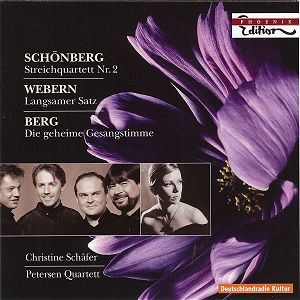
This is a CD that elicits raves and
frustration. The excellent Petersen
Quartet teams up with the sublime Christine
Schäfer and together they present us
with Arnold Schoenberg’s Second String
Quartet op.10 (for two violins, viola,
cello and soprano), Anton Webern’s heavenly
Langsamer Satz, and Alban Berg’s
Lyric Suite; the latter with
the “secret part for voice” that was
discovered some time in the late 1970s.
It would be a dream of a CD if you appreciate
the tamer, romantic reaches of the Second
Viennese School. That said, for some
reason Phoenix Edition - the unofficial
successor to Capriccio - decided that
they would not record the complete Lyric
Suite, but only the “Largo desolato”
that contains the vocal part.
Normally I’d try to view this not as an incomplete
CD with the first five movements of the Lyric Suite missing,
but as a CD which throws that last movement in as a bonus. But
with a running time of 47 minutes, that’s a little difficult.
I don’t usually mind CDs with a short run-time, either. There
is no point in squeezing extra material onto a finished product
for the sake of playing-time. But the two issues in combination,
and seeing how the rest of the Lyric Suite would have brought
this recording up to a good hour of music, it’s difficult not
to feel a little cheated. Especially since the playing and especially
the singing is so excellent throughout, that the CD really ought
to be heard by anyone who loves the Berg and Schoenberg pieces.
Schoenberg’s Second Quartet (op.10) is easily digestible
stuff when compared to his Third - its chromatic intensity veering
much more towards the romantic idiom than the modernist. Little
wonder then, that it’s the most commonly recorded of Schoenberg’s
five string quartets. Born out domestic crisis - Gustav Mahler
had left for America and Schoenberg’s wife Mathilde associated
all-too closely with their common friend, the painter Richard
Gerstl, who consequently killed himself - he composed the four
movements between March 1907 and July 1908. The strained tonality
(f-sharp minor, C-major, a-minor, d-minor, e-flat minor) makes
for a feeling of faint harmonic familiarity throughout, even
as the tonal relationships begin to dissolve. That’s particularly
notable when Schoenberg adds the voice to his string quartet,
the first time that the traditional boundaries of the string
quartet had been thus expanded. Two poems by Stefan George –
“Litany” and “Rapture” – form movements three and four.
The very atmospheric playing for Schäfer’s tender
entry in “Rapture” (“I sense air from another planet”) is so
gently woven, that the thin air into which we are to ascend
(Schoenberg, “Remarks about the four string quartets”) seems
to flitter. Among Schoenberg string quartet cycles, the Aron
Quartet’s on Preiser Records is my favorite. The Kolisch-, LaSalle-,
Leipzig-, and Schoenberg Quartets have also recorded all five
quartets, the New Vienna Quartet omits the early D-major Quartet,
and none but the aron quartet include the even earlier Presto
and Scherzo movements. But as well as Anna Maria Pammer sings
with the Viennese Aron Quartet, Christine Schäfer’s purer, more
focused tone and the Petersen’s very subtle way wins the day
here. The Pražak Quartet’s take of op.10, (recorded in 1994),
is a more nervous one than the Petersen’s – and Christine Whittlesey’s
well controlled soprano considerably more severe and earthier
than that of Schäfer who mines Schoenberg’s lines for greater
beauty. At least for those who absolutely need their Schoenberg
as intense as possible, the Pražak disc (Praga Digitals) will
be preferable.
Webern’s Langsamer Satz, one of the most
magnificent late-late romantic string quartet statements, never
fails to be gorgeous. The Quatuor Ébène gave it an indulgent,
romantic reading for their Salzburg recital. The Petersen Quartet’s
reading is a bit tighter, more muscular, forcing the work’s
beauty in compellingly tense ways. Since there is always room
for another favorite version of this work, the Petersen’s recording
is gladly granted a spot next to those of the pristinely controlled
Emerson- (DG), the Artis- (Nimbus), and the Psophos (ZigZag).
If you can get over the disappointing Berg-incompleteness, this
might be your Second Viennese School CD of the year.
Jens
F. Laurson