Editorial Board
MusicWeb International
Founding Editor Rob Barnett Editor in Chief
John Quinn Contributing Editor Ralph Moore Webmaster
David Barker Postmaster
Jonathan Woolf MusicWeb Founder Len Mullenger
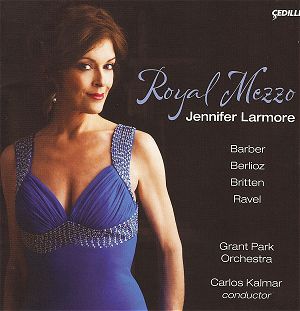
Royal
Mezzo
Samuel BARBER (1910–1981) Andromache’s
Farewell, Op. 39 (1962) [13.10] Hector BERLIOZ (1803–1869) La
mort de Cléopâtre(1829) [21.32] Maurice RAVEL (1875–1937) Shéherazade(1903)
[17.23] Benjamin BRITTEN (1913–1976) Phaedra,
Op. 93 (1976) [14.43] Jennifer
Larmore (mezzo)
Grant Park Orchestra/Carlos Kalmar
rec. Orchestra Hall, Chicago, 4-5 August 2006 (Barber
and Berlioz); Harris Theater for Music and Dance, Millenium
Park, Chicago, 29-30 June 2007 (Ravel and Britten) CEDILLE RECORDS CDR90000
104 [67.15]
Jennifer
Larmore’s latest recital record moves away from the territory
for which she is best known in the UK, namely Handel
and Rossini. Instead she gives us three cantatas all
loosely linked by the theme of tragic Queens. The cantatas
range from Berlioz’s Death of Cleopatra to Barber’s
Andromache’s
Farewell and Britten’s Phaedra. Along the
way she also includes Ravel’s Shéherezade, neither
Royal nor a cantata but nonetheless welcome.
The
problem with this programme is that the pieces are all
rather intimately linked to other notable singers. It
is difficult to think of Britten’s Phaedra without
calling up the voice of Janet Baker for whom the work
was written. Baker also made a very fine recording of
the Berlioz cantata. Similarly Shéherezade is
rather dominated in the catalogues by the inimitable
recording of Régine Crespin. And Andromache’s Farewell was
written for Martina Arroyo. But we must try to forget
all this and concentrate on the present recital.
Barber’s Andromache’s
Farewell was written for the New York Philharmonic’s
first season in the Lincoln Center. The text, translated
by John Patrick Creagh, comes from Euripides’s The
Trojan Women and deals with Andromache’s harrowing
farewell to her young son as she goes into slavery.
The piece could almost be seen as a dummy run for Antony
and Cleopatra, which he wrote shortly afterwards.
Barber consciously tried to modernise his language
for the piece. Though it probably sounded a little
old-fashioned in some circles in the 1960s it now comes
over as a powerful slice of music-making. The form
is quite traditional, a cantata as understood by Berlioz.
Barber’s skill is in the direct way he addresses the
emotions of the piece.
Larmore
does not have a grand Romantic voice. Hers is a very
warm but direct instrument perhaps shaped by her skill
in bel canto and Baroque music. This is certainly no
bad thing and she creates a direct and powerful impression
as Andromache. But there were moments when I wanted more,
something of a searing intensity rather than the powerful
control which Larmore gives us.
She
follows this with the Berlioz cantata, which was written
in 1829 as Berlioz’s entry for the Prix de Rome. On this
occasion Berlioz failed to win the prize. Cleopatra was
too dramatic and too new in style, though he would go
on to win it another year. Larmore’s voice with, its
good line and classical overtones, is a good match for
Berlioz’s neo-classical yet dramatic piece. But we still
come back to comparisons. Larmore, good though she is,
does not eclipse memories of Janet Baker, especially
as their voices have elements of timbre in common. Larmore
never seems to be able to quite let go the way Baker
does in this music.
Larmore
seems more at home in the Britten cantata, perhaps because
she is less called upon to use pure bel canto techniques.
The cantata was written at the end of Britten’s life
for Janet Baker. Britten had it in mind to write an opera
based on Phaedra but was too ill to contemplate such
an exercise. Instead he wrote this brilliant opera in
miniature, based on lines taken from Robert Lowell’s
translation of Racine’s Phèdre. He modelled the
piece on Handel’s cantatas, partly as a tribute to Janet
Baker who was a fine Handel interpreter. Larmore does
not quite capture the feeling of the crazed middle-aged
woman that other interpreters have. If you are really
looking for a recording of this cantata, then I would
advise you to consider Lorraine Hunt Lieberson (Elatus).
Instead
of a fourth Queenly cantata, Larmore has opted for a
performance of Ravel’s Shéherezade. Here again,
it is difficult to listen to her fine line and perfectly
reasonable French without remembering the gorgeous tone
and verbal subtleties of Régine Crespin. I know that
it is notoriously unfair to complain that one performer’s
work is not like another. But here I find that, for me,
Larmore fails to eclipse the earlier recording. She is
not Crespin and, competent though the recording is, she
does not quite give us anything new and different.
I
would have preferred to like this recording more, but
instead I found that none of the tracks quite moved me
the way I wanted. Larmore always seems a little too in
control. She is well supported by Carlos Kalmar and the
Grant Park Orchestra. The orchestra is the resident one
for the Grant Park Music Festival in Chicago; the Festival
was founded in 1935 and the orchestra in 1943. The accompaniment
is not quite as luxuriant as some of the other recordings
that I have mentioned but the players are confident in
the various styles of music that Larmore has chosen.
The
CD booklet includes and informative article about the
four pieces and full texts and translations. It states
in the booklet that the pieces were recorded in concert,
but there is no evidence of a live audience.
If
you like the particular combination of pieces on this
disc then look no further. These performances will certainly
not disappoint even if they don’t quite inspire.
Robert Hugill
Please support our advertisers below by clicking on the logos for further information.

























 Jennifer
Larmore (mezzo)
Jennifer
Larmore (mezzo) 
