I confess that until this CD plopped onto my doormat recently
I had not heard of Paul Juon. I feel somewhat embarrassed by this
because what I have heard here is most impressive.
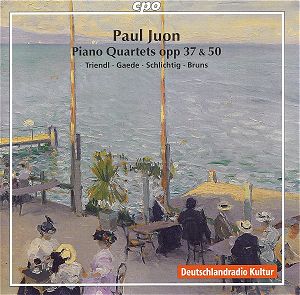
So what kind of style can be expected? When I first
saw the impressionist painting on the front of the booklet
I thought that Juon - being unfamiliar with this surname -
must hale from a southern European land. But the painter gave
me a big clue as to what I might expect. It is certainly a
French-type café painting and dated 1908 but it is by Nikolaj
Klodt (1865-1918). Klodt was a Russian artist and so indeed
Paul Juon, who pictured a couple of times in the booklet,
is Russian-born; Moscow in fact. He was
a pupil of Taneyev and Arensky. He lived much of his life
in Berlin and indeed in Azerbaijan. Perhaps this
wanderlust is the reason why he is now not at all well known.
Yet there is a sort of Gallic impressionism in this music
or more accurately an exoticism. This perhaps links him with
another master: Rimsky-Korsakov. There is, I have learned,
a Paul Juon
society and their website is worth looking at. It will
point you in the direction of other recorded chamber works.
There is also a sense in this music of Russian folk melody
as in the third movement of Op. 50. All in all, an interesting
mix and a promising beginning.
The booklet notes, translated by Suan Marie Praeder
somewhat surprisingly state that the greatest twentieth century
composers in this media - indeed the two men who saved the
Piano Quartet as a form - were Max Reger and Paul Juon. I
quote: “the piano quartet medium which began with Mozart’s
two compositions found its last two important composers …
in Paul Juon and Max Reger”.
Incidentally the booklet notes although quite useful
are sometimes rather overly poetic and in places are really
quite comic. As an example I offer “Here we witness (in the
Op. 50) an intimate conversation, pervaded by hidden allusions
and indecipherable references; but its wistfulness, which
is not at all that of a whiny lament, is so eloquent that
we really never miss the key to its secret cabinets of meaning”.
Beautiful.
So what of these two works? I always think it curious
that some record companies do not present the pieces in chronological
order. It’s a small point and one can track a CD any old way,
nevertheless I will discuss the works in their recorded order.
Both pieces are long and one might say, serious.
The later work comes first. It is in four movements with the
brief Scherzo placed second. The first movement opens with
several quite curiously contrasted ideas which the composer
‘plays with’ throughout. There is a definite, quite romantic,
second subject, but the sonata form is not treated overly
strictly. Emotionally it makes a strong impact and with the
fleeting scherzo following, ones attention is held. The slow
movement has its own distinctiveness of melody and the finale,
although possibly slightly less interesting than the rest,
rounds the works off in a thoughtful manner. It is dedicated
to the composer’s wife Ekaterina who suffered her final illness
whilst the work was on the composer’s desk. Juon was nursing
her during this time. The mood is dark and impassioned not
so much tearful - more elegiac and melancholic but a fine
testimony to their, up until then, happy lives together.
It is instantly apparent that the performances
are extremely committed, broad in tone and beautifully recorded
and balanced. The players must have come to this music from
a standing start but quite obviously believe in it. Op. 50
demonstrates this but Op. 37 proves it. This is a three movement
work, the first two being the length of the third which is
simply marked sostenuto. The subtitle ‘Rhapsodie’
explains the form, perhaps in England ‘Fantasia’ would have been used. Yet despite the
potential it certainly avoids rambling and ideas are brought
back and developed. It is a carefree piece with the almost
childlike quality of the second tune in the finale a good
example as is the short middle movement. It is the antithesis
of Op. 50, and the two works complement each other. Both are
fully romantic, but with penetrating harmonies and originality.
The opening idea of Op. 37 begins on cello and is taken up
by the violin and viola. It is then passionately pushed out
of the way by the piano – an especially arresting moment.
As you can tell I have enjoyed and much admired
this CD. I daresay it will remain little known and probably
rather specialist in its appeal, yet that should not be so.
The music is accessible and all music-lovers can take it to
heart. The performances, as I have indicated, are extremely
fine and I can only urge you to search it out and find out
more about this sadly little known figure in early 20th
Century mid-European music.
Gary Higginson