MW EXCLUSIVE 4CD sets £18 each or £28 for both postage paid
Search
What's New
Classical CD Reviews
Live Reviews
Jazz CD Reviews
Composers
Resources
Contact Us

Classical CD and DVD reviews. MusicWeb is not a subscription site and it is our advertisers that pay for it. Please visit their sites regularly to see if anything might interest you. Purchasing from them keeps MusicWeb free.
  Classical Editor: Rob Barnett  
Founder Len Mullenger   


CD REVIEW

Making a Donation to MusicWeb

About MWI

Site Map

More Reviews
How to find a review

Books

Film Music

Nostalgia

Records Of The Year

Recommendations

Comment
Arthur Butterworth Writes

Phil Scowcroft's Garlands

Classical blogs

Reviewers Logs

Announcements

Don't Go Here!

Community
Bulletin Board

Web Ring

Reviewers

Helpers invited!

Resources
How Did I Miss That?

British Composers

British Light Music Composers

Other composers

Indexes
   Label
   Masterwork

Discographies
   Composer
   National

Themed Review pages

Complete Books

Programme Notes

External sites
British Music Society
The BBC Proms
Performers
Orchestra Sites
Recording Companies & Retailers
Online Music
Agents & Marketing
Publishers
Other links
Newsgroups
Web News sites etc

Editorial Board
Classical Editor
   
Rob Barnett
Seen & Heard
Editor and Webmaster
   Bill Kenny
MusicWeb Webmaster
   Len Mullenger
Assistant Webmaster
   David Barker

PotPourri
A pot-pourri of articles

MW Listening Room
MW Office
Helping MusicWeb
Advice to Windows Vista users  
Questionnaire    
Site History  
What they say about us
What we say about us!
Where to get help on the Internet
CD orders By Special Request
Graphics archive
Currency Converter
Dictionary
Magazines
Newsfeed  
Web Ring
Translation Service

Rules for potential reviewers :-)
Do Not Go Here!
April Fools

Would you like a hyperlinked weekly summary of the CDs we have reviewed?
Click for further details

Sample: See what you will get


Buy through MusicWeb for £22 postage paid.
You may prefer to pay by Sterling cheque or Euro notes to avoid PayPal. Contact for details

Musicweb Purchase button


alternatively
CD: Crotchet AmazonUK AmazonUS
Download: Classicsonline


alternatively
CD: Crotchet


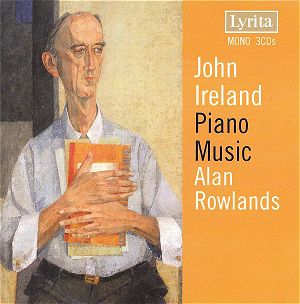
John IRELAND (1879-1962)
The Piano Music

CD 1 [69:41]
London Pieces (Chelsea Reach; Ragamuffin; Soho Forenoons) (1917-20) [12:44]
Greenways: Three Lyric Pieces (The Cherry Trees; Cypress; The Palm and May) (1938) [9:01]
Sonatina (1926-27) [10:27]
Soliloquy (1925) [3:30]
On a Birthday Morning (1922) [3:26]
Equinox (1922) [2:19]
Sarnia – An Island Sequence (Le Catioroc; In a May Morning; Song of the Springtides) (1939-40) [20:57]
Two Pieces (For Remembrance, Amberley Wild Brooks) (1921) [7:09]
CD 2 [76:27]
Ballade (1929) [9:35]
Two Pieces (February’s Child, Aubade) (1929, 1930) [8:39]
Piano Sonata (1918-20) [25:57]
The Towing-Path [4:32]
The Darkened Valley (1921) [3:54]
Rhapsody (1915) [9:00]
Month’s Mind (1933) [5:19]
Decorations (The Island Spell; Moonglade; The Scarlet Ceremonies) (1912) [9:26]
CD 3 [78:35]
Two Pieces (April, Bergomask) (1925) [7:21]
In Those Days [7:27]
Four Preludes (The Undertone; Obsession; The Holy Boy; Fire of Spring) (1913-15) [11:16]
The Almond Trees [4:06]
Prelude in E flat [5:14]
Summer Evening (1919) [4:13]
Prelude in E flat [5:13]
Columbine (1949) [3:52]
Merry Andrew (1918) [2:55]
Three Pastels (A Grecian Lad; A Boy Bishop; Puck’s Birthday) (published 1941) [8:38]
Spring will not wait (1927) [4:06]
Ballade of London Nights (c.1930) [7:20]
Sea Idyll (1900) [12:14]
Alan Rowlands (piano)
rec. The Music Room, Burnham, Buckinghamshire, January 1959 to March 1963
LYRITA REAM.3112 [3 CDs: 69:41 + 76:27 + 78:35]
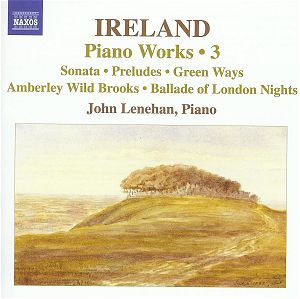
John IRELAND (1879-1962)

Piano Works - Volume 3
Piano Sonata (1918-20) [23:24]
Soliloquy (1925) [3:10]
Four Preludes (The Undertone; Obsession; The Holy Boy; Fire of Spring) (1913-15) [11:17]
The Almond Trees [4:06]
On a Birthday Morning (1922) [3:05]
Greenways: Three Lyric Pieces (The Cherry Trees; Cypress; The Palm and May) (1938) [7:47]
Two Pieces (For Remembrance, Amberley Wild Brooks) (1921) [7:15]
Equinox (1922) [2:16]
Spring will not wait (1927) [3:41]
Ballade of London Nights (c.1930) [7:11]
John Lenehan (piano)
rec. Champs Hill, Coldwaltham, West Sussex, March 2007
NAXOS 8.570461 [73:12]
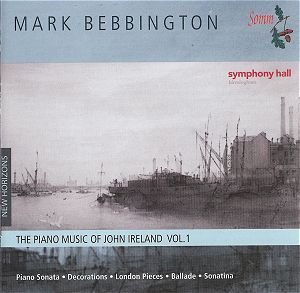
John IRELAND (1879-1962)
The Piano Music of John Ireland - Volume 1

Piano Sonata (1918-20) [26:13]
Decorations (The Island Spell; Moonglade; The Scarlet Ceremonies) (1912) [10:50]
London Pieces (Chelsea Reach; Ragamuffin; Soho Forenoons) (1917-20) [11:09]
Ballade (1929) [10:24]
Sonatina (1926-27) [10:37]
Mark Bebbington (piano)
rec. Symphony Hall, Birmingham, August 2007
SOMM CD 074 [69:20]

Experience Classicsonline


A deluge of Ireland’s piano music is upon us. Firstly there is the classic, so-long-unavailable Lyrita mono series recorded by Alan Rowlands, then the first volume in Mark Bebbington’s cycle and the third in John Lenehan’s. Add to this the fairly recently released stereo cycle by Eric Parkin, also on Lyrita and the appetites of all admirers of the composer will be unambiguously whetted.

Rowlands has special authority in this repertoire. He knew the composer and studied a number of his works with him when the composer was seventy-eight. Rowlands’ liner-note comments about his meetings with Ireland are required reading – not least for the admission that though he believes these recordings ‘give a good account of the way Ireland wanted his music done’ Rowlands is still worried about one or two details. He feels his tempo for the Sonata’s finale is too slow – despite Ireland’s famous admonitions about measured tempi in his music. He is far too modest really about everything.

For despite this moment of self-doubt and despite the rather cramped ‘front room’ mono acoustic it, and everything else, sounds utterly right. How fascinating for example to hear the rapidity of the darting figures in The Island Spell, which he plays faster than anyone else – it has the kind of sturdy confidence that doesn’t so easily elide into comfortable impressionism. Similarly the companion piece from Decorations, the delicious Moon-glade has, by virtue of the recording acoustic and Rowlands’s playing, a degree of hardness that avoids the too-easy limpidity that Ireland’s music can sometimes engender. Above all Rowlands can be, and frequently is, startlingly sympathetic even when he is earthy and loamy.

As for the Sonata I happen to feel that tempo relationships sound absolutely natural in his hands. True it’s a boxy recording but he preserves that sense of chordal solidity and spread that Ireland valued – and complained when he didn’t hear it. I think he catches the sense of romantic melancholy in the slow movement better than anyone else ever has. Yes, the finale is broader than, say, Parkin – but it has a breadth that compels attention.

Everywhere one turns there are things to learn and absorb. Try the central movement of the Sonatina. Listen to the nagging insistence, one that borders here on the laconic if also obsessive. The finale, accentuated by the drier acoustic, emphasises the rougher hewn approach that Rowlands takes – a strong contrast to the sumptuously recorded version from Bebbington. And how admirable, at slower tempo, are the London Pieces. Rowlands has the knack of altering ones perception of the characterisation of the music. Chelsea Reach begins as a tone poem of tristesse and loss before the efflorescence of chordal romance. In the Four Preludes Rowlands finds greater intimacy than anyone and makes most other Ireland players sound officiously extrovert.

Of the two contemporary cycles we’ll take Bebbington’s first. His Sonata is more clement than Lenehan’s combustible affair – the latter’s development section goes like the clappers - and broader too. Bebbington adheres to what one takes to be a broadly Ireland-like interpretation of the central movement – measured, chordally generous, giving full weight and measure. Both here and in the finale he comes very close to Alan Rowlands’ own tempi – much more so than he does to Eric Parkin’s. The lyricism of his performance is affecting and one shouldn’t downplay the humour and wit that he finds in the music.

The Island Spell (from Decorations) is a purely impressionistic evocation in his hands, whilst its companion pieces are limpid and warmly textured. The richly coloured chordal ceremonial of the last is especially resplendent in both performance and recording. He articulates the left hand accents of the Sonatina’s opening with finely chiselled acuity. The finale is springy and warm hued. Elsewhere he’s fine in the London Pieces, though not as ambiguous or affecting as Rowlands. The Ballade receives an unusually expressive and quite slow reading with Bebbington finding in it an intensity that others fail to locate.

He has been afforded a truly royal recording in Symphony Hall, Birmingham.

Lenehan, as already noted, offers a uniquely vital and dramatic reading of the Sonata. The localised intensity is more visceral than Parkin’s, say, because Lenehan allows for urgent peaks but give necessary space for reflective lyricism. This is equally true in the central movement where he’s half a minute quicker than the already pretty fast Parkin. In the finale he displays a perky confidence and striding power and surety that is unusual. The Preludes are excellent examples of Lenehan’s quite extrovert take on Ireland’s music generally – he brings a more muscular and tensile, less introvert approach, which is valuable on its own terms. Even in a less well-known piece, such as Spring will not wait, we find Lenehan quicker and more straightforward than fellow players. Ballade of London Nights is powerfully done and expands nicely at a standard tempo though a corollary is that someone like Rowlands finds more shadows in it. Amberley Wild Brooks is against brisk and bracingly extrovert – with Lenehan abjuring the kind of expressive ruabti that Rowlands brought to it. In the main then Lenehan’s are finely chiselled, just a touch steely performances, perfect for those who find Ireland too sanguine and becalmed. The warmly recorded performances are not as plush as Bebbington’s but are very satisfactory.

Three very different recordings then. Rowlands’s mono cycle is a cornerstone for Ireland devotees, just as important in terms of performance, if not more so, than Parkin’s set. Lenehan is volatile, Bebbington more conventional.

Jonathan Woolf


REAM3112 see also review by Rob Barnett



Advertising Rates
Visitor stats
MusicWeb International
has over 25,000 Classical CD reviews on offer


Gerard Hoffnung Concerts &
The Bricklayer Story

Naxos Classical


Australian Eloquence CDs on Buywell.com


New Releases

Hyperion
New Releases


Guild Music


MusicWeb sells the Polish
catalogue CDAccord
£10.50 post free W-W


MusicWeb sells the
Arcodiva catalogue
£12.00 post free W-W


£11.50
post-free
world-wide
Try it and see - Sale or Return

MusicWeb can now offer you discs from the following catalogues:
Prices include postage

[Acte Préalable £13.50]
[Arcodiva £12.00]
[Avie from £6.25]
Brilliant Classics
[British Music Society £13.49]
[CDACCORD from £10.50 ]
[ClassicO £12.50]
[Hallé from £11]
[Hortus £14.99 ]

[Lyrita ONLY £11.50 ]
LYRITA Sale or Return
[Onyx £12.00
]
ONYX Sale or Return
[REDCLIFFE £11 ]
[Sheva £11]
[Tactus £11.50 ]
[Talent from £12.00 ]
[Toccata Classics £12.50 ]

Musicweb
Special Offers

Google Ads - for information about privacy matters, click here


Return to Review Index


Reviews from previous months
Join the mailing list and receive a hyperlinked weekly update on the discs reviewed. details
We welcome feedback on our reviews. Please use the Bulletin Board
Please paste in the first line of your comments the URL of the review to which you refer.


You can purchase CDs and Save around 22% with these retailers: