|
Making
a Donation to MusicWeb
About MWI
Site
Map
More
Reviews
How to find a review
Books
Film
Music
Nostalgia
Records Of The Year
Recommendations
Comment
Arthur Butterworth Writes
Phil
Scowcroft's Garlands
Classical
blogs
Reviewers
Logs
Announcements
Don't
Go Here!
Community
Bulletin Board
Web
Ring
Reviewers
Helpers
invited!
Resources
How
Did I Miss That?
British
Composers
British
Light Music Composers
Other
composers
Indexes
Label
Masterwork
Discographies
Composer
National
Themed
Review pages
Complete Books
Programme
Notes
External sites
British Music Society
The BBC Proms
Performers
Orchestra Sites
Recording Companies & Retailers
Online Music
Agents & Marketing
Publishers
Other links
Newsgroups
Web News sites etc
Editorial
Board
Classical Editor
Rob Barnett
Seen & Heard
Editor and Webmaster
Bill Kenny
MusicWeb Webmaster
Len Mullenger
Assistant Webmaster
David Barker
PotPourri
A
pot-pourri of articles
MW
Listening Room
MW
Office
Helping
MusicWeb
Advice
to Windows Vista users
Questionnaire
Site
History
What
they say about us
What
we say about us!
Where
to get help on the Internet
CD
orders By Special Request
Graphics
archive
Currency
Converter
Dictionary
Magazines
Newsfeed
Web Ring
Translation Service
Rules
for potential reviewers :-)
Do
Not Go Here!
April Fools
|

 |
 |
|
alternatively
CD:
Crotchet AmazonUK
AmazonUS
|
Edward
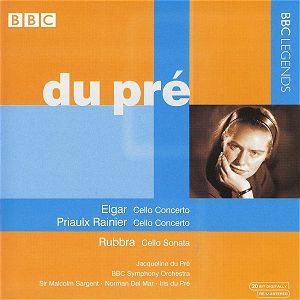
ELGAR (1857-1934) Cello Concerto
in E minor op.85 (1920) [27:29]
Priaulx RAINIER
(1903-1986) Cello Concerto (1964)
[19:57]
Edmund RUBBRA
(1901-1986) Cello Sonata in G minor
op.60 (1946) [26:00]
Jacqueline du Pré (cello)
BBC Symphony Orchestra/Malcolm Sargent (Elgar);
Norman Del Mar (Rainier)
Iris du Pré (Rubbra)
rec. Royal Albert Hall London, 3 September
1964 (stereo) (Elgar, Rainier); Cheltenham
Festival, 6 July 1962 (mono) (Rubbra). ADD.
BBC
LEGENDS BBCL42442 [73:42]  |
|
|
Jacqueline du Prè
(1945-1987) played these two starkly
contrasting concertos in the same Prom
concert. Their idioms could hardly be
more distant from each other. They were
after all separated by some 45 years.
I suspect du Prè found the language
of the Rainier unappealing – certainly
she did not go on to record it as she
did the next year for the Elgar. Violent
incongruity or tart contrast, the two
works certainly polarized the conductors.
Sargent, an Elgar stalwart but rarely
a friend of the avant-garde left the
podium to Norman Del Mar, ever the inspirational
professional.
This reading of the
Elgar is well worth acquiring. The long
final allegro is packed with revelatory
and sensitive touches. For all of my
lack of sympathy with Sargent I have
to confess that he is splendid here.
Sargent and du Pré strike celestial
fire off each other – volatile tinder
and flinty passion and this is recognized
by the storm of applause from the Prommers.
I am not sure I do not like this more
than the classic EMI-Barbirolli although
that is so much better recorded. One
version it does not supplant is the
CBS one du Pré made with her
husband Daniel Barenboim in concert
in Philadelphia in 1970. The smoke and
flame of that live recording is sui
generis; it is in my personal Hall
of Fame. It too has its technical roughnesses
but its trajectory and spirit are irresistible.
As for Sargent, du Pré may have
had to abandon him for Barbirolli in
what was to become her classic recording
(Elgar) but she did return to him for
the Delius Cello Concerto with the RPO
on 12-14 January 1965 (EMI 5041672).
And that was in the same Kingsway Hall
where on 19 August 1965 she recorded
that iconic version of the Elgar.
Both Rainier
and Rubbra died in the same year. Their
linguistic style could hardly be more
different. Rubbra the traditionalist
forged his way within the range offered
by a tonal palette. He gripped listeners
with spiritual gravity. Rainier in her
single movement Cello Concerto is an
apostle of dissonance and of a halting
yet atrabilious emotionality. The cello
solo has the fluent soulfulness of Bloch’s
Schelomo which certainly suits
du Pré. It is as if the
cello is a passionate pilgrim traversing
a seething landscape of tragedy, abrasion
and spectral threat.
Two years before the
Royal Albert Hall concert du Pré
gave her last concert with her mother
Iris. This was at the Cheltenham Festival
which for some years remained more accommodating
of the British tonal tradition than
London with its obsession with the shock
of exclusivity and dissonance. Rubbra
wrote his Cello Sonata for William Pleeth
(du Pré’s much-loved teacher)
following their return to civvie street
at the end of the Second World War.
The Sonata and the performance have
a potent spiritual concentration. Du
Pré sustains this as she also
did in her magnificent Newbury
performance of Rubbra’s Soliloquy
– itself a miraculous survival despite
primitive sound. The present Cheltenham
performance of the Sonata captures the
combustible riptide of Rubbra’s writing
as in the furious passion towards the
end of the first movement and in the
middle Vivace flessibile. It
is captured in clear and sturdy mono.
The valuable liner-notes are by Tully
Potter.
Rob Barnett
|
|
Advertising
Rates
Visitor
stats
MusicWeb
International
has over 25,000 Classical CD reviews on offer
Gerard
Hoffnung Concerts &
The
Bricklayer Story

New
Releases

New
Releases


MusicWeb
sells the Polish
catalogue CDAccord
£10.50 post free W-W

MusicWeb sells the
Arcodiva catalogue
£12.00 post free W-W

£11.50
post-free world-wide
Try
it and see - Sale or Return
MusicWeb
can now offer you discs from the following catalogues:
Prices include postage
Musicweb
Special
Offers
Google Ads - for information about privacy matters, click here.
|