When in 1986 I first bought the LP version of this disc in Oxford the shop assistant
quite rightly commented that the record gave an excellent overall
perspective of Corelli’s chamber music compositions. For teaching
purposes it was just right and it came at a time when encountering
Corelli’s music on original instruments was still not that common.
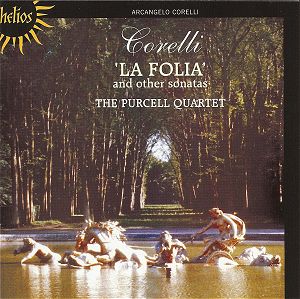
Returning to this issue, now on Hyperion’s budget label, I still
feel the same way: it makes an excellent introduction to the composer
using pieces from many of his early works. The performances, which
are first class, demonstrate well-blended artistry and variety
of ensemble textures. It set a worthy standard.
The disc is named after a seemingly insignificant
melody which had been popular since the renaissance. As was
common at the time, Corelli sets out to impress with a virtuoso
sequence of variations or doubles for solo violin and continuo
on ‘La Folia’. The piece has attracted much attention over the
last twenty years especially as an encore. In his useful notes
Tim Crawford adds that the role of the accompanist is not forgotten
and that “the sonata ends with a sequence of dazzling semiquavers
for the basso continuo”. However it is not typical of the calm
and dignified manner of the rest of the music here.
We cannot say when exactly Corelli wrote these
works. We can only go by certain publication dates. The Sonatas
da chiesa found the press in 1681 and more followed in 1689.
Many of the violin sonatas, as we have them, were printed in
1700.
The Sonatas da camera - published in 1685 and then
added to in 1694 - and da chiesa were multi-movement works with
the many movements split into short, contrasting sections. In
the ‘camera’ or chamber works dance names are given for each
- for instance ‘Corrente’ and ‘Sarabanda’. These the Purcell
Quartet accompany with harpsichord continuo. In the ‘Sonatas
da chiesa’ (so called Church Sonatas) only speed indications
are offered. They are given the more solemn organ as continuo
in line with common practice. In some other recordings the archlute
is preferred. The abovementioned virtuosity can be encountered
in other works, for example the opening of the A major Sonata
da chiesa from the Op. 3 set. This tends towards a more showy
style in general. The Op. 1 sonata - presumably written when
Corelli was a very young man beginning to make his name - also
displays virtuoso antiphonal effects between the two violins.
The Viola da gamba sonata has curious antecedents.
Corelli was popular in England and arrangements were
made of the Op. 5 sonatas for recorder and continuo. They are
represented here by two others from the publication. In 1713
two of them appeared in anonymous arrangements for the still
popular but outdated Viola da gamba. It is possible that the
arrangements are German. In any event they are virtuoso and
are obviously down an octave from the originals. The present
example is now in D but was composed in E major. Anyway it sounds
very suitable and Richard Boothby gets his fingers around the
tricky passages with panache and flare.
All in all this is a most welcome release and,
as indicated, acts as an excellent introduction to Corelli’s
music outside the more often heard Concerti Grossi - which anyway
come towards the end of his career. The music is compelling
and can be quite meltingly beautiful or foot-tappingly happy.
Buy it.
Gary Higginson

























 The Purcell Quartet (Catherine Mackintosh (violin); Elizabeth Wallfisch
(violin); Richard Boothby (cello, viola da gamba); Robert Woolley
(harpsichord, organ); Richard Campbell (cello))
The Purcell Quartet (Catherine Mackintosh (violin); Elizabeth Wallfisch
(violin); Richard Boothby (cello, viola da gamba); Robert Woolley
(harpsichord, organ); Richard Campbell (cello))
