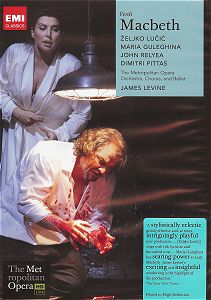
The Met’s new Macbeth arrives on DVD in good picture and
super sound. The results are mixed, though, and your response
to it will broadly depend on what you’re looking for in this work.
Verdi was famously devoted to Shakespeare.
He called Macbeth one of the greatest works of man, and
he was deeply offended when he was accused of not knowing Shakespeare.
As if to give him a worthy interpreter, the Met commissioned
Adrian Noble, former director of the Royal Shakespeare Company,
to direct this new production. In an interesting, though brief,
interview Noble suggests that Shakespeare would have been delighted
with Verdi’s interpretation of the play because of the insights
Verdi brings. He updates the setting to the twentieth century
so as to stress the universality of the Macbeths’ fall: like
many rulers they are viewed as heroes at the outset but by their
demise they have destroyed their country and people. Noble
doesn’t really seem to have anything new to say, though: he
goes for effects rather than insights. That’s not necessarily
a bad thing, but I expected more from a director of Noble’s
stature.
Act 1 opens on a truly blasted heath.
The floor resembles a cracked mirror, while the background is
made up of stark black trees, like a Friedrich painting. Noble
demystifies his witches by depicting them like a demented Women’s
Institute; part bag-ladies, part bored housewives. Their ceremonies
aren’t especially chilling, but the sheer quantity of the players
certainly packs a punch. Macbeth and Banquo enter as guerrillas
having successfully crushed an uprising, and the soldiers who
greet them with the news of Macbeth’s promotion wield machine
guns. The Scotland of Noble’s vision could be any modern dictatorship:
the opening of Act 4 shows refugees crouched under the snow,
huddling next to a jeep which will be driven by Macduff and
Malcolm. It’s fine as a concept; it doesn’t have an awful lot
to say, however, and it doesn’t illuminate much of the action.
The most successful scene of all is in fact the one which gets
furthest from this setting. Noble creates a genuine claustrophobia
for Duncan’s murder as a set of tall monolithic columns close
in on Macbeth, mirroring the prison within his mind as he takes
the fatal decision to kill the king. When he emerges with bloodied
hands a lone spotlight descends to highlight his guilt and his
remorse, an effect echoed during the sleepwalking scene. Then
when Duncan’s murder is discovered we see the King’s body on
a white sheet stained in blood. This simple touch makes the
end of Act 1 very effective, and from the looks they exchange
it is clear that Banquo knows that Macbeth is the killer. Throughout
this scene, as in the rest of the opera, the action is driven
by the crackling sexual chemistry between Macbeth and his wife,
something Noble is keen to point up.
The large-scale drama of the apparition
scene works well, with a set of holographic projections taking
the place of the cauldron. A set of crowned statues descend
to evoke the line of Banquo’s descendants, while Banquo himself
comes onstage with a jagged mirror.
Other parts of Noble’s staging are less
effective, however. There is too much reliance on flag-waving
in the big scenes of Act 4, and the witches in the apparition
scene are given very little to do so the scene appears quite
static, in spite of the busily demonic music that Verdi provides.
A strange pantomime precedes Lady Macbeth’s appearance in the
sleepwalking scene, distracting from the melancholy scene-setting
of the orchestral prelude, though the aria itself is choreographed
with fitting simplicity. The biggest clanger of all, however,
happens in the closing seconds. As the chorus finish their
hymn of victory and the orchestra sails into the home straight,
Fleance, Banquo’s son, reappears. It’s obviously Noble trying
to hint at future strife; after all the witches had predicted
that Banquo’s – not Duncan’s – heirs should be king. But it’s
completely misjudged and absolutely out of keeping with the
triumphal mood of the final bars. The boy comes on stage and
looks (daftly) out at the audience while Macduff and Malcolm
try to appear shocked but end up looking absurd. It’s a risible
conclusion which spoilt my recollection of previous scenes,
and someone of Noble’s standing should have known better.
The singing is broadly good, with one important
exception. Željko Lučić is a young, vibrant Macbeth.
The focus of his acting and his singing is to evoke our sympathy
for a noble soul who becomes corrupted, and he’s broadly successful,
though his final aria just seems a bit pathetic. His virile
baritone is well contrasted with the cavernous bass of John
Relyea who is the most exciting vocal presence here. His Banquo
sounds truly momentous and his big voice almost goes too far
in dominating the scenes in which he appears. His Act 2 aria
is superb, perfect breath and note control in every range, and
his acting as the ghost is truly unnerving. Dimitri Pittas
is a serviceable Macduff. His Act 4 aria sounds a bit thin
at the start and, while he gains heft, his interpretation is
rather one-dimensional. Russell Thomas’ Malcolm has similar
problems, but that doesn’t stop La Patria tradita from
being tremendous fun.
The weak link, however, is Maria Guleghina’s
Lady Macbeth. She has good stage presence and her big voice
has an undeniable power: her first sung line after the letter-reading
really takes one aback. The top of her range is markedly insecure,
however, to an extent that one cannot ignore. Worse, her tuning
is often out. Her first act arias showcase this uncomfortably:
the coloratura of Or tutti sorgete requires a lightness
of touch that she does not have, and the end of both arias feels
like an uncomfortable bellow. She is better in the sleepwalking
episode, but the top note at the end of the scene is awkward,
to put it politely.
The Met Chorus sing with typical vigour,
whether they are being witches, soldiers, party guests or refugees,
and Levine keeps a tight control over a score he obviously loves.
The orchestra are their usual impeccable selves, and the acoustic
effects of the various scenes sound great in DTS 5.1. The extra
documentaries are good fun, but they’re not enough to give the
set a competitive advantage.
So there’s a lot to enjoy here, but I still
felt a little disappointed at how much better this performance
really should have been. With stronger casting and the tweaking
of a few scenes, this could well have been a top contender.
Simon Thompson