I first became aware
of British symphonies when I heard
Vaughan Williams’ Sea Symphony.
It was not long until I discovered
that he wrote another eight. It was
but a short step to hearing the symphonic
works of Walton, Elgar and one or
two from the pen of Bax. Naturally
I read a lot about music in those
early days, and soon came to realise
that there were many such works locked
away in the musical vaults. These
included the symphonies of Charles
Hubert Hastings Parry and Charles
Villiers Stanford. However, any reference
to these works was always qualified
by the epithet – ‘dry as dust’. Moreover,
perhaps more damningly, it was insisted
that they were pale reflections of
the music of Johannes Brahms. Of course,
as a neophyte, one believes whatever
learned musicologists tell you. It
was not until I heard a recording
of Sir Adrian Boult conducting Parry’s
Fifth Symphony that I pricked
my ears up. This was a work worthy
of hearing. It may not be as great
as Elgar’s Second, but it was
still a fine piece of music, full
of vitality, depth of emotion and
good tunes.
A few years later,
Chandos embarked on an ambitious scheme
to issue the complete Symphonies
of both Parry and Stanford. By that
time, I had heard Stanford’s Irish
Symphony – so I was ready to give
these two cycles a chance. They were
issued at a time when vinyl was giving
way to CDs so I ended up having to
buy most of them twice! Nevertheless,
they were worth it. After a couple
of years the issue was complete –
not only all of Parry’s and Stanford’s
Symphonies, but also the latter’s
Irish Rhapsodies, the Second
Piano Concerto and his Clarinet
Concerto. It was a magnificent
achievement. However, I truly believed
that it was a one-off adventure. Buy
now, or regret not having them in
your collection for ever! However,
that was before MP3 – the original
Chandos recordings are now available
for download. And then, a couple of
years ago, I was surprised that Naxos,
with David Lloyd-Jones, had decided
to embark on another cycle to complement
Vernon Handley and the Ulster Orchestra.
It would be easy
to apply a kind of progressive aesthetic
and write off Stanford’s symphonic
achievement as being retro and therefore
worthless. It is all too easy to detect
echoes, and loud ones at that, of
the music of Felix Mendelssohn, Robert
Schumann and Johannes Brahms. It would
be simplistic to suggest that Stanford
is no Mahler or Bruckner or Elgar,
pushing the boundaries of post-romantic
music to its limits. It is much better
to try to understand and enjoy these
works as they are. Stanford is a consummate
craftsman - he understands the formal
principles of the symphony better
than most and he develops some very
subtle approaches to the various so-called
‘standard movement forms’. There is
certainly nothing predictable about
his music.
The First Symphony
in B flat was written in 1876 and
was entered into a competition run
under the auspices of the Alexandra
Palace. It was deemed so successful
that it won the second prize. The
first prize went to the now long-forgotten
composer Francis Williams Davenport.
John F. Porte writes, "The judges
were the once famous [George] Macfarren,
now deemed a musty academic, and Joachim,
the famous violinist. There were thirty-eight
symphonies submitted.
Stanford’s work was
not performed until some three years
later. It was never published and
was not given again in the composer’s
lifetime. However, there is no doubt
that the work was successful and did
something to draw attention to the
twenty-four year old composer."
The Symphony No.
1 is quite long, lasting for more
that forty minutes. Naturally with
any work of this length there are
issues of maintaining the listener’s
interest. In this case I believe that
Stanford manages to achieve this –
with one proviso. Many people hearing
this work will assume either that
the rumours of his style are true
– and they will expect to be bored.
Or else they will expect a late-romantic
work and be disappointed. Either way
there is a danger that fatigue will
set in. I guess the true approach
to this work is to see it in the trajectory
from Beethoven, Mendelssohn and Schumann
and treat it as a kind of extension
of these three composers. Of course
it is no ‘Fifth’ or ‘Ninth’ but I
feel it compares well with Mendelssohn
and he should certainly not allow
Schumann to make him feel embarrassed.
The long opening
movement is probably unique in British
music prior to Sir Edward Elgar –
most especially for its length. There
are so many ‘lost’ and ‘hidden’ British
symphonies from that period - including
the other thirty seven that were entered
for the competition – so who really
knows? I find this music totally satisfying
and from the opening slow introduction
into the ‘allegro’– the contrast between
themes and sections avoids any possible
lack of interest. The principal theme
and the second subject seem to complement
each other in music that is at times
reflective and sometimes decisive.
The second movement
is hardly a traditional scherzo –
it is signed ‘In Landler Tempo’ which
suggests an ‘intermezzo’ rather than
more robust or witty music. It is
not ground-breaking stuff - but both
the formal and the instrumental balance
reveals this as well thought out music
that is both captivating and suave.
Stanford contrasts the main theme
with two fine trios.
Like a number of
Stanford’s Symphonies, the
slow movement is probably the heart
of this work. Yet this is not some
great meditation on the meaning of
life – more a reflection on a young
man’s dreams. Here and there the careful
listener may detect hints of Irish
folk-song and a general feel of the
Emerald Isle rather than the banks
of the Rhine. Look out for the use
of the solo violin towards the end
of the movement. I think this CD is
worth the purchase price just to hear
this one movement – although I strongly
counsel against excerpting!
The ‘Finale’ manages
to combine drive and momentum with
a more pedantic, but thoroughly enjoyable
fugal passage. Here Stanford makes
expert use of the brass. This is an
exuberant and exciting end to what
was surely a superb First Symphony.
There are a number
of other versions the Clarinet
Concerto. In fact it is probably
the most popular and performed of
all of Stanford’s orchestral works.
Perhaps most British music enthusiasts
will already own Janet Hilton’s account
with Vernon Handley on Chandos or
one of those by Thea King (Hyperion)
or Emma Johnson (ASV Sanctuary). Without
wishing to knock any of these fine
recordings, I do wish to suggest that
this present version is essential
for all Stanford enthusiasts. I am
especially impressed by the contrast
that Robert Plane creates between
and within movements. For my money,
it is a moving and sometimes revelatory
performance.
The Clarinet Concerto
is written in three movements with
the two outer ones together being
nearly the same length as the ‘andante
con moto’. The opening movement balances
a sense of exuberance with more reflective
music that definitely looks forward
to the slow movement. It ends quietly
and prepares the way for the ‘andante’,
which is the heart of the work. Here
the fifty-one year old composer is
in his element. Every note of the
music makes it mark, yet it does not
wear its heart upon its sleeve. This
is not all ‘genial’ as clouds impose
on the progress of this music. I would
suggest that in some ways there is
a valedictory feel to this movement.
Yet just before the depression sets
in, the geniality is revealed: once
again the sun shines. However, all
of this is truly beautiful. The final
movement, an allegro moderato, resolves
any outstanding problems created in
the foregoing movements and, after
a number of quasi-cadenza episodes,
leads the work to an optimistic and
positive conclusion.
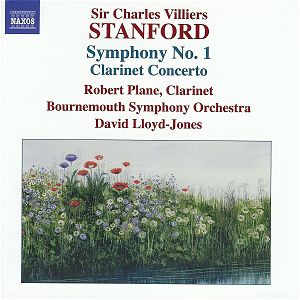
I am disappointed
that there is no mention in the liner-notes
about the soloist, Robert Plane, the
orchestra or David Lloyd-Jones. In
these days of the ‘Net’ it is easy
to find out about the protagonists
– but a few words would have been
helpful – for those who are not permanently
logged-on or who wish to listen to
the music away from a computer terminal!
The programme notes, by Richard Whitehouse,
could have been a tad fuller for these
two major works – but I guess there
is little historical material to build
on.
Yet all-in-all this
is essential listening for three groups
of people. One, Stanford buffs like
myself who never imagined I would
live to see one, let alone two
Stanford cycles in my lifetime. Secondly,
to any British music fan who wants
to see what kind of symphonies were
being written in the 1870s. And finally
by those people who still swear by
the old lie that Stanford is somehow
‘dry as dust’, that he lacks romance,
drama, poetry, interest and sheer
musicality. They need to get their
heads around this CD and discover
why people are coming to regard Stanford
as the G.O.M. (Great Old Man).
John France

























 Robert Plane (clarinet)
