For some years now Portsmouth Grammar School has commissioned
new works for its annual Remembrance Day concert, which the school
choir gives in partnership with the school’s Associate Musicians,
the London Mozart Players. This very enterprising CD presents
some of the most recent compositions. All but one of the works
receives its first recording here. The exception is the piece
by Cecilia McDowall. That was included on a fine disc of her music
on the Dutton Epoch label, to which my colleague, Hubert Culot,
gave a warm welcome in 2005 (see review).
Otherwise all the music was new to me, though I’ve heard previously,
and admired, a number of choral works both by Tarik O’Regan and
by Sally Beamish.
I think the first
thing to be said is that it’s fantastic that young singers are
being exposed to contemporary music of such quality. More than
that, they’re not performing established contemporary
works, which would be admirable in its own right, but actually
giving the first performances, and thereby starting the performance
tradition for these pieces. What an experience that must be!
I don’t believe
I’ve ever encountered the music of Lynne Plowman before. Her
piece Cries like Silence is written for SATB soloists,
choir, orchestra and organ, with optional children’s choir,
brass band, electric guitars and bass drums. I’m not certain
that the brass band and electric guitars are used in this recording;
I think perhaps not. For her text Miss Plowman has chosen to
combine two poems, these children singing in stone by
e.e.cummings and Crow’s Account of the Battle from Crow
by Ted Hughes. In her booklet note the composer tells us that
her intention “was to compose a work which would challenge and
excite the accomplished young musicians….contrasting dynamic
and dramatic story-telling with poignant and lyrical music.”
I’d say that she’s certainly succeeded in her aim of providing
contrasting music and I would be amazed if she’d failed in the
first part of her objective.
In brief, the cummings setting, which is
fairly quiet, begins the work. There’s innocence in the vocal
writing for high voices (children) and female soloists. The
substantial middle section is a gripping, vivid setting of what
Miss Plowman aptly describes as Hughes’ “dark and visceral”
words. The music is much more jagged and disturbing than that
which we heard in the opening cummings section. After a powerful
climax the opening music is reprised. Does it now speak to us
of innocence despite war or of innocence that will, in time,
be corrupted by the violence of our world? I suspect that the
thunderous, dull drum-roll with which the piece concludes, after
the voices have been silenced, provides us with the answer.
This is a provocative, disturbing piece and I suspect it made
a huge impact on the young performers, just as it did on this
listener.
Cecilia McDowall’s
Ave Maris Stella falls more easily on the ear, though
that’s not a coded way of saying it’s a lesser piece of music.
It’s the only piece on the disc that’s not in English – Miss
McDowall uses verses from the old Marian hymn, which refers
to the Virgin Mary as the Star of the Sea, and some verses from
Psalms 26 and 106, all of them in Latin. The choice of Ave Maris
Stella as a text is appropriate given the naval traditions of
Portsmouth.
Writing of Ave
Maris Stella Hubert Culot opined that it reminded him of
Finzi and he also compared the melodic invention with that of
John Rutter. I wouldn’t dissent but I’d add that the piece reminds
me at times of some of the choral music of Morten Lauridsen.
It’s a finely crafted and poetic work, scored for soprano solo,
choir and strings. I enjoyed hearing it again in this very good
performance.
Tarik O’Regan’s
music is attracting a lot of interest these days and the vocal
works of his that I’ve heard have all seemed to me to be very
interesting indeed. His 2005 piece, And There Was A Great
Calm, should enhance still further his reputation. Nowadays
the composer divides his time between Cambridge and New York.
He writes of this piece that his dual residency played a part
in the style of the piece because it contains some of what one
might term “traditional” memorial material but also music with
more of an urban edge. It’s divided into two sections, the first
of which is, in his words, “quiet and gentle (a moment of recollection),
while the second is much faster and vibrant (the texts here
dealing with transmigration [of souls] and the future. Put simply,
And There Was A Great Calm begins looking back
and ends going forward”.
I think that’s a marvellous and highly original
conception for a Remembrance piece and I believe that O’Regan
pulls it off. Thus the first section consists of slow, haunting
and contemplative music for high voices and soprano solo accompanied
by the string orchestra that O’Regan uses throughout. The second
part follows without a break and is much more propulsive. The
music does indeed have ‘edge’ but I find both the music and,
for the most part, the words that O’Regan has selected, have
an air of optimism. For much of this section the music has the
character of a vigorous dance, with the choir repeating melodic
phrases over a strongly rhythmical string accompaniment that
recalls the heyday of the American minimalists. There’s a short
pause for a calm soprano solo over slow, ethereal string chords
before the dance resumes and the piece hurtles to a sudden end.
This is a most imaginative and impressive piece.
The most substantial
offering is by Sally Beamish. Her The Lion And The Deer,
which falls into six sections, ambitiously brings together English
translations of poems by the fourteenth century Persian metaphysical
poet, Hafez, and excerpts from haikus contained in a collection,
War and Conflicts, written by Year 7 pupils at Portsmouth
Grammar School. The haiku excerpts are read by pupils at the
school. The piece is scored for countertenor, choir, a small
group of strings and trumpet and cello soloists – here the excellent
Paul Archibald and Sebastian Comberti respectively. Incidentally,
there’s a nice link in that Sally Beamish pursued a career as
an orchestral violist before becoming a full-time composer and
between 1985 and 1987 she was principal violist of the London
Mozart Players.
The work is ingenious,
though it’s not easy to grasp, I find. The use of the counter-tenor
in particular imparts a suitably Arabian feel to the music and
Michael Chance is certainly given some challenging and atmospheric
music, to which he responds with his customary eloquence. He
and the two solo instruments, the trumpet in particular, carry
the argument in the first movement. The following section uses
the chorus and the music is more complex, with multi-layered
textures and greater use of the spoken haiku interjections.
Much of the music in the whole work is moderate or slow in pulse
but the fourth movement, ‘Lion’, which is the most extrovert
section of the piece, is much quicker in tempo. The choir mainly
sings sustained chords and it’s the vigorous orchestral part
that, for the most part, drives the music forward.
The counter-tenor
returns for the next movement, ‘Horse’, and is given some powerfully
dramatic, declamatory music. Frequently pounding timpani suggest
the horse’s hooves. The final section reprises material from
the opening movement though this time round the solo trumpet,
important at the start, is silent. The last few minutes of this,
the most extended section, are very affecting with choir and
the gently keening counter-tenor gradually bringing the music
to a quiet close.
I confess that I
don’t feel that I’ve really got to grips with this demanding
piece yet. In part I think it’s because I am confused by the
subject matter. Sally Beamish tells us that “by placing Hafez’
words in the context of Remembrance Day, I hoped to reflect
an ultimate human goal – a theme of enduring love.” I get the
connection between Remembrance and human love but for me the
chosen Hafez poems don’t really express loving sentiments in
a way that I readily comprehend. Maybe I’ll get it in time and
so come to a better appreciation of this piece and I’m sure
others will understand it much better than I do from the outset.
The Lion And
The Deer is certainly a challenging piece and it must be
very difficult to perform. However, it sounds as if the young
singers and the members of the LMP rise to the occasion splendidly.
Faced with over
an hour of music that’s both intellectually and musically difficult
the Portsmouth singers acquit themselves splendidly. They’ve
obviously been trained with great skill and understanding by
their respective choir masters, with the lion’s share of the
work falling on Andrew Cleary, the Director of Music at Portsmouth
Grammar School and of its Chamber Choir. As with all the best
youth choirs, the singing on this disc has freshness, vigour
and, where required, an appropriate edge. Above all, it’s the
enthusiasm and commitment of these young that shines through
and impresses. They are fortunate to have excellent professional
collaborators in the shape of the London Mozart Players and
some very good vocal soloists. Nicolae Moldoveanu conducts
with rhythmic acuity and evident belief in the music.
The recorded sound
is first rate, as is the comprehensive documentation.
Absolutely no allowances
need be made for the fact that school choirs are involved in these
performances. This disc contains some exciting and original modern
choral music, splendidly performed.
John Quinn
























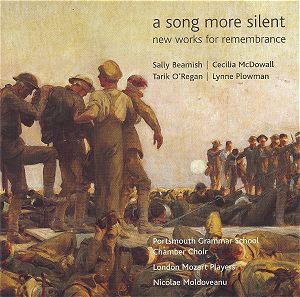
 *Alexandra Stevenson
(soprano); **Sophie Bevan (soprano); **Carolyn Dobbin (mezzo); **Ben
Johnson (tenor); **David Kimberg (baritone); *** Sophie Bevan (soprano);
****Michael Chance (counter-tenor); Portsmouth Grammar School Chamber
Choir; **Portsmouth Grammar Junior School Choir; **The Choristers
of St. Thomas’s Cathedral, Portsmouth; London Mozart Players/Nicolae
Moldoveanu
*Alexandra Stevenson
(soprano); **Sophie Bevan (soprano); **Carolyn Dobbin (mezzo); **Ben
Johnson (tenor); **David Kimberg (baritone); *** Sophie Bevan (soprano);
****Michael Chance (counter-tenor); Portsmouth Grammar School Chamber
Choir; **Portsmouth Grammar Junior School Choir; **The Choristers
of St. Thomas’s Cathedral, Portsmouth; London Mozart Players/Nicolae
Moldoveanu 
