“As a very credible Scarpia he was low-voiced, even honeyed. Renato
Bruson – even at an age when Chiefs of Police normally retire
– had retained his superb caressing legato, making him a satanic
tamer of his subjects. When he wanted to stress his points, to
show his powers, his voice was no longer the pliable instrument
it once was. The force was there but also a heavy old man’s vibrato
that developed to an ugly wobble. It would have been totally unsuitable
for a nobler character but for Scarpia it was adequate.”
This quotation is
from my review
of a DVD live from Bari and published in 2001. Twenty years earlier,
when the present EMI set was recorded, there were no misgivings
as to the quality of Bruson’s voice. His is plainly the most beautiful
singing of the role ever. Whether it is also the best interpretation
of the role is another matter. His marvellous legato and smooth
delivery has been a constant pleasure to wallow in on a great
number of recordings, nowhere more in evidence, I believe, than
on his Donizetti recital, once available on Decca in the Grandi
Voci series. This is bel canto singing of a kind that hadn’t
been heard since the days of the legendary Mattia Battistini.
What has been lacking in his singing has been a couple of notes
in the lowest register and more variation of tonal colour and
for the role as Scarpia this is a serious shortcoming. There is
no lack of intensity and vitality and with the visual aspect added
his reading of the role would probably have been a highly satisfying
portrait of this disgusting Chief of Police, but without the visuals
one misses the inflexions and the ‘face’ of some other Scarpias:
Tito Gobbi (twice with Maria Callas), Giuseppe Taddei (on Karajan’s
first Tosca with Leontyne Price), maybe also the sinister
George London (on Tebaldi’s stereo remake) or Ruggero Raimondi
(on Karajan’s second Tosca and also on DVD from Verona
as recently as 2006, see
review). Still Bruson’s is a reading to live with and I far
prefer it to exaggerated histrionics and ugly delivery.
It may seem perverse
to start a review of Tosca with an assessment of the
villain of the drama, but since this reading is the most controversial
I wanted to sort it out first of all. Those who can’t imagine
a bel canto Scarpia can stop reading here. This set
is not for them. James Levine’s conducting has sometimes been
controversial too but here he leads a kind of middle-of-the-road
performance: rather rough-hewn with tremendous fortissimos
in a recording with very wide dynamic contrasts. It is thrilling,
no doubt but in a moderately sized listening venue like mine
the problem is that if I want to remain on speaking terms
with my neighbours I have to turn down the volume several
notches from my ordinary setting and then the solo voices
become recessed and indistinct. It is possible to adjust the
volume with the remote control every so often but this takes
away some of the pleasure of listening. In some of the lyrical
passages I felt that Levine lost interest and there the reading
lacked tension. The playing of the Philharmonia is first class
and the Ambrosian Opera Chorus, trained by John McCarthy,
are excellent with a grandiose Te Deum as the pinnacle.
Placido Domingo
is a brilliant Cavaradossi, who delivers a strong Recondita
armonia without many nuances. Later in the first act he
is more sensitive in the long scene with Tosca and in the
last act he sings an inward E lucevan le stele and
caresses O dolci mani. Cavaradossi has been one of
his most frequent roles and this is certainly a reliable reading.
His Floria Tosca is Renata Scotto and at this stage of her
career her voice has lost some of its bloom and she has adopted
a rather wide vibrato at forte and above – not unlike Maria
Callas’s in fact and her reading is also in the Callas mould,
detailed and full of insight. Her Vissi d’arte is restrained
and beautiful; here the vibrato is kept well in check.
The supporting
roles are excellently cast. John Cheek makes a strong character
of Angelotti and his vocal resources are such that he might
as well have been singing Scarpia. The veteran Renato Capecchi,
almost 60 at the time, is a good Sacristan who avoids too
much caricature. That he had retained his magnificent voice
is amply demonstrated in the phrase tutta devota e pia.
Andrea Velis is a light voiced Spoletta and master violinist
Itzhak Perlman is probably the most sonorous gaoler on any
recording – a surprising cameo, indeed!
While hardly a
first choice this recording has still a great deal to offer.
My favourites are still the old Sabata mono recording with
Callas and Gobbi and the spectacular Karajan set from around
1960 with Leontyne Price and Giuseppe Taddei. On both sets
Giuseppe Di Stefano sings Cavaradossi.
Göran Forsling
























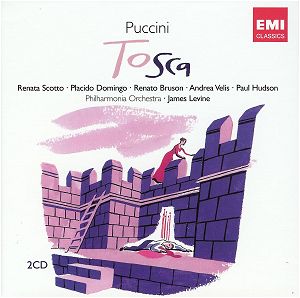

 Renata Scotto
(soprano) – Floria Tosca; Placido Domingo (tenor) – Mario Cavaradossi;
Renato Bruson (baritone) – Scarpia; John Cheek (bass) – Cesare Angelotti;
Andrea Velis (tenor) – Spoletta; Renato Capecchi (bass) – A Sacristan;
Paul Hudson (baritone) – Sciarrone; Dominick Mertinez (treble) – A
Shepherd; Itzhak Perlman (bass) – A Jailer
Renata Scotto
(soprano) – Floria Tosca; Placido Domingo (tenor) – Mario Cavaradossi;
Renato Bruson (baritone) – Scarpia; John Cheek (bass) – Cesare Angelotti;
Andrea Velis (tenor) – Spoletta; Renato Capecchi (bass) – A Sacristan;
Paul Hudson (baritone) – Sciarrone; Dominick Mertinez (treble) – A
Shepherd; Itzhak Perlman (bass) – A Jailer 
