Editorial Board
MusicWeb International
Founding Editor Rob Barnett Editor in Chief
John Quinn Contributing Editor Ralph Moore Webmaster
David Barker Postmaster
Jonathan Woolf MusicWeb Founder Len Mullenger
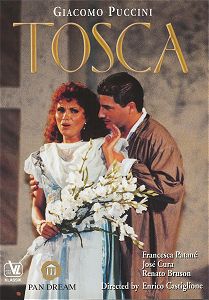
Giacomo PUCCINI (1858–1924) Tosca(1900) Francesca
Patané (soprano) – Tosca; José Cura (tenor) – Cavaradossi;
Renato Bruson (baritone) – Scarpia; Giancarlo Tosi (bass) – Angelotti;
Frederico Longhi (baritone) – Sagrestano; Nicola Sette (tenor) – Spoletta;
Orchestra of the Province of Bari, Chorus from the Teatro Petruzzelli/Pier
Giorgio Morandi
Direction, Sets and Costumes: Enrico Castiglione
Picture Format 5:1; Dolby Digital Surround
rec. live, Bari, Italy. Published in 2001 VL KLASSIK
VLEA096 [123:00]
The preliminary impression of this set wasn’t all that inviting.
The back of the box has an incomplete cast list, the inlay is a
simple sheet, listing the 37 chapters, there is not a trace
of recording venue or date of performance and I wasn’t able
to find surtitles in any language. The main menu had two options: “chapters” and “play”.
Pressing “play” I got directly into the performance from a
stage that obviously had no curtain – an outdoor event it seemed,
also considering the heavily fluttering flames of the candles – and
the orchestra seemed rather distant. What was more, the conducting
was fairly lax and lacked momentum.
On the other hand the setting was comforting: mega-realistic and as
close as possible to the original intentions of the libretto.
One wasn’t exactly in the Sant'Andrea della Valle but definitely in a church. The only
thing that jarred was Cavaradossi’s altar-piece, whose Madonna
was nowhere like 1800 – rather 1950s kitsch. The heart sank
further when Angelotti appeared, no doubt emaciated and exhausted – which
he should be – but also singing with the shaky tone of a long-time
prisoner in Castel Sant’Angelo – which he shouldn’t. Opera
convention is still such that the singing should be enjoyable,
whatever the predicament of the character. Things didn’t improve
when the Sacristan swept in. He could sing but he overacted
violently, making a parody of his character.
With the entrance of the third character the prospects looked better.
Here was José Cura, good-looking and neat, but his acting was
pale; he seemed to wish he were somewhere else. That it was
a classy voice was never in doubt, but his singing has often
been quite idiosyncratic. Hhe inserted little glottal stops – for
expressive reasons – and he sounded worn. He delivered his Recondita
armonia with some verve but it was not until Mario … Mario was
heard off-stage that the temperature rose. Enter a temperamental
redhead, charismatic with flashing eyes and a Callas-like timbre.
She was a bit hampered by Morandi’s lethargic tempos but her
intensity and expressive acting soon overtrumped the orchestra.
Even Cura, though still benign, warmed to this Tosca - the
very attractive Francesca Patané - and the close-ups of their
caressing seemed more than just posturing.
After the customary running-about-and-teasing-the-Sacristan of the
choir boys, the Chief of Police marched in. He was dressed
in black, elegant, with a sardonic twist in the corner of his
mouth – in short a frightening creature. As every credible
Scarpia he was low-voiced, even honeyed. Renato Bruson – even
at an age when Chiefs of Police normally retire – had retained
his superb caressing legato, making him a satanic tamer of
his subjects. When he wanted to stress his points, to show
his powers, his voice was no longer the pliable instrument
it once was. The force was there but also a heavy old man’s
vibrato that developed to an ugly wobble. It would have been
totally unsuitable for a nobler character but for Scarpia it
was adequate.
The second act of this “shabby little shocker”, as George Bernard
Shaw soubriqueted the opera, became that spine-chilling thriller
one hoped for. Palazzo Farnese was luxuriously furnished with
high well-filled book-cases behind Scarpia’s desk – was he
an intellectual after all? Against this backdrop the cruel
proceedings unfolded mercilessly and rarely has a Cavaradossi
been more ruthlessly tortured, bleeding copiously from severe
wounds on his forehead and temples and the shirt torn to pieces.
But in this act Cavaradossi is just a comprimario and it is
the verbal duels between Scarpia and Tosca that are the backbone
of the scene. Both were tremendous and the ritual placing of
the candlesticks and the crucifix is as chilling as ever.
At the beginning of the third act at Castel Sant’Angelo, the cameras
caught sleeping soldiers at daybreak while the Shepherd boy
sang his song unseen at a fair distance. Cavaradossi’s E
lucevan le stelle was deeply felt – maybe even too deeply;
there was more than a hint of melodrama. Long applause – the
audience seemed far away – but also something sounding like
booing. O dolci mani was soft and loving and the whole
final scene breathed resignation – at least on behalf of Cura.
There was bad synchronization between sound and actual firing
in the execution, but Cavaradossi died anyway. Not until the
final credits did I find that the year was 2001, and considering
that Cura by then had been singing Otello for four years
did the traces of wear in his voice seem plausible.
I started the review on a negative note and certainly there are drawbacks
here but Tosca and Scarpia save the day through their deeply
felt acting. Some full-blooded (excuse the pun) singing from
José Cura shows that at his best he is a stirring tenor in
his unorthodox way.
Göran Forsling
Please support our advertisers below by clicking on the logos for further information.

























 Francesca
Patané (soprano) – Tosca; José Cura (tenor) – Cavaradossi;
Renato Bruson (baritone) – Scarpia; Giancarlo Tosi (bass) – Angelotti;
Frederico Longhi (baritone) – Sagrestano; Nicola Sette (tenor) – Spoletta;
Francesca
Patané (soprano) – Tosca; José Cura (tenor) – Cavaradossi;
Renato Bruson (baritone) – Scarpia; Giancarlo Tosi (bass) – Angelotti;
Frederico Longhi (baritone) – Sagrestano; Nicola Sette (tenor) – Spoletta;  [123:00]