As with other SVET
boxes this one comes armed without some
essential information. Which orchestras
are being conducted and is there anything
new and unexpected here? The short answers
in the main are; the USSR Symphony –
though Raymonda is with the Bolshoi
– and no. These are commercial Melodiyas.
I’ve written about
the Raymonda recording elsewhere in
its Melodiya guise so a reprise is in
order. Armed with the sweeping strings
and beefy Bolshoi brass, and with three
excellent principals, this orchestra
is a natural for this score - preferable
to the USSR State. And Svetlanov doesn't
mess about -Act I's Page scene is full
of bold gestures and powerful striving
brass. Listen too the narrative unfolding
of the Countess's Story and its winding
wind passages, so aptly descriptive
here. The Bolshoi's trumpet principal
was Oleg Usach and his brassy, hugely
vibrated sound can be heard in the Act
I Dance scene. There's also a delightful
lilt and lift in the Grand Waltz and
an incremental power in the Mime Scene
- but what sheen and delicacy in its
early stages. Here as elsewhere details
are splendidly controlled by Svetlanov
and there Is no sense of grandiloquence
for its own sake or the feeling that
he and the orchestra are turning these
little movements into mere orchestral
playthings.
Harpist Vera Dulova
imparts some rippling virtuosity, bardic
feel and, not least, romance in the
Prelude and Romanesca. A real standout
is the Entr'acte between scenes seven
and eight where the gravity and warmth
of the writing is crowned by a shattering
climax dominated by Usach's blisteringly
braying trumpet. It's not pretty - but
it is exciting. The Bolshoi's leader
was Sergei Kalinovsky and his eloquent
playing in the Grand Adagio is suitably
memorable. So too is the way in which
Svetlanov brings out the counter-themes
in Scene VIII's Coda - vital and fulsome.
Svetlanov's ear for
rhythmic buoyancy - never gabbled or
over stressed - pays rich dividends
in Act II's Fourth variation, the one
for Raymonda. And still he seldom misses
a trick - note the wittily phrased Entrance
of the Jugglers and the intense and
exciting Bacchanal. The floridity of
the Arrival of the Knight and King is
resplendent here and for pompous nobility
Svetlanov takes some beating in Act
III's Entrance scene. It was a Glazunovian
coup, richly exploited by the conductor
here, to follow it with the touching
and delicate Classical Hungarian Dance.
As these more delicate
and refined moments show, Svetlanov
is alert to the Gallicisms inherent
in the score as indeed he is to the
more grandiloquent Borodin-derived ones
as well. He strikes a fine balance,
literally and figuratively, between
the two. The 1961 sound is certainly
serviceable though it has its raw moments.
Raymonda occupies two discs of the six.
One great work is followed
by another, The Seasons. The hail variations
in Winter is dashingly presented whilst
Summer is relished with lashings of
Glazunovian colour and allure. Autumn
could have been written for Svetlanov.
Its sweep and taut, vibrant, warmly
sprung emotionalism brings out the very
best in him. He prepares for the great
theme with superb tension and vitality.
The Op. 52 Ballet Suite is lesser Glazunov
but still diverting in its melodic avuncularity.
The fourth disc gives us The Romantic
Intermezzo, full of evocative wind solos
and curvaceous legato from the strings.
Imposing lower brass lower in the Solemn
Overture whilst the Ballade Op.78 has
its Wagnerian-Franckian moments. The
symphonic suite From the Middle Ages
is a set of four movements with archaic
titles. It’s full of bardic romance,
balladry, folkloric warmth, troubadour
wistfulness and the towering granite
of the Crusading finale.
Disc five has something
of a memorial feel. The Song of Fate
quotes Beethoven’s Fifth and is brooding
and a bit over-ruminative for its own
good – but gallantly played to be sure.
The pieces to the memory of Stasov,
Rimsky-Korsakov and Gogol are necessarily
brassy and in memoriam – that to Rimsky
is unsettling, but unfolds a big tune
with great nobility of utterance and
strength of character. The Finnish Fantasia
in C major is skirling and dramatic.
The final disc includes the Op.90 Introduction
and Salome’s dance from – of course
– Salome. There are strong echoes of
Scheherazade in the orchestration and
whilst it’s not overtly erotic there
is a real sense of nervous anticipation,
partly fuelled by the occasionally lurid
writing for brass. One of the strongest
works in the set is the anonymously
titled Theme with Variations for strings
Op.97. Not only is Glazunov’s antenna
for gorgeous melodies working supremely
well but the variations are noteworthy
and the set is laid out expertly for
the orchestra. The Karelian legend is
an extensive tone poem. If in the final
resort it lacks the last ounce of melodic
distinction it’s still vibrantly scored
– the cuckoos and other birdcalls and
the sense of forestry is unmistakable
– and Svetlanov and his forces respond
to it avidly.
There may be a lack
of specificity when it comes to orchestras,
dating and provenance but one should
also note that the works are presented
in ascending opus number beginning with
Raymonda in 1899 and ending with Karelian
Legend in 1916; a rather useful and
I think in this case non-didactic exercise.
Jonathan Woolf
























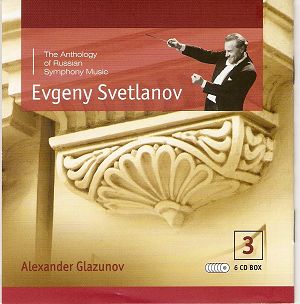
 Orchestra/Evgeni Svetlanov, rec. Moscow
1961 (Raymonda)]
Orchestra/Evgeni Svetlanov, rec. Moscow
1961 (Raymonda)] 