Editorial Board
MusicWeb International
Founding Editor Rob Barnett Editor in Chief
John Quinn Contributing Editor Ralph Moore Webmaster
David Barker Postmaster
Jonathan Woolf MusicWeb Founder Len Mullenger
Johann
Sebastian BACH (1685-1750)
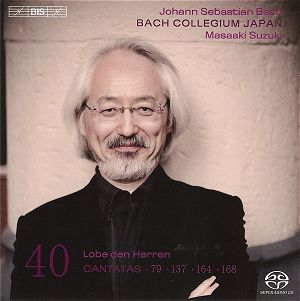
Cantatas, Vol. 40 Lobe den Herren, den Machtigen Konig der Ehren, BWV137 (1725) [12:36] Tue Rechnung! Donnerwort, BWV168 (1725) [12:51] Gott der Herr ist Son und Schild BWV79 (1725)
[14:10] Ihr, die ihr euch von Christo nennet, BWV164
[16:25] Yukari
Nonoshita (soprano); Robin Blaze (counter-tenor); Makoto
Sakurada (tenor); Peter Kooij (bass)
Bach Collegium Japan/Masaaki Suzuki
rec. June 2007, Kobe Shoin Women's University Chapel,
Japan BIS
BIS-SACD-1671 [57:22]
For
this latest instalment of Suzuki’s Bach cantata series
Suzuki regulars Yukari Nonoshita (soprano) and Makoto
Sakurada (tenor) have replaced Carolyn Sampson and Gerd
Türk. Sampson, in particular, performed superbly on vol.
39 so I was rather disappointed that she is not featured
here. Nevertheless, all forces acquit themselves admirably
on this new recording, and it stands as another highly
enjoyable addition to this consistently rewarding series.
The
CD opens with BWV 137, probably first performed on 19
August 1735. The lively first movement, in which trumpets
and timpani underscore words of thanks and praise (“Praise
to the Lord, the Almighty, the King of creation!”) seem
somewhat out of kilter with the passage of the day (the
healing of a deaf and dumb man). It is perhaps not surprising,
therefore, that some have traced it back to the more
festive Midsummer account of the birth of John the Baptist
(24 June). In any case, the primarily fugato introductory
movement is deeply impressive and beautifully captured.
The second movement, later transcribed for organ as a
Schubler chorale, is an elegant aria in which Robin Blaze’s
plaintive voice is underscored by a beautiful violin
part, perfectly judged by Natsumi Wakamatsu. The melody
is taken up by soprano and bass voices in the following
delightful duet, accompanied by agile interplay of two
oboes and continuo. After a short tenor aria a splendid
chorale - later incorporated in the wedding cantata,
BWV 120a - rounds off an exceptional performance of an
under-appreciated cantata.
BWV
168 (first performed on 29 July 1725) is based around
the parable of the unjust steward. It kick-starts with
an urgent bass aria, convincingly performed by Peter
Kooij. One cannot imagine a more involving account of
this movement, characterised by razor-sharp accompaniment
on strings. The tenor aria (movement 3) has a far more
restrained character than the first movement, but shares
a similar ritornello structure. The aria for soprano
and alto (movement 5) is particularly unusual, taking
the form of a gigue, and marked by repeated descending
scales in the bass. This is a relatively minor work overall,
but under Suzuki’s direction it emerges as a highly engaging
cantata to which I am sure I will return.
BWV
79, written for the Reformation Festival and first performed
on 31 October 1725, is remarkable primarily for its opening
chorus. It is marked by an orchestral introduction of
some 44 bars, in which horns and timpani jubilantly announce
themselves in march-like fashion. Against this rich orchestral
texture, the vocalists present words from Psalm 44 “The
Lord God is a sun and shield …” later breaking into a
complex four-part fugue. This is staggeringly brilliant
and inventive music, and subsequent movements unsurprisingly
fall short. Nevertheless, the alto aria is very pretty
- Bach originally employed an oboe part, but later replaced
this with a flute, which Suzuki also adopts here. For
the subsequent chorale, the horn parts from the first
movement are reinstated as accompaniment – to wonderful
effect. The remaining movements seem relatively inconsequential,
but are well performed.
The
primary backdrop for the final cantata is the parable
of the good Samaritan (first performed on 26 August 1725).
The opening alto aria, while rhythmically pastoral, has
a dark undercurrent carried by the strings, in which
Christians are chastised for not coming to the help of
an injured man. The gentle alto aria (movement 3) is
particularly affecting, with two obbligato flutes
weaving a sad song around Blaze’s leisurely lines. The
duet for soprano and bass (movement 5) has a much fuller
texture and presents a more uplifting atmosphere. The
work ends with a straightforward chorale.
This
is an excellent addition to Suzuki’s ongoing series,
and despite the absence of Sampson and Türk, all four
works are very impressively performed and recorded. Although
at least one of the works on the disc is relatively undistinguished
among the scores of outstanding of extant cantatas, Suzuki
taps the astonishing beauty and inventiveness of Bach’s
music with great flair and attention to detail.

























 Yukari
Nonoshita (soprano); Robin Blaze (counter-tenor); Makoto
Sakurada (tenor); Peter Kooij (bass)
Yukari
Nonoshita (soprano); Robin Blaze (counter-tenor); Makoto
Sakurada (tenor); Peter Kooij (bass)  [57:22]
