Editorial Board
MusicWeb International
Founding Editor Rob Barnett Editor in Chief
John Quinn Contributing Editor Ralph Moore Webmaster
David Barker Postmaster
Jonathan Woolf MusicWeb Founder Len Mullenger
Judith
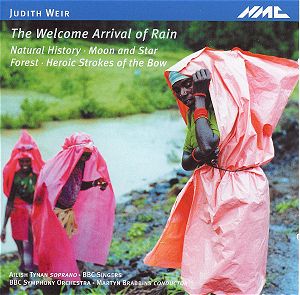
WEIR (b. 1954) The Welcome Arrival of Rain (2001/2) [17:16] Natural History (1998)a [17:55] Moon and Star (1995)b [14:12] Forest (1995) [11:38] Heroic Strokes of the Bow (1991/2) [14:24] Ailish Tynan
(soprano)a; BBC Singersb;
BBC Symphony Orchestra/Martyn Brabbins
rec. Studio 1, BBC Maida Vale, London, 18 September 2007
(The Welcome Arrival of Rain); 1 October 2007 (Heroic
Strokes of the Bow); 24-25 November 2007 (Natural
History, Moon and Star, Forest) NMC D137 [75:52]
Unless
I am mistaken, this is the first release ever devoted to
Judith Weir’s orchestral music. It presents five works spanning
some ten years of her creative life. As such, it reveals
how the composer progressed over the years as well as how
consistent her music-making has been and still is.
The
title makes it fairly clear that the substantial orchestral
work The Welcome Arrival ofRain,
completed in 2002, was inspired by the annual Indian monsoon,
although the music does not make any attempt at description.
What is suggested here, is the idea of organic growth - but,
now, what else is music? As John Fallas rightly remarks in
his excellent and informative insert notes, “the music evolves
in a succession of episodes which seem each to grow out of
the last, so that its conclusion is experienced as both surprising
and necessary”. Bright Tippett-like fanfares and held string
chords open the piece in establishing a sense of expectancy.
Out of this unfolds a long meandering melody with a slight
oriental flavour that might be associated with India or Bali.
The opening gesture underpins much of the ensuing music throughout
the work. The music unfolds till it reaches a first percussion-led “tabla-like” dynamic
section, that later supports a high-lying clarinet part.
This leads to a varied restatement of the opening music,
which in turn leads into a lighter section with “a trio of
humorously marching bassoons”. Earlier material is recalled,
albeit in fragmentary form. The music soon gathers considerable
momentum unleashed in an energetic climax. The conclusion
- solo trumpet and solo oboe over a shimmering accompaniment
- “both surprising and necessary”, subtly suggests the welcome
arrival of rain experienced as a soft blessing.
Composed
for the Boston Symphony Orchestra and Dawn Upshaw, Natural
History is a song-cycle to texts selected from an
old collection of Taoist writings. Each of the four songs
is conceived as a miniature tone poem with a short orchestral
introduction setting the mood. The first song Horse is
about the negative impact (“the error of order”) of man on
the nature of horse (and on Nature in more general terms)
that “needs no lofty halls and no palaces”. In the second
song Singer, an old, ragged singer, whose “face was
blotched” and with “shoes burst and down at heel”, undergoes
a complete metamorphosis when singing. Both text and moral
of the third song Swimmer are rather ambiguous; for
when the swimmer concludes his song with the words “That
is how I stay afloat”, he may imply either bare survival
or joy in riding the waves of life. The final song Fish/Bird is
about the mysteries of Nature and of Space. The music dies
away quietly in “the infinite distance”, thus bringing no
resolution. This substantial song-cycle is a splendid work:
the vocal writing is eminently singable and the often subtle
orchestral textures never obscure the words, the full orchestral
forces being used quite sparingly. It is also worth remarking
that Weir deliberately eschews any attempt at any picturesque chinoiserie,
thus emphasising the universal appeal and actuality of these
old texts.
Moon
and Star, to words by
Emily Dickinson, is scored for small mixed chorus and
orchestra. The opening section for women’s voices and
orchestra, suggests the mysterious vastness of space.
Men’s voices join for “the procession of amazing objects”.
The music moves towards a varied restatement of the opening
preparing for the dancing climax; but the piece ends
as quietly as it began.
Forest, a tone poem, opens calmly with solo strings playing an undulating
motif laying the seed of much that is to follow and weaving
a sound-web through which tunes proliferate, at times punctuated
by Tippett-like brass chorales. The work, however, ends abruptly
and quietly. I notice that I have mentioned Tippett on two
occasions in this review. Weir’s music actually shares – or
so I think – some characteristics with Tippett’s: capricious
rhythms, long and sinuous melodies and a real liking for
bright orchestration.
Heroic
Strokes of the Bow, also
known as Heroische Bogenstreiche, is the
earliest work here. It was composed for the Westdeutsche
Sinfonie. The music alludes – often obliquely – to Beethoven.
The work is actually scored for classical orchestra of
double woodwind, two trumpets, timpani and strings. It
opens with isolated notes and chords spelled out with
much energy, but the music does not seem to have any
clearly defined goal. It rather suggests someone lost
in a maze and trying to find his way out in almost any
direction, sometimes retracing his steps and looking
for another exit. This trial-and-error process goes on
for some time; and, then, all of a sudden, here is the
way out: the fragments that had been tossed around for
so long, at last fall into place. This colourful work
may well be enigmatic, for one is not perfectly sure
of what it is about; but, as so much else in Weir’s output,
it is quite attractive, perfectly proportioned so that
the music never outstays its welcome.
This
is a magnificent release with five substantial, ultimately
rewarding and attractive works in splendid performances,
warmly recorded. Judith Weir’s music is of the kind dear
to my heart for it is honest, sincere, often quite beautiful,
strongly communicative and utterly accessible. This superb
release should not be missed.
Hubert
Culot
Please support our advertisers below by clicking on the logos for further information.

























 Ailish Tynan
(soprano)a; BBC Singersb;
BBC Symphony Orchestra/Martyn Brabbins
Ailish Tynan
(soprano)a; BBC Singersb;
BBC Symphony Orchestra/Martyn Brabbins 
