Editorial Board
MusicWeb International
Founding Editor Rob Barnett Editor in Chief
John Quinn Contributing Editor Ralph Moore Webmaster
David Barker Postmaster
Jonathan Woolf MusicWeb Founder Len Mullenger
Max
BRUCH (1838-1920)
Violin Concerto No.1 in G minor, Op. 26 (1864-68) [25:11] Franz SCHUBERT (1797-1828)
Rondo in A for violin and strings D438 [16:02] Felix MENDELSSOHN (1809-1847)
Violin Concerto in E Minor, Op. 64 (1844) [29:12] Nigel Kennedy
(violin)
English Chamber Orchestra/Jeffrey Tate
rec. No.1 Studio, Abbey Road, London, 19-20 December 1987. EMI CLASSICS 5181732 [70:35]
When
I worked for a short while in the CD department of a large
department store in The Hague, there was an assistant who
had long thought that Mendelssohn-Bruch was a single composer
and that ‘The Mendelssohn-Bruch’ but a single grand masterpiece;
such is the frequency with which this coupling has appeared
over the years.
This
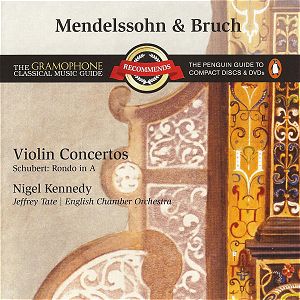
disc is the ‘Gramophone/Penguin Guide Recommends’ re-issue
of Nigel Kennedy’s now ‘classic’ recordings of these pieces,
but fans beware, this entire programme has also appeared
as part of Kennedy’s Platinum
Collection. It is however a good thing that we have this
now vintage recording available at around half the price
of the original.
Much
has been said about these performances, and to sum up, you
are either bowled over by Nigel Kennedy and can’t get enough
of them, or you can’t stand the thing and won’t have it in
the house, even for use as a silver non-absorbent beer mat.
I can rarely sum up the energy to be passionate or partisan
one way or another about individual performers, so whatever
Nigel Kennedy’s prowess and pretentions before and since
these recordings are water off this fellow performing duck’s
happily unbiased back.
To
put the thing in context, Kennedy would have been a bit over
thirty, and had long made it as a professional soloist by
the time he made these recordings, so no excuses can be made
for lack of experience or the brashness of youth if we’re
going to be critical. This was also just before he was let
loose on his notorious first version of the ‘Four Seasons’.
Listening to these recordings again after the excitement
of their release about twenty years ago and I can’t help
feeling there is just ‘too much’ in the solo. I’m quite happy
to hear butch violin playing, and would prefer it to wafting
and perfumed romanticism. The Bruch solo part does however
receive quite a punishing, which no doubt reflects a soloist’s
need to project above a big but largely sympathetic orchestra.
As has been mentioned by others, Kennedy wrings every drop
out of each note – the only question is, what is it that
is wrung? Scanning my shelves, I picked out the almost contemporaneous
DGG recording by Gil Shaham and Giuseppe Sinopoli conducting
the Philharmonia Orchestra. Shaham is by no means feminine
in his playing, but where Kennedy often seems to be popping
all cylinders at once, Shaham somehow creates a wider scale
and range of emotions by keeping, or giving the impression
of keeping just that little bit more in reserve. He also
lifts the orchestra where the score demands, rather than
constantly rising above it, so that the performance becomes
more of an organic whole, rather than something of a battle
ground. Don’t get me wrong, the Kennedy/Tate combination
is very good, and very exciting, but it doesn’t ‘get me’ in
the same way, I’m impressed, but not so moved.
Looking
at the Mendelssohn, and the picture is similar. Kennedy has
us on the edge of our seats an gritting our teeth virtually
from the start, which is a good thing if you’re writing a
novel – ‘start with an avalanche and go on from there’, but
in a piece of music like this I would suggest that the impression
might better be given that there are greater climaxes to
be had later on, that there is more and better to look forward
to, rather than pushing the whole pie into the public’s face
within the first 20 seconds or so. Pinchas Zukerman does
this very well in his 1983 Philips recording with the St.
Paul Chamber Orchestra, arching over the opening exposition
with expansive ease, drawing us into the longer narrative
rather more elegantly. Kennedy does settle down well into
the gentler sections of this first movement however, and
his technical prowess in the most demanding passages is a
wonder to behold.
The
version of Mendelssohn’s Violin Concerto in E minor Op.64 that
we usually hear today differs in some details to the original
version the composer made in 1844 , and I would direct collectors
to a wonderful recording and performance in the BIS label
with Isabelle van Keulen and the Nieuw Sinfonietta Amsterdam
under Lev Markiz to what amounts to an ‘authentic’ performance
of the original version of this marvellous work. Both van
Keulen and Zukerman seem to reach the heart of the music
more attractively than Kennedy. This is something hard to
define, and I’m usually reluctant to use words like ‘heart’ and ‘soul’,
but with these alternatives, and with Gil Shaham for that
matter, I couldn’t go back to Kennedy and sincerely say that
he was giving me more of the music than these other soloists.
Nigel Kennedy’s is a sincere and honest performance, and
I’d be that last to accuse him of showmanship over musical
communication, but by the end I was becoming a bit fed up
with the whole thing. Those little upward flicks at the beginning
of the final Allegro molto vivace should be witty,
I want them to make me smile – giving the kick-start to the
fun bit in the last furlong. Kennedy doesn’t make me smile
there, but does at 2:51 where that little flick at the interval
of an 11th is a joy. In other words, technical
wonders, power and excitement galore, but I’m less drawn
into the music than into a critical evaluation of the playing,
which is part of the reason for being here in the first place
of course, but ultimately the very thing you want in the
end to be able to let go of, just allowing the music to take
you on that special journey.
Having
Schubert’s Rondo D438 between the two main concertos
is an excellent idea: like Victor Borge’s third pedal on
the piano, it stops them bumping into each other. In this
piece Kennedy is not obliged to be intense or expressive
in quite that same romantic front-foot concerto manner, so
this in many ways turns out to be the most appealing recording
on this disc. The playing is light and yes, witty in places,
and the piece certainly deserves its orchestral version,
having originally been scored for violin and string quartet.
My
own conclusions on this re-release? It most certainly is worth
its now much reduced asking price, but the world has moved
on since 1988 and I would suggest that if you already possess
loved and well-worn versions of these works, then this much
vaunted recording is possibly less likely to blow them out
of the water than the critics might have you believe. Kennedy
most certainly does have special qualities, but to my ears
these are more in the bravura technical achievement in the
playing rather than in revealing the essentials of the music.
If you miss and long for the brave, brash, ‘Cool Britannia’ late
1980s then this may do it for you, but I personally won’t
be making this recording my all-time first choice. If however
you’ve had your eye on this recording for ages but were reluctant
to shell out the shekels at full price, now is the time and
here is the low-budget solution to your problem. At least
you can hear what all the fuss was about for yourself, and
not feel too bad if it ultimately ends up in mother-in-law’s
Christmas stocking.
Dominy Clements
Please support our advertisers below by clicking on the logos for further information.

























 Nigel Kennedy
(violin)
Nigel Kennedy
(violin) 
