Editorial Board
MusicWeb International
Founding Editor Rob Barnett Editor in Chief
John Quinn Contributing Editor Ralph Moore Webmaster
David Barker Postmaster
Jonathan Woolf MusicWeb Founder Len Mullenger
Simon
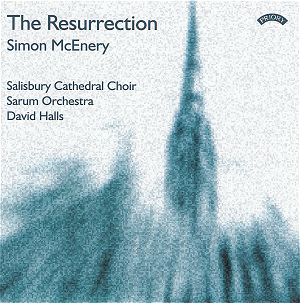
McENERY (b. 1964) The Resurrection(2005) [66.44] Imogen Roose
(soprano),
Carolyn Jackson (mezzo),
Declan Kelly (tenor),
Dyfed Wyn Evans (baritone),
Daniel Cooke (piano)
Salisbury Cathedral Choir
Sarum Orchestra/David Halls
rec. Sarum St. Martin, July 2007 PRIORY
PRCD1002 [66.44]
Composing
is a practical craft; you need to write a work suitable for
your performers especially if they are commissioning you.
Very few composers can get away with writing exactly what
they want and expecting to get it performed. The trick, inevitably,
becomes one of creating something which has something of
the eternal verities whilst being within the scope of the
performers. With any luck, your chosen audience will enjoy
it as well.
So,
with a commission to write a major oratorio to be premiered
during Holy Week at Salisbury Cathedral it is unlikely that
Simon McEnery was ever going to write a piece of complete
Ferneyhough-esque music. The brief was to write a popular
oratorio which took the gospel story on from where Stainer’s Crucifixion stops.
The reference to the Stainer work is important; this new
piece with a text by Canon Jeremy Davies includes three hymns
just like the Stainer.
McEnery
and Davies have collaborated before, on The Way of the
Cross which was premiered in Salisbury in 2000. Davies’s
text comprises a series of extended dramatic meditations
on the events in John’s Gospel. There is no recitative and
no strict narrative, instead there are fourteen set-pieces
which take us from the empty tomb to our own contemplation
of the resurrection. Though there are fiour soloists, they
do not take named roles and, for instance, the movement entitled Peter
and Jesus is in fact sung by the baritone and soprano
soloists.
Davies’s
text is capable and poetic in a direct and robust way. For
me, he falls between the poeticism really necessary for this
task and the sort of robust prose which might be equally
appealing. That said, my reactions to the text are rather
coloured by my views as to whether I would want to set it,
or not. For this, dear reader, is one of those reviews where
the reviewer’s attitude is inevitably complicated by their
involvement with the material. I can’t help listening to
this work without thinking how I would have approached it.
Because
my feelings about the libretto are rather ambivalent, I thought
it might be helpful if I quoted a passage. Here is a verse
from the second movement, The Empty Tomb:-
‘For
God’s sake listen and open your eyes
The
truth is plain: the world has changed
From
Friday’s death and Saturday’s grieving
Shattered
hopes and minds deranged
The
body’s gone, the grave’s been stripped:
The
massive stone has been rolled away
The
Roman guard that Pilate set
Did
not survive the light of day.
Though
Davies includes three hymns in the piece, his writing in
the other movements is extremely hymn-like, with verses often
being strophic.
A
more interesting point, is how a non-Christian might take
the piece. Davies’s writing is not always direct, he refers
to events in the Gospel narrative rather then telling the
story directly. I wondered how someone who did not know the
story very well would get on with the text: would they make
sense of the piece. Similarly, I wonder how non-believers
might take a work which is so bound up with presenting Christian
belief. Contrary to popular opinion, Handel’s oratorios were
not intended as religious works: they were theatre pieces
telling rattling good stories.
McEnery’s
atmospheric score is set for four soli, chorus, string orchestra
and piano; a combination which is obviously intended to be
highly practical, but which the composer makes good use of.
As can probably be guessed from the description of the brief
for this work, McEnery writes tunes. But the work is well
away from a simple tuneful romp. Instead, he embeds his melodic
material into more complex structures. Besides being a composer,
McEnery is also a tenor, being both a choral singer and a
cabaret performer. This gives his music an immense feeling
of practicality. He responds to Davies’s text with music
which is apt in form and never over-taxes his forces or his
audience. McEnery has a good feel for textures and creates
a distinctive multi-layered texture for each of his movements.
The overall impression is that of a Musical. Much of McEnery’s
writing, his big tunes, his emotional punch at the ends of
movements, owes a lot to the way modern musicals are written.
The
result is credible and creditable. It almost certainly went
down well with his target audience who were there for both
musical and devotional reasons. As such, McEnery’s Resurrection aptly
fulfils his brief and provides a highly attractive and practical
work which will be of interest to other choral societies
and church groups. There is however scope for the piece to
have gone further - to have pushed the boundaries just a
little. McEnery and Davies seem just a shade too content
in their own little world and I wanted an element of danger.
This is, after all, a piece about the Resurrection. The work
is too comfortably descriptive and does not, for me, evoke
the mystery and danger of the gospel events.
Salisbury
Cathedral Choir and the Sarum Orchestra give an exemplary
performance under David Halls, though there are occasional
lapses in ensemble. The writing for choir is relatively straightforward
and homophonic. The talents of Salisbury Cathedral Choir
seem under-used somehow. There were a number of moments when
I longed for a little vocal polyphony, or for McEnery to
add a counter-melody to one of his strong tunes.
When
it comes to the soloists, things are problematic. Tenor Declan
Kelly has a fine lyric voice, but appears a little taxed
by the high tessitura of some of the writing and soprano
Imogen Roose sounds positively uncomfortable. McEnery’s writing
for the soprano soloist is demanding indeed. Dyfed Wyn Evans
has a lovely baritone voice and his is the voice which responds
best to the microphone. Carolyn Jackson seems to come off
worse as the microphone has caught so much of her vibrato
that it becomes too intrusive and tends to obscure the vocal
lines.
Considering
the work is in English and has a distinctly contemplative
and devotional cast, I would also have liked better diction
and a greater feeling for the words from the singers. There
is too much of a sense of the performers being rather too
relaxed in enjoying McEnery’s eminently singable vocal lines,
to the detriment of Davies’s text. I am not convinced that
you could follow this piece without recourse to the libretto,
which in an approachable setting of an English text is surely
a cardinal sin.
Overall
this is a fascinating and accessible work, one to which I
will return in the future. If it does not quite reach the
heights of which, I think, McEnery is capable, it certainly
fulfils amply the commissioning brief, which is no small
credit.
Robert
Hugill
Please support our advertisers below by clicking on the logos for further information.

























 Imogen Roose
(soprano),
Carolyn Jackson (mezzo),
Declan Kelly (tenor),
Dyfed Wyn Evans (baritone),
Daniel Cooke (piano)
Imogen Roose
(soprano),
Carolyn Jackson (mezzo),
Declan Kelly (tenor),
Dyfed Wyn Evans (baritone),
Daniel Cooke (piano) 
