Site
Map
More
Reviews
How
to find a review
Classical CD Review Archive
Book
Reviews
Film
Music Reviews
Jazz
CD Reviews
Nostalgia
Comment
Norman
Lebrecht Weekly
Arthur
Butterworth Writes
Phil
Scowcroft's Garlands
Classical
blogs
Reviewers
Logs
Announcements
Don't
Go Here!
Community
Bulletin
Board
Web
Ring
Reviewers
Helpers
invited!
Resources
How
Did I Miss That?
British
Composers
British
Light Music Composers
Other
composers
Indexes
Label
Masterwork
Discographies
On-line
Music
[Download sites]
Themed
Review pages
Our
Classic Classics
Online
books
MWI
Classical
Encyclopaedia
Gilder
Dictionary of
Composers
MWI
Pop
Encyclopedia
Other
Complete
Books
Programme
Notes
British
Music Society
Performers
The
BBC Proms
Musical
WWW pages
Classical
Music Online
Recording
Companies and Retailers
Agents
and Marketing
Publishers
Non-Classical
Web pages
Orchestra
Web Sites
Newsgroups
Web
News sites etc
Editorial
Board
Classical Editor
Rob Barnett
Seen & Heard
Editor and Webmaster
Bill Kenny
MusicWeb Webmaster
Len Mullenger
Assistant Webmasters
Patrick Waller
David Barker
PotPourri
A
pot-pourri of articles
MW
Listening Room
MW
Office
Helping
MusicWeb
Advice
to Windows Vista users
Questionnaire
Site
History
What
they say about us
What
we say about us!
Where
to get help on the Internet
CD
orders By Special Request
Graphics
archive
Currency
Converter
Dictionary
Magazines
Newsfeed
Web Ring
Translation Service
Rules
for potential reviewers :-)
Do
Not Go Here!
April Fools
|

 |
 |
|
alternatively
Crotchet
AmazonUK
AmazonUS
|
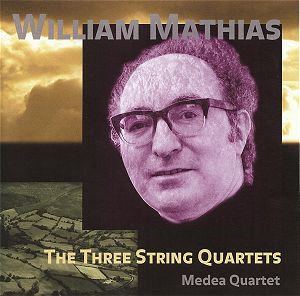
William
MATHIAS (1934-1992)
String Quartet No. 1 (single movement) op.
38 (1967) [20:00]
String Quartet No. 2 op. 84 (1980-81) [19:12]
String Quartet No. 3 op. 97 (1986) [23:04]
Medea Quartet
rec. church of St Martin's, East Woodhay,
4 May, 29 July, 5 November 1993. DDD
METIER MSVCD92005 [63:26]  |
|
|
The Welsh composer William Mathias
died at the grievously young age of
58. I knew his name because of the
Sinfonietta on a Pye LP (GSGC
14103). His music came to mean more
to me when in 1975 I taped from BBC Radio
3 the first broadcast performance
of This Worldes Joie. It was
conducted by the composer who directed
massed choirs – including children’s
choirs - and the BBC Welsh Orchestra.
The soloists were Kenneth Bowen and
Janet Price. I listened obsessively
to this extravagantly orchestrated
work on tape and became increasingly
impressed and won over. His writing
for voices is orally intriguing and
inventive; the same applies to his
startling way with the percussion.
There are echoes of Britten but the
music breathes a deeper humanity and
a more yielding emotional air. You
can now hear that piece on Lyrita
SRCD325 having first been
issued on an EMI Classics LP (ASD3301).
After that choral broadcast from the
Fishguard Festival I scanned the Radio
Times and added recordings of his
orchestral pieces Requiescat,
Litanies, Vistas,
Helios and Laudi.
Hearing his Elegy
for a Prince I was further
won over by the lapidary Baxian orchestral
technique and ceremonial-magical atmosphere
- the aural equivalent of druidic
tapestry in motion. As for his Dance
Overture it is irresistibly catchy
and has more rumba in it than the
Arthur Benjamin genre pieces.
Mathias wrote three
symphonies and three string quartets.
We can hear the three quartets conveniently
assembled on this disc by a quartet
who performed the Third Quartet and
who were then invited to tackle all
three. This they did at three separate
recording sessions so there is no
sense of a gabbled or ill-thought
through results.
The First Quartet
is dedicated to Alun Hoddinott
and his wife Rhiannon. It inhabits
a sombre world afflicted, to varying
degrees of intensity, by anxiety.
The language stands between the gloomier
reaches of the ensemble writing in
Warlock's The Curlew and the
later Bartók quartets. This
is leavened but never completely dispelled
by a Bartokian didicoi wildness of
the violins at 16:38. At 19:20 the
violin primo is memorably heard high
in the stave whistling wistfully.
The music ends in a not unclouded
tenderness. The music of the four
movement Second Quartet takes
wing although always feeling the pull
of sorrow. The solo violin carries
this flighted buoyancy (tr. 2 4:02)
but there are also vigorous chafing
insect-stridulant voices. The second
movement smacks of folk music veering
between the Celtic muse and the Appalachian
hills. There’s also a Britten-like
pizzicato which in this close recording
pings in the ears with physical impact.
The andante returns to the gloomy
undertow of the First Quartet. The
finale has the exuberant complexity
of the Tippett Concerto for Double
String Orchestra as well as the
seething weave of insectiform lines.
Mathias's last quartet – The Third
- was not intended to be his last.
He had accepted a commission from
the Lindsays but death intervened.
The third is in three movements. Lyrical
release can be found in the first
movement as can springy Tippett-like
ideas often set amid potently grave
reflective writing. The finale begin
dramatically with a sort of suppressed
shriek and soon develops a strongly
etched rhythmic energy - a rough magic
that also ends the piece.
Interesting that
all three of these serious works have
an Eastern European leaning amid a
rooted tonality spiced with dissonance.
Rob Barnett
William
Mathias on MusicWeb International
The Mathias symphonies
are available on the Nimbus
label (to be reviewed)
|
|
Advertising
Rates
Visitor
stats
MusicWeb
International
has over 21,000 Classical CD reviews on offer
Gerard
Hoffnung Concerts &
The
Bricklayer Story
New
Releases

New
Releases


MusicWeb
sells the Polish
catalogue CDAccord
£10.50 post free W-W

MusicWeb sells the
Arcodiva catalogue
£12.00 post free W-W

Price
Reduction: £11.00
post-free world-wide
Try
it and see - Sale or Return
MusicWeb
can now offer you discs from the following catalogues:
Prices include postage
MusicWeb
Recommended Recordings 2008
DISCS
OF THE YEAR 2007
|