Editorial Board
MusicWeb International
Founding Editor Rob Barnett Editor in Chief
John Quinn Contributing Editor Ralph Moore Webmaster
David Barker Postmaster
Jonathan Woolf MusicWeb Founder Len Mullenger
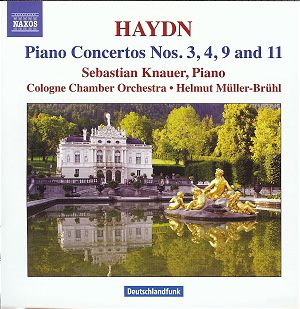
Joseph HAYDN (1732-1809)
Concerto in F major, Hob.XVIII:3 (c.1766) [20:07]
Concerto in D major, Hob.XVIII:11 (1784) [19:33]
Concerto in G major, Hob.XVIII:4 (c.1770) [20:17]
Concerto in G major, Hob.XVIII:9 (1767?) [18:03] Sebastian
Knauer (piano)
Cologne Chamber Orchestra/Helmut Müller-Brühl.
rec. 15-18 February 2007, Deutschlandfunk Kammermusiksaal,
Cologne, Germany. DDD NAXOS 8.570485 [77:59]
These
are honest, unfussy performances, recorded in clear and well-integrated
sound. Neither the Cologne Chamber Orchestra nor the soloist
Sebastian Knauer employ period instruments, but their performances
have a sense of proportion and a refinement that lend their
own air of authenticity. Those who have heard the Cologne
Chamber Orchestra under Helmut Müller-Brühl in various installments
of Naxos' Haydn symphony cycle will expect this.
In
the 37 year old German pianist Sebastian Knauer they find
an ideal collaborator. He is a natural Haydn pianist and
an intuitive musical conversationalist. Although he plays
a modern piano on this recording, he is alive to the balances
required in Haydn's music and creates dynamic contrast with
shades of piano and pianissimo, caressing rather
than banging his keys. His facility for nuance never draws
attention to itself, colouring the score subtly instead.
Knauer plays his own cadenzas in concertos nos. 3, 4 and
9 and in each case he captures the idiom beautifully.
The
concerto in D major Hob.XVIII:11 – in which Knauer plays
Paul Badura-Skoda's cadenzas – is the stand-out in this collection.
It opens with a sprightly allegro first movement which spins
a delightfully memorable tune, and closes with a glistening,
spicy Hungarian rondo. The central slow movement, which is
almost as long again as the first movement, has a wonderful
singing quality. Knauer creates moments of delicate rhapsody
here, breathing a gentle rubato and coaxing delicious pianissimi
from his keys. This is mature Haydn: expressive, witty and
infectious. It was a popular hit across Europe in its day,
and it is easy to hear why.
The
F major concerto Hob.XVIII:3 that precedes it on this disc
is the work of a younger composer, but still bears its author's
marks. Just listen to the way the piano takes up and embellishes
the artlessly pretty theme that is the first subject of the
relaxed opening allegro. A dreamy adagio and a bright, witty
presto balance the long first movement, and throughout orchestra
and soloist are in fine form.
The
first of the two G major concertos, Hob.XVIII:4 opens with
a similarly spacious allegro, but as in the F major concerto
the gentle pace does not dull the music's impact. Instead
it creates space for Knauer's thoughtful articulation and
phrasing. The closing rondo is perky, but it is the slow
movement that really impresses here, exuding a sighing wistfulness.
All
four of the concertos on this disc have had questions asked
about their authenticity. Keith Anderson's liner notes more
or less confirm that nos. 3, 4 and 11 are genuine Haydn,
though there seems to have been some retouching of the orchestration
in nos. 3 and 4. As for no.9, which closes the disc, whether
or not it is genuine Haydn it is certainly quite different
from the three concertos that precede it. The scoring is
much lighter and the outer movements are much shorter than
the deeply meditative slow movement, which Knauer casts in
beautiful legato phrases, delicately ornamented.
Haydn
was no virtuoso, and his concertos for keyboard have no pretensions
to the dazzle and grandeur of Mozart's works in the medium.
He was, however, an expert musical dramatist and had a magpie's
eye for sparkle. While Ronald Brautigam’s disc of nos. 3,
4 and 11 (together with 2) on BIS (CD 1318) crackle with
greater excitement, these performances are unfailingly pleasing,
making this just the sort of head-clearing, smile-inducing
disc you will want to have close to hand at the end of a
long day.
Tim Perry
Please support our advertisers below by clicking on the logos for further information.

























 Sebastian
Knauer (piano)
Sebastian
Knauer (piano) 
