MW EXCLUSIVE 4CD sets £18 each or £28 for both postage paid
Search
What's New
Classical CD Reviews
Live Reviews
Jazz CD Reviews
Composers
Resources
Contact Us

Classical CD and DVD reviews. MusicWeb is not a subscription site and it is our advertisers that pay for it. Please visit their sites regularly to see if anything might interest you. Purchasing from them keeps MusicWeb free.
  Classical Editor: Rob Barnett  
Founder Len Mullenger   


CD REVIEW

Making a Donation to MusicWeb

About MWI

Site Map

More Reviews
How to find a review

Book Reviews

Film Music Reviews

Nostalgia

Comment
Arthur Butterworth Writes

Phil Scowcroft's Garlands

Classical blogs

Reviewers Logs

Announcements

Don't Go Here!

Community
Bulletin Board

Web Ring

Reviewers

Helpers invited!

Resources
How Did I Miss That?

British Composers

British Light Music Composers

Other composers

Indexes
   Label
   Masterwork

Discographies
   Composer
   National

Themed Review pages

Complete Books

Programme Notes

External sites
British Music Society
The BBC Proms
Performers
Orchestra Sites
Recording Companies & Retailers
Online Music
Agents & Marketing
Publishers
Other links
Newsgroups
Web News sites etc

Editorial Board
Classical Editor
   
Rob Barnett
Seen & Heard
Editor and Webmaster
   Bill Kenny
MusicWeb Webmaster
   Len Mullenger
Assistant Webmaster
   David Barker

PotPourri
A pot-pourri of articles

MW Listening Room
MW Office
Helping MusicWeb
Advice to Windows Vista users  
Questionnaire    
Site History  
What they say about us
What we say about us!
Where to get help on the Internet
CD orders By Special Request
Graphics archive
Currency Converter
Dictionary
Magazines
Newsfeed  
Web Ring
Translation Service

Rules for potential reviewers :-)
Do Not Go Here!
April Fools

Would you like a hyperlinked weekly summary of the CDs we have reviewed?
Click for further details

Sample: See what you will get

alternatively
Classicsonline AmazonUK   AmazonUS


John Herbert FOULDS (1880-1939)
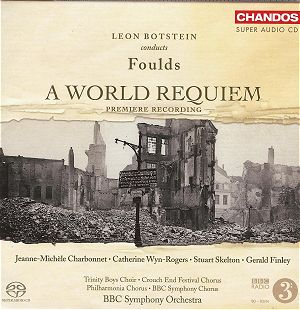
A World Requiem, Op. 60 (1918-21) [89:58]
(for soprano, contralto, tenor and baritone soli, small chorus of boys and youths, full chorus, orchestra and organ; A tribute to the memory of the Dead [a message of consolation to the bereaved of all countries]) Dedicated to M.M.C. (his wife Maud McCarthy) 
Jeanne-Michèle Charbonnet (soprano); Catherine Wyn-Rogers (mezzo); Stuart Skelton (tenor); Gerald Finley (baritone); Trinity Boys Choir; Crouch End Festival Chorus; Philharmonia Chorus; BBC Symphony Chorus 
BBC Symphony Orchestra/Leon Botstein 
rec. Royal Albert Hall, London (live), 11 November 2007 
premiere recording 
CHANDOS CHSA5058(2) [45:08 + 44:50]
Experience Classicsonline


Over the years since his death Manchester-born composer John Foulds has had his angels. I will mention a few but there have been many and there will be more. Malcolm Macdonald of Tempo fame, his biographer and the leading Foulds authority. Richard Itter of Lyrita who elected to record his Dynamic Triptych in the late 1980s. Robert Simpson also played his part as did the Endellion who made a signature recording of the Quartetto Intimo for Pearl. Moray Welsh and Ronald Stevenson in 1979 broadcast a still unmatched performance of the Cello Sonata; Foulds was a cellist in the Hallé during his early 20s. Sakari Oramo has championed Foulds with the City of Birmingham Symphony Orchestra and recorded them with Warner. Roger Wright, Controller of BBC Radio 3, put the World Requiem revival in motion with the Foulds family, the Royal British Legion and The Daily Telegraph. To them we must add Leon Botstein a conductor with a reputation for championing the tragically neglected. He has a concert and recording schedule to match.
 
The World Requiem was to Foulds’ reputation what The Gothic was to Havergal Brian. The difference was that Adrian Boult was so convinced by The Gothic that he gave the work its professional premiere in 1966 - a broadcast once pirate issued on an Aries gatefold 2 LP set. Boult in his position at the BBC had little time for the World Requiem. After its phenomenal early sequence of four Remembrance Day performances between 1923 and 1926 it languished unheard.
 
The texts are from the Requiem Mass mixed with words by John Bunyan and the Hindu poet Kabir. This mix of Christian with other religions can be heard in another artefact of the Great War, Delius’s Requiem. Written between 1919 and 1921, Foulds conceived the work as a memorial to the dead of all nations in the wake of Great War. It was premiered on Armistice Night, 11 November 1923 in the Royal Albert Hall. The composer referred to the work as 'A Cenotaph in Sound' – a sort of parallel with the Cenotaph then recently constructed to a design by his friend and fellow theosophist Sir Edwin Lutyens.
 
I have found it hard to come to terms with the World Requiem and I think it will take even longer, such is the scale of the piece. The challenge for me - a challenge from which I at first turned away - was that it seemed so different from his other master-works. His Lyra Celtica, his Cello Sonata, Dynamic Triptych, Mirage and Quartetto Intimo were so different – all ragingly rich and strange. The World Requiem does not cut free from the English choral tradition in the way I expected. It recalls Vaughan Williams (Dona Nobis Pacem) and others drawing from Stanfordian springs: Dyson (Quo Vadis) and Holst. It should however provide most listeners with an easier toe-hold than Foulds’ works of the late 1920s and 1930s.
 
The Verdian Dies Irae-like Pronuntiatio of Part I (CD1) partakes of the ruthless writing in Tippett's A Child of Our Time: 'break down their houses'. Gerald Finley is magnificently steady in his ‘alpha and omega’ soliloquy in the Confessio - so very like Dona Nobis Pacem. Later in the Pax movement there are pre-echoes of RVW's Sancta Civitas. The echoing and distant children's choir in dialogue with the mezza voce men in the foreground recalls the otherworldly singing in Holst's Hymn of Jesus and in the exulting magnificence of Walton's Te Deum of 1937. Clearly The World Requiem was highly influential and left a mark on many composers whose works have survived better.
 
Foulds must have regarded this piece as a very special case because there is certainly an element of sentimentality. It can be heard in the direct candour of the Consolatio. There the language is in touch with Coleridge-Taylor's Hiawatha trilogy yet with a stiffening from Delius. This influence returns in the Angeli movement in Part II with its almost literal feathery rustle of the angels' wings which offset by the same lavish orchestration we know from Mirage. Part I ends with the steady march of the Requiem with the soloists joining in dialoguing echo with the choir. One can see where the whirring marches written by Vaughan Williams and Holst in their Whitman-inspired Dona Nobis Pacem and Dirge for Two Veterans came from. The end of Part I echoes in peaceful calm the same Requiem aeternam words as the opening.
 
Part II (CD2) starts with a 20th century echo of Handel's Entry of the Queen of Sheba with Tippett's Concerto for Double String Orchestra all bristlingly active. This rises to some firmament-assaulting brass writing. Jeanne Michèle Charbonnet is too floridly operatic for my taste and yet this is forgivable in the context of the wide-eyed wild choral writing of the Laudamus. It has the Old Testament feral barbarism of Havergal Brian's Fourth Symphony Das Siegeslied. The silvery Elysium movement is enhanced by Finley's sturdy, thoughtful and virile Bantockian singing; less acceptable in this context is Charbonnet's vibrato. Notable is the great shudder of the orchestra and the softened quarter-tone strangeness in the In Pace. There is impressive singing from Stuart Skelton in the Promissio et Invocatio with shimmering string writing that lofts the singing even higher. The lapidary writing of the Benedictio and the soft undulation of the four soloists provide a prelude to belling brass leading direct to the Consummatus with its glinting silver-lights and consolatory exaltation. Deeply satisfying.
 
This is a concert performance so allowance must be made for the odd shuffle and cough - far fewer than you may fear though.
 
This set is staggeringly well documented so there is little else you will need to revel in the experience that moved the masses in the wake of the Great War. So many in the audience will have known what wartime bereavement meant and lived it through Foulds’ music touching off the deepest of emotional wellsprings.
 
Now can we please have the Cello Concerto - heavily indebted to the glorious Cello Sonata which I rather hope that will one day also be released in the still unmatched BBC broadcast made in the late 1970s by Moray Welsh and Ronald Stevenson.
 
Rob Barnett

see also review by Patrick Waller

 
Track Listing
CD1 [45:08] CD2 [44:50]
Part I 
1 I Requiem [8:44]
2 II Pronuntiatio [4:05]
3 III Confessio [5:46]
4 IV Jubilatio [5:06]
5 V Audite [7:04]
6 VI Pax [3:53]
7 VII Consolatio [5:08]
8 XIII Refutatio [0:38]
9 IX Lux Veritatis [1:19]
10 X Requiem 3:25]
Part II
1 XI Laudamus [6:30]
2 XII Elysium [6:24]
3 XIII In Pace [3:17]
4  Hymn of the Redeemed [4:37]
5 XIV Angeli [3:27]
6 XV Vox Dei [3:07]
7 XVI Adventus [4:01]
8 XVII Vigilate [2:03]
9 XVIII Promissio et Invocatio [7:30]
10 XIX Benedictio [1:41]
11 XX Consummatus [2:06]


Advertising Rates
Visitor stats
MusicWeb International
has over 25,000 Classical CD reviews on offer


Gerard Hoffnung Concerts &
The Bricklayer Story

Naxos Classical


Australian Eloquence CDs on Buywell.com


New Releases

Hyperion
New Releases


Guild Music


MusicWeb sells the Polish
catalogue CDAccord
£10.50 post free W-W


MusicWeb sells the
Arcodiva catalogue
£12.00 post free W-W


£11.50
post-free
world-wide
Try it and see - Sale or Return

MusicWeb can now offer you discs from the following catalogues:
Prices include postage

[Acte Préalable £13.50]
[Arcodiva £12.00]
[Avie from £6.25]
Brilliant Classics
[British Music Society £13.49]
[CDACCORD from £10.50 ]
[ClassicO £12.50]
[Hallé from £11]
[Hortus £14.99 ]

[Lyrita ONLY £11.50 ]
LYRITA Sale or Return
[Onyx £12.00
]
ONYX Sale or Return
[REDCLIFFE £11 ]
[Sheva £11]
[Tactus £11.50 ]
[Talent from £12.00 ]
[Toccata Classics £12.50 ]

MusicWeb Recommended Recordings

DISCS OF THE YEAR 2008

Google Ads - for information about privacy matters, click here


Return to Review Index


Reviews from previous months
Join the mailing list and receive a hyperlinked weekly update on the discs reviewed. details
We welcome feedback on our reviews. Please use the Bulletin Board
Please paste in the first line of your comments the URL of the review to which you refer.


You can purchase CDs and Save around 22% with these retailers: