Editorial Board
MusicWeb International
Founding Editor Rob Barnett Editor in Chief
John Quinn Contributing Editor Ralph Moore Webmaster
David Barker Postmaster
Jonathan Woolf MusicWeb Founder Len Mullenger
Guillaume
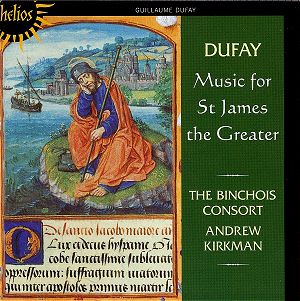
DUFAY (1397–1474) Mass for St. James the Greater [41.08] Rite majorem Jacobum canamus [4.19] Balsamus et munda cera [4.31] Gloria [5.52] Credo [6.50] Apostolo glorioso [3.47] Binchois
Consort/Andrew Kirkman
rec. Rickmansworth Masonic School Chapel, 16-18 July 1997 HYPERION HELIOS CDH55272 [66.53]
The
one surviving copy of Dufay’s complete Mass for St. James
the Greater dates from the late 1420s and was made in
the Veneto. This has lent credence to the idea that the mass
was associated with the Bishop of Vicenza, Pietro Emiliani. Emiliani
paid for pilgrims to go to Compostela, the influential centre
of veneration for the cult of St. James.
On
the other hand, Dufay’s motet Rite Majorem which has
audible stylistic links to the mass, includes an acrostic
on the name of Robert Auclou who was curate at the church
of St. Jacques de la Boucherie in Paris during the 1420s;
the church was a well-known starting-off point for pilgrims.
It is here that links begin to enter the realms of the fanciful.
The communion motet in Dufay’s mass is set using the fauxbourdon technique;
before leaving mass Pilgrims would have their staffs or bourdons blessed,
thus making some commentators suggest a punning link.
In
fact, the whole mass might not have been written for St.
James at all as the only text which refers to the Saint directly
is the Alleluia. Dufay may have written the piece originally
for a different venue, even if it is still associated with
Robert Auclou.
Whatever
its origins, the mass is a remarkable piece written at a
time when complete polyphonic masses were something of a
novelty. Certainly, at the time Dufay was writing it there
were not the sort of standardised procedures for linking
movements familiar to later composers. This means that, on
first hearing, it can sound a little disparate. This is partly
because Dufay sets both the ordinary and the propers and
has tailored each movement to its specific location. But
we can detect him repeating motivic ideas throughout the
mass, suggesting that the work was written as a whole.
This
mass is not part of the group of cantus firmus masses
from later in Dufay’s career and seems to have been little
recorded. Perhaps this is partly because this apparent disparity
between the movements can make the work seem difficult to
bring off.
On
this recording, originally released in 1998 and recently
re-issued on Hyperion, Andrew Kirkman and the Binchois Consort
seem to make light of the work’s difficulties. In Kirkman’s
hands the Mass holds together in a remarkable way, the different
movements contrasting but complementing each other to form
a remarkable 40 minute span of music.
Speeds
seem entirely apposite and it helps that Kirkman and his
singers have an infectious way with Dufay’s rhythms. At a
certain point you stop worrying about the disparate movements
and settle down to enjoy the brilliant musicality of the
performance. The eight singers of the consort all have distinctive
voices, this is no blandly homogenised ensemble; each line
is vividly characterised, but complementary so that the whole
is understandable and richly textured.
I
had great enthusiasm for Kirkman and the Binchois Consort’s
recording of Dufay’s Mass for St. Antony of Padua,
included on another Hyperion reissue. And everything I said
about that performance applies here as well. This is surely
one of those discs to be played to people who perhaps remain
unconvinced about music from this period.
The
associated motet Rite Majorem, includes a text which
details St. James’s life and miracles. It is one of those
complexly organised pieces, with two different texts and
a use of isorhythm. But Dufay turns what could be an icy
academic exercise into a dazzlingly passionate piece which
receives a suitable performance from the consort. Of equal
complexity of organisation is the motet Balsamus et munda
cera, though this is not related to St. James. Unusually,
the first performance of this can be dated accurately to
7 April 1431 as it was written for a particular ritual which
took place in the first year of a Pope’s reign and then every
seven years.
Also
included on the disc are the Gloria and Credo which
use quotations from popular songs in their long Amens. And
there is also Dufay’s extrovert Apostolo glorioso which
concludes the disc in a fittingly brilliant manner.
Robert Hugill
Please support our advertisers below by clicking on the logos for further information.

























 Binchois
Consort/Andrew Kirkman
Binchois
Consort/Andrew Kirkman 
