“Dale has few works to his credit, but practically all of them
have a real permanent value, and, in the path of his choice, he
has certainly achieved remarkable eminence.” Edwin Evans (‘Modern
British Composers. III. Benjamin Dale’, Musical
Times, Vol. 60, No. 915 (May 1, 1919), pg. 201-205).
The
Dutton Epoch label continues to explore British late-Romantic
repertoire with a new disc of Music for Viola by neglected
English composer Benjamin Dale. Two of the scores: the Viola
Sextet and the English Dance are claimed as world
première recordings.
London-born
Benjamin Dale was a pianist as well as a composer who from 1900
studied at the Royal Academy of Music (RAM) under Frederick
Corder. In August 1914, shortly before the outbreak of the First
World War, Dale was holidaying in Germany and together with
fellow composers Frederick Keel and Edgar Bainton was interned
at the Ruhleben civilian detention camp near Berlin for the
duration of the war. Dale taught harmony and later composition
at the RAM from 1909 being appointed to Academy Warden there
in 1936. Between 1919 and 1920 Dale became an examiner for the
Associated Board travelling to Australia and New Zealand. He
served on the BBC Music Advisory Panel from 1936 until his death
in 1943.
Dale
composed a relatively small number of scores but what I have
heard of his output is of high quality. A student work from
1902 the Piano Sonata was taken up by pianists York Bowen
and Myra Hess (both ex-RAM students) although its acclaim was
rather short-lived. Another student work his Concertstück
for Organ and Orchestra from 1904 was popular for a while.
His Suite for Viola and Orchestra won the support of
many including Havergal Brian. The contemplative and predominantly
elegiac Violin Sonata (1922) is a fine score and his
Ballade for violin and piano (1927) was moderately successful
for a time. Dale’s tone poem The Flowing Tide (1943)
was premiered on 6 August 1943 with the BBC Symphony Orchestra
conducted by Adrian Boult. The Flowing Tide (thought
to be its premiere) was broadcast on BBC Radio 3 on 25 April
2002 in a performance by the BBC Symphony Orchestra under conductor
Vernon Handley but has not been commercially recorded.
The
disc opens with the substantial three movement Suite for
Viola and Piano. A first performance, of the first two movements
only, was given at the Aeolian Hall, London in 1906. The players
were the star team of renowned violist Lionel Tertis and the
pianist/composer York Bowen; both ex-RAM students who later
were to become professors there. The first performance of the
complete work was given the next year at Broadwood’s Rooms in
London. The opening Maestoso - Allegretto espressivo
contains music of a rather unsettling quality that explores
the broad range of the viola with the piano part an equal partner.
The central Romance conveys a sense of gazing up at grey
and foreboding clouds. Dale lightens the mood a touch in the
central section but then the intensity increases and the serious
character of the opening section returns. The Romance is
often played as a stand-alone. The technically demanding Allegro,
finale contains rich and vigorous writing that makes
a significant dramatic impact. A calmer and lyrical central
core at 6:48-9:05 gives the duo of Chase and Otaki some welcome
respite. The conclusion to the score is dramatic and highly
entertaining leaving this listener wondering why this excellent
piece is not heard more often.
The
sumptuous Introduction and Andante for Six Violas,
Op.5 is cast in a single continuous movement. More commonly
known as the Viola Sextet this composed in 1911. Its
unusual scoring for six violas came about as it was commissioned
by Lionel Tertis to be played by him and his viola pupils; one
of which was Eric Coates, an RAM student who later achieved
great fame as a composer of light music. According to Frederick
Corder the original title of Dale’s score was A short piece
(Introduction & Andante) for six Violas
(letter from Corder, Musical Times, October 1917). The inclusion
of Introduction and Andante in the title is a rather
curious one as the marking of Andante is never used:
the second section is marked Lento espressione. As for
possible influences Dale would surely have known the earlier
Phantasy (Fantasie) Quartet for four violas,
Op. 41 composed by his friend York Bowen in 1907. In the Viola
Sextet the confident partnership of Chase and Otaki convey
a lavish outpouring of rich, dark colours. This is a dramatic
and powerfully intense score of significant grandeur, a hidden
gem of the English chamber repertoire that deserves to be more
widely known.
The
English Dance from 1916 was one of the scores that Dale
composed whilst interned at the Ruhleben camp. Dale originally
titled the work Country Dance for use as a violin interlude
for a production of Francis Beaumont and John Fletcher’s play
The Knight of the Burning Pestle at Ruhleben. The score
to the English Dance has appeared as a score arranged
for solo piano, violin and piano and for small orchestra; this
arrangement of the English Dance was prepared for viola
and piano by York Bowen. Chase and Otaki adroitly convey a convincingly
boisterous music-hall atmosphere to this entertaining if slight
English Dance.
The
concluding work is the Phantasy for Viola and Piano,
Op.4 that Dale composed in 1910. The score was a commission
by Walter Wilson Cobbett the great champion and benefactor of
British chamber music. It follows Cobbett’s obligatory single
movement ‘Phantasy’ format. The essay in the booklet and back
inlay/page 2 provides two differing sequences of the six sections
for the Phantasy but I was unable to discover which one
was correct. Rather than use the six sections stated in the
booklet notes I have separated the Phantasy into the
following eight contrasting sections:
0:00-1:35
- A doom-laden trudge pervades the introductory section for
solo piano.
1:36-3:08
- Tender and yearning music that is tinged with but not overwhelmed
by a bucolic feel.
3:09-5:10
- A bright and lively section with the character of a country
folk-dance.
5:11-9:23
- This heart-warming slow movement develops an increased yearning
intensity.
9:24-12:16
- Nimble and waspishly rhythmic, this section cultivates additional
weight and force from 11:10-12:16.
12:17-13:40
- A rather languid, sultry feel to the section communicates
a sense of exhaustion.
13:41-16:01
- Scampering music of a restless and robust energy. From around
15:20 one notes a distinctive Hungarian/Gypsy feel to the music.
16:02-19:46
- The music is taken at a crawling pace. One wonders if this
is a moving lament by Dale for the loss of a loved one.
There
are very few discs of Benjamin Dale works currently in the catalogues.
The disc most likely to be encountered is the Complete Works
for Violin and Piano: Sonata in E major, Op.11
(1922); English Dance (1916); Prunella (1917); Holiday
Tune (1922) and Ballade, Op.15 (1926) played
by Lorraine McAslan (violin) and Michael Dussek (piano) recorded
in 2005 at the Henry Wood Hall, London on Dutton Epoch CDLX 7157.
I have another disc titled Heartache: An Anthology of English Viola Music
that includes the Romance movement from the Suite for
viola & piano played by Dame Avril Piston (viola) and
Shamonia Harpa (piano) recorded in 2002 at Potton Hall, Suffolk
on Guild GMCD 7275.
The
impressive violist Roger Chase displays a rich broad tone performing
on the same Montagnana instrument that belonged to Lionel Tertis.
Michiko Otaki provides exemplary support. The duo are sterling
advocates for the music of this neglected English composer playing
throughout with assurance and expression.
This
is an outstandingly performed and recorded disc of richly rewarding
viola scores that deserve to be heard. I enjoyed this recording
from start to finish; undoubtedly one of my Records of the
Year for 2008.
Michael Cookson
























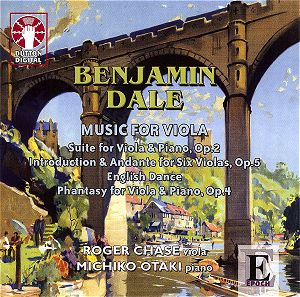

 Roger Chase
(viola); Michiko Otaki (piano); *Hannah Shaw, Fiona
Opie, Thomas Beer, Rumen Cvetkov, Karel Coninx (violas)
Roger Chase
(viola); Michiko Otaki (piano); *Hannah Shaw, Fiona
Opie, Thomas Beer, Rumen Cvetkov, Karel Coninx (violas) 
