Editorial Board
MusicWeb International
Founding Editor Rob Barnett Editor in Chief
John Quinn Contributing Editor Ralph Moore Webmaster
David Barker Postmaster
Jonathan Woolf MusicWeb Founder Len Mullenger
Mary Ellen
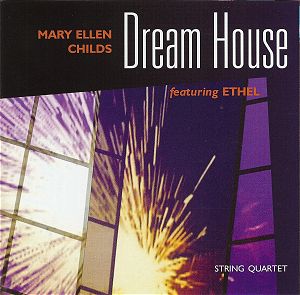
CHILDS (b. 1957) Dream House (2004) [65:13] Ethel (string
quartet), Neverwas (sound collage)
rec. The Clubhouse, Rhinebeck, New York, July 2006. DDD.
Premiere recording. INNOVA 672 [65:13]
Mary Ellen Childs’ Dream
House was originally designed as an evening-length multi-media
piece combining live string quartet with prepared sound collages
and video projections. Childs was inspired by the process
of building a new home, with all the stresses, joys and noises
that entailed. She expanded the piece by offering the mirror
image of demolition and destruction of a house. Video images
of demolition and rebuilding were projected during performances,
while sound collages by Neverwas - the professional name
of Christopher Cunningham - were assembled from the noise
of hammering and construction equipment. The present Innova
CD eschews the video, but preserves the live music and interpolated
collages to impressive effect.
The first movement, “Hocket,” is
stern, questioning music unfolding in the pattern of an obsessive
rhythm. The hocket - each note of the rhythm half the length
of the preceding note - drives the music forward, often with
one instrument holding or repeating a single, focal tone. The
music’s foundations vary between tonal and modal. “Destruction” features
mournful dissonances and glissandos in the strings, which are
gradually overtaken by a montage of ominous building demolition
sounds. The strings retreat to high, mechanical harmonics at
the end of the movement. The following movement, “After Dust,” returns
to the questioning mood of the first movement, but in a more
settled, less severe manner. Childs draws some intense and
expressive phrases out of a minimalist/alt-rock vernacular.
The fourth movement
is “Bass Line,” and as the title suggests, it is a passacaglia,
with variations over a chord progression in the bass. The chords
move slowly, in parallel harmonies, making it sound like Gregorian
chant. But the first variation presents skittish rhythms played
with the wood of the bows alternating and overlapping with
passionate lyrical phrases. The second variation amplifies
the chords into snarling distortion. The following “Chimewerk” is
a sound collage of brightly ringing mechanical noises. “Pizz
Hocket” comes next, featuring plucked strings and a return
to the hocket rhythm, which is never far away throughout the
work. I love the daring of the players in Ethel here. They
strike the pizzicato notes with great force, daring to knock
the instruments out of tune in their pursuit of expression.
“Welding” is an
exhilarating, primarily rhythmic scherzo that serves as a fulcrum
between the work’s halves. The clattering beats are surrounded
by clouds of glittering mechanical noise, courtesy of the interpolated
sound montage. The montage takes over completely for the brief
eighth movement, “Toweling,” featuring the distorted sounds
of sweeping and scraping. “Waiting” offers plaintive music
of forced patience. The uncertainty and active unease which
Childs seems to mine for inspiration gives this movement, and
the whole work, metaphorical resonance that takes it far beyond
the specific. Here the mood is not merely someone waiting on
a house to be built, but anyone waiting on something that may
never come: Dreams, success, survival or whatever one may imagine.
The sound montage “Breath” leads
into “Very High,” a movement full of mysterious high harmonies
that bring on a strange, disembodied feeling. The dream state
coalesces in the affecting emotional peak of the work as the
instruments begin falling down into their lower registers,
leading to “Strum,” the piece’s twelfth movement. While the
music remains in a minor key, the guitar-like groove expresses
relief with a quietly dancing joy. The last big push forward
comes in the thirteenth movement, “Saws,” where minimalist
arpeggios are used like buzz-saws to propel the music forward,
though more lyrical sections begin to appear. The work ends
with “Shavasana,” a quiet, prayer-like piece that hangs between
major and minor, capturing the warmth and the doubt of mixed
keys. It takes its named from the “dead pose” used to both
begin and end yoga sessions. With hopeful uncertainty, the
music fades off into nothingness.
The recorded sound
is close and rich but clear, except where it is intentionally
distorted for aesthetic effect. The sound collages add dense
layers to the sound in places, but Childs wisely varies her
layers of density in the quartet music, allowing for a sense
of space that is captured beautifully in the recording. Despite
lasting over an hour, the music never becomes wearing on the
ears.
This work lives
in the same land that the New York string quartet Ethel has
been exploring in recent years, a frontier where modern classical
and alternative rock meet and mingle. One could note Childs’ apparent
influence on the players in Ethel in some of their own compositions
on the recent album Light, particularly first violinist
Cornelius Dufallo’s “Lighthouse.” Like that album, Dream
House strikes a balance between accessibility and challenge,
sounding utterly of its time without having an expiration date
stamped on its side. This is music that has potential appeal
for both the open-minded classical listener and the rock music
fan who enjoys the daring edge. If this sort of thing keeps
up, modern classical music could become — dare I say it? — relevant
to more than just a handful of aficionados.
Mark Sebastian Jordan
Please support our advertisers below by clicking on the logos for further information.

























 Ethel (string
quartet), Neverwas (sound collage)
Ethel (string
quartet), Neverwas (sound collage) 
