Editorial Board
MusicWeb International
Founding Editor Rob Barnett Editor in Chief
John Quinn Contributing Editor Ralph Moore Webmaster
David Barker Postmaster
Jonathan Woolf MusicWeb Founder Len Mullenger
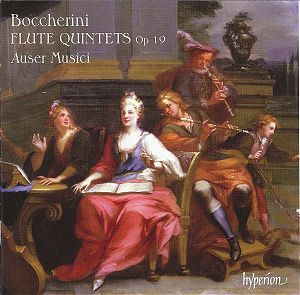
Luigi BOCCHERINI (1743-1805) Flute Quintets Op. 19
Quintet No. 1 in E flat (G 425) [10:14]
Quintet No. 2 in g minor (G 426) [11:35]
Quintet No. 3 in C (G 427) [14:01]
Quintet No. 4 in D (G 428) [09:53]
Quintet No. 5 in B flat (G 429) [11:31]
Quintet No. 6 in D 'Las Parejas' (G 430) [11:45] Auser Musici:
(Carlo Ipata (transverse flute), Luca Ronconi, Francesco
La Bruna (violin), Teresa Ceccato (viola), Luigi
Puxeddu (cello))
rec. March-April 2007, Oratorio di S. Domenico, Pisa, Italy.
DDD HYPERION CDA67646 [69:09]
In the 18th century there were several reasons for composers
to write music. Most were at the service of a church or a court,
and
delivered what was expected of them. But sometimes they wrote
music for specific individuals, for instance a musician who
was a virtuoso on his instrument. Some composers were virtuosos
themselves, and they composed music to play during private
or public concerts. Luigi Boccherini's oeuvre reflects all
these permutations.
Since 1770 he was at the service of Don Luis, Infante of Spain and
brother of King Carlos III. He was an avid and apparently
accomplished player of the cello which explains the large
production of quintets with two cello parts - the first and
most demanding cello part to be played by Boccherini himself.
In the years 1773 and 1774 Boccherini wrote three collections
of chamber music with parts for the transverse flute. It
is not known why exactly he did so, but it is very likely
there was an accomplished flautist at the Infante's court
at the time. The role of the flute is different in these
collections. The Divertimenti op. 16, for instance, were
called divertimentos for two violins, flute obbligato, viola,
two cellos (again!) and double bass (three of these divertimenti
have been recorded by Piccolo Concerto Wien - Symphonia SY
01188). In the quintets recorded by Auser Musici the flute
plays a more prominent role, but not as much as in most chamber
music pieces for flute and strings by Boccherini's contemporaries.
Remarkable is the role of the cello: in two movements, the
first of the quintets 3 and 4, it plays a very prominent
role. In these movements cello and flute are involved in
a dialogue which puts the other instruments at the sideline.
Five of the six quintets are in two movements, fast - fast, slow (or
moderate) - fast or fast - faster. This puts these quintets
in the realm of the divertimento: most divertimento-like
compositions of the second half of the 18th century were
in two movements. This had also a very prosaic reason: pieces
like this were relatively cheap and therefore commercially
more interesting than longer works. As Marco Mangani writes
in the booklet: "As disappointing as it may be to champions
of art as a mission, that was the way Boccherini and his
contemporaries treated the matter". The idea of 'l'art
pour l'art' (art for art's sake) was still very far away.
The fact that these pieces are divertimentos doesn't make them easy
to play. As already indicated two of the quintets contain
sophisticated cello parts, and there can be hardly any doubt
that these were to be played by Boccherini himself. But also
in content these quintets are more than just easy-listening
stuff. The first movement of the Quintet No. 2 is pretty
dramatic, and the opening movements of the Quintets 3 and
4 contain a lot of expression.
The last quintets also have something special to offer. The Quintet
No. 5 ends with a brilliant and exciting presto assai. The
Quintet No. 6 is the only one with three movements, and has
a descriptive character, like the famous 'Musica notturna
di Madrid'. The title is 'Las Parejas', which means 'the
couples'. The first movement is called 'Entrada - Marcia'
(entrance - march), the second 'Galope' (gallop), which is
followed by a repeat of the first movement. "The title
refers to a typical Spanish horse race, in which two horsemen
run hand in hand". The way Boccherini has set this scene
has almost orchestral traits, and one can only admire the
vivid picture he is painting here with music.
The players apparently immensely enjoy this piece, as it is played
with panache and fantasy. But the other quintets are realised
just as well. The flautist Carlo Ipata plays his part with
technical assurance and great feeling for the character of
the music, sometimes delicate and almost tender, like in
the first movement of the fourth quintet, sometimes firm,
like in the last movement of Quintet No. 5. The cellist Luigi
Puxeddu is excellent in dealing with the intricacy of his
part. The ensemble as a whole has provided a very enjoyable
recording of these fine quintets which shows how exciting
diverting music can be if composed by a master like Luigi
Boccherini and played by such an excellent ensemble as Auser
Musici.
Johan
van Veen
Please support our advertisers below by clicking on the logos for further information.

























 Auser Musici:
(Carlo Ipata (transverse flute), Luca Ronconi, Francesco
La Bruna (violin), Teresa Ceccato (viola), Luigi
Puxeddu (cello))
Auser Musici:
(Carlo Ipata (transverse flute), Luca Ronconi, Francesco
La Bruna (violin), Teresa Ceccato (viola), Luigi
Puxeddu (cello)) 
