Editorial Board
MusicWeb International
Founding Editor Rob Barnett Editor in Chief
John Quinn Contributing Editor Ralph Moore Webmaster
David Barker Postmaster
Jonathan Woolf MusicWeb Founder Len Mullenger
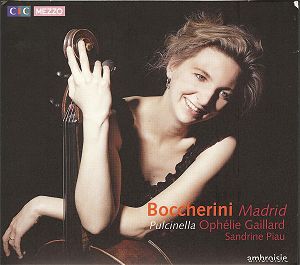
Luigi BOCCHERINI (1743-1805) Madrid
CD
Quintet for guitar, 2 violins, viola and cello in D (G 448): Fandango [14:35]
Concerto for cello and orchestra in D (G 483) [20:32] Se d'un amor tiranno, aria accademica for soprano,
cello and orchestra (G 557) [14:29]
Concerto for cello, strings and bc in G (G 480) [17:06] Ophélie
Gaillard (cello), Sandrine
Piau (soprano), Rolf Lislevand
(guitar), Luz Martin León Tello (castanets), David Mayoral
(percussion), Maude Gratton (fortepiano); Pulcinella
rec. January 2007, Théâtre de Poissy and April 2007 at the
Temple Notre-Dane du Bon-Secours, Paris, France. DDD
Bonus DVD:
2 documentaries on Boccherini's music, with commentaries
by Ophélie Gaillard AMBROISIE AM126 [CD:
66:55; DVD: 47:00]
The French cellist Ophélie Gaillard is a great admirer of Luigi
Boccherini. She writes about her passion in the form of an interview
in the booklet and talks about it on the DVD. She planned
a project with his music, and invited some musicians to join
her. Some of these artists were Spanish and are close to
the culture which unmistakably influenced Boccherini's music.
The result is the present disc which contains two specimens
from a genre for which he is famous - the cello concerto.
There’s also an aria which is part of a much neglected side
of Boccherini: the composer of vocal music. The disc opens
with what is probably - apart from the menuet - Boccherini's
most famous piece: the Fandango.
There can't be enough praise for a musician who is willing to explore
the music of Boccherini, who is still at the sidelines of
today's concert life, and wants to share her enthusiasm for
his music. But being a lover of Boccherini's music I am not
very impressed with the results of Ms Gaillard's efforts.
In a way it is understandable that a disc which aims to present a
musical portrait of Boccherini starts with the Fandango.
At the same time this piece is so often played that one wonders
if it is really doing Boccherini a favour by recording it
once again. It has to be said that this piece is not only
often played, but also frequently mistreated. That is also
the case here, not as severely as happens sometimes, but
nevertheless I believe that the scoring in this recording
is off the mark. The Fandango is the last movement of a quintet
for guitar and strings; in the Fandango Boccherini adds castanets.
Here two guitars are playing, with additional percussion.
I can't see any reason for that, in particular as Ms Gaillard
in one of the documentaries on the DVD says that the strings
try to imitate the percussion now and then. Then why add
percussion? Moreover, towards the end a kind of improvisation
of the two guitars and the percussion is inserted. I find
this rather odd, and what is worse, the excitement which
has built up during the performance just ebbs away.
The main part of this disc is devoted to cello concertos. It is disappointing
that Ms Gaillard has chosen two of Boccherini's best-known
cello concertos. This disc would have been a worthwhile addition
to the catalogue if some lesser-known concertos had been
recorded. The performances are questionable in several ways.
Firstly, Ms Gaillard has chosen to perform them with one
instrument per part. That seems a rather strange decision.
These cello concertos are specimens of the classical solo
concerto, in which the soloist is not 'primus inter pares'
any more, as in the baroque concerto. In this scoring the
concerto in G is almost reduced to a string quintet. In the
booklet Ms Gaillard says a performance with one instrument
per part "redefines the balance between soloists and
orchestra and between wind and strings". That is certainly
true, but here it doesn't do Boccherini's music any favours.
In the Concerto in G, where the tutti consists of strings
only, the solo part isn't as prominent as it should be. And
in a concerto with wind, like the Concerto in D, it is perfectly
possible to make the wind audible, without reducing the strings
to one instrument per part. Here the wind even threaten to
overshadow the strings.
Another debatable decision is the use of a fortepiano in the basso
continuo section. That is defensible in the case of the Concerto
in D, which dates from about 1782, but hardly in regard to
the Concerto in G, which was composed in 1770. At that time
the harpsichord was still the dominant keyboard instrument.
But apart from all this I find the performances not very captivating,
even a bit flat. That is partly due to the tempos, which
are generally a little slow, in particular the fast movements
but also the andante lentarello of the Concerto in
D. Ms Gaillard rightly adds cadenzas in every movement. When
I heard them I found them too long, but I gather from Ms
Gaillard's remarks in the booklet that she uses Boccherini's
own cadenza in the second movement of the Concerto in D,
which is indeed pretty long. So maybe she is right in taking
her time to play the cadenzas. Ms Gaillard imitates percussion
towards the end of the cadenza in the last movement of the
Concerto in G. Again I think she is wrong here: Boccherini's
music contains influences of folk music, therefore in my
view interpreters should not add some of their own. It is
especially out of place in the cello concertos which contain
few traces of folk music anyway.
The strings use somewhat more vibrato than seems historically justified.
Ophélie Gaillard's playing isn't bad at all, but the likes
of Anner Bijlsma and Ivan Monighetti are definitely better
in their respective recordings of Boccherini’s cello concertos.
The most interesting part of this disc is the aria for soprano, cello
and orchestra. Boccherini's vocal music is largely neglected – with
the exception of his setting of the Stabat mater – but
he composed a fair number of vocal pieces, among them more
than ten solo arias. The voice and the cello are equals and
it is certainly right that after the cadenza of the soprano
in the da capo the cello adds a cadenza of its own.
This aria is anything but a ditty and requires a skilled
singer. Sandrine Piau certainly is that, and she sings the
aria quite beautifully. But I am surprised to read in the
booklet that the da capo and the cadenzas for Ms Piau
were prepared by the player of the fortepiano, Maude Gratton.
In the 18th century singers were supposed to invent their
own material for such occasions, and I don't understand why
Ms Piau, with her vast experience in singing 18th-century
operas, was not able to or not allowed to come up with her
own ornamentation and cadenzas. I enjoyed Ms Gaillard's playing
best in this aria. Maybe the singing of Sandrine Piau inspired
her. In the documentary on the DVD she compares Boccherini's
aria with the concert arias by Mozart. It is certainly true
that Boccherini's arias deserve more attention, and that
there is no reason why they shouldn't become standard repertoire
for the sopranos of our time.
The DVD contains two documentaries. In the first Ophélie Gaillard
talks about Boccherini and gives her perspective on his music.
That is interesting but could easily have been written down
in the booklet. Instead I would have liked to see something
more biographical about Boccherini, about the places where
worked and the cultural environment which influenced him.
After all, of the great composers of the classical era he
is the least well-known. The second documentary shows the
recording of the Fandango. It's nice to watch once, but adds
little to our knowledge of the composer or of this particular
project. From that perspective the DVD is a kind of missed
opportunity. The language is French, with English subtitles.
These are clear to read, and seem pretty reliable. Only in
the recording session some remarks by the players are not
translated. I don't know if there was any specific reason
for that ...
To sum up: an interesting project which falls short of the expectations.
Johan
van Veen
Please support our advertisers below by clicking on the logos for further information.

























 Ophélie
Gaillard (cello), Sandrine
Piau (soprano), Rolf Lislevand
(guitar), Luz Martin León Tello (castanets), David Mayoral
(percussion), Maude Gratton (fortepiano); Pulcinella
Ophélie
Gaillard (cello), Sandrine
Piau (soprano), Rolf Lislevand
(guitar), Luz Martin León Tello (castanets), David Mayoral
(percussion), Maude Gratton (fortepiano); Pulcinella 
