Editorial Board
MusicWeb International
Founding Editor Rob Barnett Editor in Chief
John Quinn Contributing Editor Ralph Moore Webmaster
David Barker Postmaster
Jonathan Woolf MusicWeb Founder Len Mullenger
Vincenzo
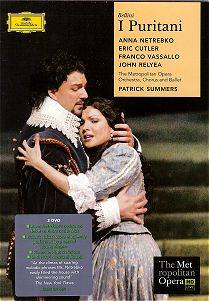
BELLINI (1801-1835) I Puritani - opera in three acts (1835) Gualtiero Walton,
Puritan Governor General and Elvira’s father -
Valerian Ruminski (bass); Elvira, his daughter - Anna Netrebko (soprano);
Arturo, a Cavalier and supporter of the Stuarts in love with Elvira
- Eric Cutler (tenor); Riccardo, a Puritan officer who has been promised
the hand of Elvira - Franco Vassallo (baritone); Giorgio, a retired
Puritan colonel and elder brother of Lord Walton - John Relyea (bass);
Bruno, a Puritan officer - Eduardo Valdes (tenor); Enrichetta, widow
of the executed Charles the first - Maria Zifchal (soprano)
Metropolitan Opera Orchestra, Chorus and Ballet/Patrick Summers
Production: Sandro Sequi. Set design: Ming Cho Lee. Costume
design: Peter J Hall
rec. live, 6 January 2007; 1976 production.
Filmed in 16:9 High Definition; Colour; Sound formats: PCM
Stereo, DTS 5.1.
Subtitles in Italian (original language), English, German,
French, Spanish. Notes and synopsis in English, German, French DEUTSCHE
GRAMMOPHON 0734421 [2
DVDs: 149:00 + 22:00]
In
the spring of 1833 Bellini’s ninth opera, Beatrice di
Tenda, (see review)
was presented at Venice’s La Fenice. It was not a success.
During its composition Bellini had quarrelled with Romani
his librettist and long-time friend, even mentor. At about
the same time, back in Milan, the husband of Giuditta Cantu,
his mistress, discovered some letters that left no doubt
about the nature of the relationship of his wife with the
handsome composer. A scandal followed and the husband and
wife separated. Bellini had earlier accepted an offer from
the King’s Theatre in London to present several of his operas.
Turning his back on Giuditta Cantu he left for England. His
operas were successful in London where he met and was infatuated,
or even more, with Maria Malibran.
Despite
the success of his operas in London, no new commissions were
forthcoming, and Bellini decamped to Paris, the musical capital
of Europe. His earlier operas had preceded him and he was
welcome in every salon, and particularly that of Madame Joubert.
Bellini hoped for a commission from the Opéra, having made
contact with its director, Veron, on his way to London. When
no commission arrived, Bellini accepted one from the Théâtre Italien where his Il Pirata and I
Capuleti e I Montecchi had been favourably received by
audiences if not by critics. Having fallen out with Romani,
Bellini looked around for a new collaborator. His choice
fell on Count Carlo Pepoli, an Italian political radical
in exile in France whom the composer had met at a salon of
like-minded fellow Italians.
Following
the custom of the time composer and poet decided to adapt
a recently successful play as the basis of the new opera.
They chose the historical drama by Ancelot and Boniface based
on the English Civil War in the period after the execution
of Charles I. By using this story, composer and librettist
also sought to exploit the European infatuation with Sir
Walter Scott’s works and at one stage called the opera I
puritani di Scozia, the title of an Italian translation
of the novelist’s Old Mortality. Count Pepoli was
no Romani and he and Bellini had many disagreements in the
course of the construction of the libretto with Bellini seeking
advice from Rossini as well as depending on what he had learned
working with Romani as well as his own theatrical experience.
The
action of the story takes place in Plymouth after the massive
defeat of Charles I at the hands of the Puritans, his execution,
and the defeat of the Cavalier rebellion. The Puritan governor,
Lord Valton, has agreed to the marriage of his daughter Elvira
to Lord Arturo Talbot, a Cavalier, after persuasion by her
uncle Giorgio and despite having originally promised her
hand to Riccardo Forth, a captain in his Puritan army. Valton
explains that he cannot attend the ceremony, as he is to
take a prisoner to London to stand trial. Arturo recognises
the prisoner as Enrichetta, widow of the executed king. To
save her from certain death he smuggles her out of the castle
in Elvira’s bridal veil, passing her off as his wife. Elvira
assumes she has been betrayed and loses her reason. Giorgio
implores Riccardo to save Arturo from death otherwise Elvira
will die of grief. He reluctantly does so. Arturo returns
to the castle and explains his sudden disappearance to Elvira
who, after more mental anguish as she worries that Arturo
will desert her again or be executed, is finally convinced
and restored to reason. Cromwell, who has defeated all the
Royalists, declares an amnesty that allows the marriage of
Arturo and Elvira to go ahead
With
a dream cast of Giulia Pasta as Elvira, Rubini in the high-lying
tenor role of Arturo along with the famed baritone and bass
Tamburini and Lablache, Bellini’s long melodic lines and
mad scenes made I Puritani an outstanding success
from the first night. The opera was performed seventeen further
times in the Paris season before travelling first to London
and then throughout Europe. Fellow Neapolitan Queen Maria
Amelia received Bellini and he was awarded the Légion d’Honneur.
Somewhat fragile in health at the best of times, and after
the tensions of the production, Bellini returned to stay
with his Parisian hosts and planned additions to I Puritani for
an Italian production with Malibran. He suffered a recurrence
of the gastric problems from which chronic condition he had
ailed for some time. Despite the attentions of Princess Belgoioso’s
personal physician, Bellini died on 23 September.
Unlike
his contemporaries Bellini did not compose at speed. In his
brief life he had composed a mere ten operas finding greatest
fame with Norma, at least after its disastrous first
night. Like I Puritani it is characterised by long
and flowing melodic lines with one section blending nearly
imperceptibly into another. It was a technique that even
Verdi did not either emulate or achieve until late in his
compositional career.
Although
the quartet of the premiere went to London and was performed
there, becoming known as The Puritani Quartet, the
focus of the opera is the soprano singing Elvira. It is an
ideal vehicle for a singing actress with coloratura facility.
When Anna Netrebko, being the lady of the moment at many
of the best operatic addresses, decided to dip her elegant
toes deeper into the highly testing waters of bel canto opera,
she did so in New York with this I Puritani. This
was a very brave step. The city saw Joan Sutherland at the
height of her powers, in the role of Elvira alongside Pavarotti
in 1976. The city is also the home town of the late Beverly
Sills whose performances of the Donizetti Tudor Queens and
Bellini’s Elvira are still held in fond memory by many New
Yorkers. Having made her choice, the Met wheeled out the
1976 set for her, with some new costumes it is rumoured.
The set is opulent and some may consider it dated with backdrops
of castles and a large central staircase. In reality, both
the set and costumes are appropriate to the period, although
I thought the colourful costumes of the ladies rather non-Puritan.
There is no need to search for some hidden message or political
concept. Bellini would have recognised his opera - no little
plus point these days where works about civil wars and involving
religion often seem perverted for the sake of variety and
producer egos, leaving audiences struggling and empty seats.
Well,
as the saying goes: if you’ve got it flaunt it. Netrebko
has perhaps the most appealing stage presence among contemporary
sopranos. She is a natural stage animal who can sing as she
moves around the stage and interacts with her colleagues.
Her sheer physicality on stage is awesome. This skill is
well illustrated in her hyper-active Salzburg Violetta (see review).
I have heard she did some training as an acrobat and she
certainly moves her trim figure with the lithesome quality
of an athlete. At one point in Elvira’s mad scene she sings
with her head hanging over the orchestra pit (Disc 2 Ch.
4). This was, it seems, Netrebko’s own suggestion and is
frankly a bit over the top. It became a talking point and
in my view it detracts from the many virtues of her well
sung and acted performance. In that scene, when she sings
those vocal tours de forces, O rendetemi la speme … Qui
la voce, Netrebko first descends the stairs before whirling
then twisting and laughing hysterically in Elvira’s madness.
She varies the colour of her voice consummately, singing
with pliancy, plaintively and with mezza voce tone
when appropriate. Add excellent diction, vocal characterisation,
heft and secure top notes and Netrebko shows herself worthy
of the role and to be named alongside her illustrious twentieth
century predecessors including Callas (see review).
Not all is absolute vocal perfection in Netrebko’s interpretation.
Her coloratura isn’t in the Sutherland or Sills class. In Son
Vergin vezzosa (Disc 1 Ch.14) she smudges the coloratura
and at the conclusion of the duet Qual suon desta? (Disc
1 Ch. 9) with Giorgio she cuts the final note a little short.
However, for me her overall diction and variation in vocal
colour and involved total acting more than compensates. No
wonder there was rave applause from the Met audience at the
end of the mad scene. Thankfully she did not break role.
As
I have indicated, I Puritani demands four major voices.
Regrettably the baritone Franco Vassallo’s Riccardo was a
dull dog vocally and as an actor. His tone was lacking in
variety of colour and vocal vitality in his opening recitative
and aria Or dove fuggo … Ah! per sempre io te perdi (Disc
1 Chs. 5-6). Fortunately he did come a little more alive
in the famous duet of the final scene of act two, Il raval
salvar … Riccardo1 Riccardo (Disc 2 Chs.6-7) when Giorgio
presses Riccardo to save his rival from the scaffold as the
latter’s death would also mean that of Elvira. As Giorgio,
John Relyea, imposing of stature and a good actor, sang with
steady tone throughout. Whilst not erasing memories of Sam
Ramey or having his even vocal sonority, Relyea is steadier
and more tuneful than the often woolly-toned Paul Plishka
who seems now to only sing the comprimario roles with the
company.
More
important than the lower male voices is that of the tenor
singing the role of the Royalist Arturo, who sacrifices his
marriage to Elvira to save the Queen from certain death.
With the renowned Rubini in the cast for the premiere, Bellini
let the high notes multiply. In the storm music and Arturo’s
serenade to Elvira and their following duet, high Cs and
D proliferate for the tenor (Disc 2 Chs.9-12) and despite
the earlier demands on him Eric Cutler copes with pinging
notes and acted aplomb; no mean feat. Comparisons are odious,
but Cutler’s singing and capacity to vary tone and inflect
a phrase with elegance and nuance reminded me of the young
Alfredo Kraus. I would not suggest he is at the standard
of the late Canarian just yet, but his tall presence and
the grace in his acting give me hope. He wisely avoided any
ugly effort at the high F in Credeasi, misera, the
note where Pavarotti does a semi-falsetto or croon on the
Decca audio recording with Sutherland (417 588-2), by a downward
transposition (Disc 2 Ch. 14). Has any tenor since Rubini
managed this note from the head with ease and beauty?
The
orchestral side of the proceedings are more than capably
handled by Patrick Summers who had a natural feel for Bellinian
cantilena. Those wonderful simple flowing melodies that are
the hallmark of Bellini’s operas are lovingly attended to
and receive their full due. In the intervals another reigning
diva of the Met, Renée Fleming, conducts interviews with
Netrebko (DVD 1 Ch.19, DVD 2 Ch.8) and on the Bonus with
Beverly Sills. There are also some intriguing shots of scene-shifting
and an interview with the stage manager. The picture quality
is of a high standard although the video director has the
habit of shooting from below, perhaps from a camera in the
orchestra pit. This has the outcome of making tall men look
elongated.
The
only current DVD alternative is the performance featuring
Edita Gruberova in Andrei Surban’s 1982 production for Welsh
National Opera. This production with its sparse representational
sets saw life in many theatres before this recording from
the Liceu in Barcelona. I saw it a couple of times when still
on the stocks of WNO, simply to experience bel canto in
the theatre not for any particular enlightenment it brings
to the plot or support for Bellini’s melodic lines. My colleague,
Ray Walker saw the production at Covent Garden in the 1992
Covent Garden season with a star-studded cast which included
June Anderson, Robert Lloyd, Giuseppe Sabbatini and Dimitri
Hvorostovsky. He finds more in the DVD performance than
I do (see review).
In the meantime I believe this Met recording sets the benchmark
higher.
Robert J Farr
Please support our advertisers below by clicking on the logos for further information.

























 Gualtiero Walton,
Puritan Governor General and Elvira’s father -
Valerian Ruminski (bass); Elvira, his daughter - Anna Netrebko (soprano);
Arturo, a Cavalier and supporter of the Stuarts in love with Elvira
- Eric Cutler (tenor); Riccardo, a Puritan officer who has been promised
the hand of Elvira - Franco Vassallo (baritone); Giorgio, a retired
Puritan colonel and elder brother of Lord Walton - John Relyea (bass);
Bruno, a Puritan officer - Eduardo Valdes (tenor); Enrichetta, widow
of the executed Charles the first - Maria Zifchal (soprano)
Gualtiero Walton,
Puritan Governor General and Elvira’s father -
Valerian Ruminski (bass); Elvira, his daughter - Anna Netrebko (soprano);
Arturo, a Cavalier and supporter of the Stuarts in love with Elvira
- Eric Cutler (tenor); Riccardo, a Puritan officer who has been promised
the hand of Elvira - Franco Vassallo (baritone); Giorgio, a retired
Puritan colonel and elder brother of Lord Walton - John Relyea (bass);
Bruno, a Puritan officer - Eduardo Valdes (tenor); Enrichetta, widow
of the executed Charles the first - Maria Zifchal (soprano)  [2
DVDs: 149:00 + 22:00]
[2
DVDs: 149:00 + 22:00] 
