This
is the fourth instalment of Vänskä’s Beethoven cycle. He
treats the introduction of the first movement of Symphony
1 in benign, airy fashion, with a sense of opening out in
those three sequences of chords at the outset, rather than
tensing to resolve. The following graceful line from violins,
oboes and clarinets is carefully marked. The Allegro is
lightly articulated by the strings; the woodwind and brass
are sufficiently sonorous to add impetus. The cheery second
theme (tr. 1 2:01) has more momentum and a chamber-like,
deft exchange of strings and woodwind while the exposition
codetta (2:42) is kept sheeny. The development (4:58) has
stimulating fp chords circled by light strings’ tracery
and its ff passages appear only mock stern. Vänskä’s
approach then is fundamentally light and smooth but not lacking
in verve either, as in the ff recapitulation, though
the timpani could be more prominent in the closing bars.
This is Beethoven honouring Haydn yet also introducing his
own personality.
Vänskä’s
slow movement begins with a touch of mystery but above all
grace and a lilt. The second theme (tr. 2 0:49) is consistently
light, dainty and winsome. In the exposition the passages
designated forte are a touch firmer rather than really
loud but come the development (3:55), after energizing sfps,
they are more marked. The added counterpoint in the recapitulation
is made delectably clear without detriment to the overall
mood.
The
Minuet is treated more purposefully by Vänskä yet remains
measured enough to retain a vein of urbanity while the wind
sonorities are well displayed. It’s as if Vänskä is acknowledging
Beethoven titling it minuet though in rhythmic drive it’s
a scherzo. The Trio is a marvel. For most of the time there
is a shimmering haze of contented glowing wind and fluttering
violins’ tracery. Late on and suddenly it switches seamlessly
to the Minuet’s decisive manner.
Vänskä gives
us an imposing yet teasing finale introduction before a smiling,
frisky Allegro. This is, however, differentiated from
the first movement in having more bounce and resilience,
yet with a second theme (tr. 4 1:05) which brings
back the lilt and grace of the slow movement. Vänskä achieves
a good blend of spirit and charm underpinned by sensitive
dynamic shading. The coda (4:43) is bracingly forthright.
I
compared the most recent recording to appear in surround
sound, the London Symphony Orchestra/Bernard Haitink recorded
live in 2006 (LSO Live LSO 0590). Here are the comparative
timings:
| Timings |
I |
II |
III |
IV |
Total |
| Vänskä |
8:32 |
7:49 |
3:35 |
5:38 |
25:51 |
| Haitink |
9:40 |
6:51 |
3:19 |
5:45 |
25:35 |
The
steadier pace of Haitink’s first movement makes for more
formality than Vänskä’s. The latter simply has more joie
de vivre: his violins’ tremolandi are more exhilarating
and there’s a delight about the interchange between instruments
that eludes Haitink. Vänskä gives us Beethoven as a young
man with spirit. Haitink’s faster slow movement presses forward
humorously yet without Vänskä’s charm and substance which
comes from fine melodic shaping and a sense of due weight
and proportion. Haitink’s Minuet is livelier, in pace and
dynamics fully fledged - later Beethoven barnstorming. Even
in the Trio the violins remain edgy. Vänskä’s steadier pulse
is more dance-like. The Trio’s early delicate violins offer
more contrast, with the second strain transformation thereby
more surprising and effective. Haitink’s finale delightfully
combines grace, with very nifty string articulation, and
the grand manner. Vänskä brings more humour to the introduction
and development. He points up the orchestration more, while
taking a more refined, less rumbustious view of the louder
material. Vänskä’s acceptance of the work’s smiling, youthful
nature makes for a more engaging performance while Haitink
provides clearer glimpses of later Beethoven.
How
do you like to experience the Pastoral symphony?
If you favour a benign, stylishly manicured environment
Vänskä is
your man. I’ll quote the authentic Beethoven headings for
the movements. These Barry Cooper supplies in his booklet
note. Vänskä’s first movement, ‘Pleasant, cheerful feelings
which awaken in people on arrival in the country’, steals
on the ear in a beguiling combination of relaxation yet
also momentum. The first tutti has a warm density.
The second theme (tr. 5 1:13) is lightly articulated but
its
two simultaneous elements, the smoothly falling melody
in the first violins and doggedly rising one in the cellos,
are beautifully balanced. A similar equipoise comes when
the chief motif of the development in the violins is matched
with sustained chords from clarinets, bassoons and horns
from 5:06. Yet Vänskä’s dynamic shaping is firm so that when
loud passages occur they are suitably climactic and compelling.
His attention to shape and contour and revealing of Beethoven’s
texture and musical strategy is superlative. The overall
effect is of wonderful finesse and clarity, but is this enough
for you? For me, the ‘feelings’ seem a little too distanced.
Again I compared the London Symphony Orchestra/Bernard
Haitink, this symphony recorded live in 2005 (LSO Live
LSO 0582).
Here are the comparative timings
| Timings |
I |
II |
III |
IV |
V |
Total |
| Vänskä |
11:26 |
11:58 |
5:13 |
3:38 |
9:03 |
41:36 |
| Haitink |
11:39 |
11:48 |
4:58 |
3:31 |
9:36 |
41:32 |
Haitink’s
first movement, though marginally slower, is more bracing
and rustic; rougher hewn if you like but with a more heady
joyousness about it. Where Vänskä’s first violins’ skipping
passage just before the second theme dances demurely Haitink’s
has more character, even cheekiness. Haitink’s second theme
is more affectionate and warm. His development has more natural
energy and zest.
In
appreciably fusing all the elements of ‘Scene by the brook’ Vänskä makes
clear the rippling pulse while all around is sultry, basking,
appreciative. Together this creates an active serenity. The
tender, winsome second theme (tr. 6 2:56) is exquisitely
balanced between bassoon, violas and solo cello across which
the second violins flutter delicate trills. In this movement
Haitink has a little more momentum, is more freshly direct
and blithe. Vänskä is more tranquil with something of a state
of reverie.
Vänskä’s ‘Merry
gathering of the country folk’ is cheery, excited yet precise
with a ‘Trio’ (tr. 7 0:58) of agile soloists before a country
dance (1:42) of more gusto, terminated by a fruity pause
on the trumpet, as marked. Haitink provides even more pace
and pep, to more racy effect where Vänskä generally emphasises
deftness of articulation, more like a fantasy whirl than
vivid rusticity. Vänskä’s ‘Thunder Storm’ begins with creepily
soft foreboding. Its power and the first appearance of trombones,
timpani and piccolo make their mark, though Vänskä still
seems to retain a touch of classical restraint, with Haitink’s
timpani having more shattering impact.
Vänskä’s ‘Shepherds’ song: ‘beneficent
feelings combined with thanks to the Godhead after the storm’ starts
in soft and saintly fashion. It soon acquires a rounded density
of orchestral involvement and fine detail like that of a
congregation with a sense of purposeful progression. To give
one example of this: very satisfying multi-layering revealed,
the sudden clarity (from tr. 9, 4:01) of a gentle, hardly
moving tune in the inner texture in the violas between first
violins’ arabesques and cellos’
pizzicato. Vänskä finds
an air of joyful celebration in this finale which has an
engaging homeliness as well as fervour. He doesn’t forget
that these are shepherds singing. That said, Haitink’s
tutti have
more fervour and excitement of affirmation. There again Vänskä’s
main theme is more tender.
To sum up, Vänskä’s approach remains consistent
with that I noted in his SACD of symphonies 3 and 8 (see
review).
The distinguishing characteristics are highly cultivated
playing and fidelity to Beethoven’s dynamic markings. The
surround sound is luxuriant, cushioned. The resultant emphasis
on the polished and urbane aspects of Beethoven works better
in the first symphony than the
Pastoral. For me the
comparison with Haitink reveals that there can be, for all
its generally sunny disposition, more excitement in the
Pastoral, more
inner fire, than Vänskä expresses. But the sheer quality
of the Minnesota Orchestra’s playing and the detail that
Vänskä reveals nevertheless make this SACD a very rewarding
experience.
Michael
Greenhalgh
























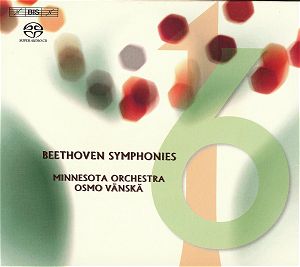

 Minnesota Orchestra/Osmo Vänskä
  [68:22]
