Editorial Board
MusicWeb International
Founding Editor Rob Barnett Editor in Chief
John Quinn Contributing Editor Ralph Moore Webmaster
David Barker Postmaster
Jonathan Woolf MusicWeb Founder Len Mullenger
Arnold
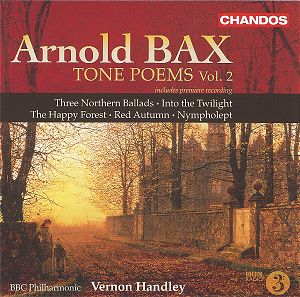
BAX (1883-1953) Tone Poems - Volume 2 First Northern Ballad (ded. Basil Cameron) (1927, orch. 1931)
[9:59] Second Northern Ballad (ded. Adam Carse) (orch. 1933-34) [14:02] Prelude for a Solemn Occasion (Third Northern Ballad) (1927,
orch. 1933) [8:16] Nympholept - Nature Poem for Orchestra (ded. Constant
Lambert) (1912, orch. 1915) [15:23] Red Autumn (orch. Graham Parlett, 2006) (1912) [5:03] The Happy Forest (Nature Poem, ded. Eugene Goossens)
(1914, orch. 1922) [9:42] Into the Twilight ('Eire' No. 1 - after the poem of
the same name by W.B. Yeats) (1908) [13:22] BBC Philharmonic
Orchestra/Vernon Handley
rec. Studio 7, New Broadcasting House, Manchester, 20 November
2007 (Happy Forest); 20-21 December 2006 (others). DDD CHANDOS
CHAN10446 [76:44]
Three Bax triples are presented on
this disc: one is incomplete; one
speculatively assembled and one exists
by virtue of a certain generalised
shared mood.
The incomplete ‘three’ is the
Eire trilogy - not that the other works do not exist; it's
just that Into the Twilight - or Twiglet as
one wag insists - is the only representative here. In fact
it is the first of the trilogy and is succeeded by In
the Faery Hills(CHAN10362) and Roscatha (CHAN10157X).
Bax unequivocally intended those works as a trilogy and gave
the grouping a name: Eire. More contentious is the
designation of the triple sequence of Northern Ballads.
The ‘glue’ is their common vintage and similar style. The
first two works were called by Bax ‘Northern Ballad’. The
Third is actually titled Prelude for a Solemn Occasion but
the short score is headed simply 'III'. Beyond that nothing;
Never mind terminology though all these episodes are enjoyable.
This is the first time they have been grouped sequentially
on a commercial CD although each has been recorded separately
before. Handley has played these before in this sequence
with the BBC Concert Orchestra and they were broadcast as
such in the 1990s. The final three are Nympholept, Red
Autumn and The Happy Forest which share a lush
pagan nature theme.
The first two Northern Ballads
make excellent symphonic first and second movements while
the third is a close miss. Handley takes an indomitable grip
on the First and the result vies with Boult's
glorious analogue first recording from the 1972 Lyrita
sessions. Handley benefits from splendid crystalline transparent
sound and silvery gleaming strings. This is music with a
Scottish snap benefiting from, the gravelly bass thud and
undertow of Bax’s Sixth Symphony. This is indeed Bax gone
Northern. The first ballad is a gripping piece and it's wonderfully
done - I am not at all sure I wouldn’t recommend listening
to this before Tintagel and Fand if not before November
Woods. It's a work of great concentration, drama
and mercurial mood-swing.
The Second Northern Ballad
is another unwaveringly concentrated piece which seems to
draw sustenance from Tapiola and Isle of the Dead.
It's brooding angry mood is very sustained and the music
arches stirringly across a wide span of just over 14 minutes
which is faster than Del Mar. It's played with all the vigour
of maturity - no sign of any slackening from Handley - just
as with his stingingly potent First
and Second Symphonies from 2003. The mood in this Ballad
has more in common with the Fifth Symphony which is also
the kith and kin of the growlingly tense and relaxedly hymnal
Third Ballad. The last section of Ballad 3 has that hint
of the diffuseness of the Coronation March and the
discursive pleasures of the Seventh Symphony so doubts and
the rot were beginning to set in.
The only other commercial
recording of Northern Ballad No. 2 is also on Chandos
and involves the RPO conducted by Norman Del Mar. It shares
a disc with the much earlier Swinburnian delights of Spring
Fire. Neither the new recording nor the older one capture
completely the potent tension derived from this score by
Leslie Head and the Kensington Symphony Orchestra - vintage
1977, BBC Radio London. Even so Handley's reading, which
was broadcast with the other works here in December 2006,
is completely successful.
Nature is a unifying theme
here. It arches across Nympholept and The Happy
Forest and a work orchestrated by Graham Parlett from
a two-piano score, Red Autumn. They are roughly contemporaneous
being written 1912-14 and they flowing from the same vein
as Spring Fire. This verdant, luxuriant wellspring
is also tapped by Roussel in Symphony No. 1, and by Ludolf
Nielsen (Forest Walk), Havergal Brian (Wine of
Summer), Granville Bantock (Pagan Symphony) and
Edward Burlingame Hill (Prelude). Nympholept has
the bejewelled raindrop accent and wondrous translucency
of Daphnis. The rearing up of a faery land, glimpsed
in danger and made alluring by seduction rather than tame
Victoriana can be felt in the gestural upheaval at 2:43 onwards.
The recoding and performance are ideal and compare favourably
with David Lloyd-Jones on Naxos. The luxury, hedonism and
cruelty of Swinburne are reflected here. Red Autumn is
only short but in its five minutes it takes its cue from November
Woods and this reference returns at 3:37. That classic
tone poem is a very strong presence in the opening pages
of Red Autumn. Things then relax with writing that
is redolent of RVW's Pastoral but with a dash of the
Waltz - as in the Bax Violin Concerto. Graham Parlett has
the Bax manner down to a tee and more than that has kept
the orchestration in the Bax style of the 1920s. This is
music of brooding groves and with a sense of something of
dread in the shadows. There are, on the other hand, few shadows
in The Happy Forest. This asserts a more relaxed mood
with light cutting shafts through the forest ceiling. Glades
are bright with the sun’s dazzle and nymphs and satyrs are
at play. I ‘learnt’ this piece as I imagine many now in their
fifties did, through Edward Downes’ RCA LP with the
LSO (1969). While Downes’ Third Symphony was slackly put
across the performance of this tone poem was spot-on. Handley
here gives it a well chiselled rhythmic emphasis. His Bax
never loses touch with the underlying pulse. There is however
some magical relaxation here as in the moonlit clearing evoked
in the andante musings of 4:12 onwards. The ostinato from
5:24 onwards, pecked out by the trumpet at pianissimo, does
however seem just too fast to gain the fully telling emotional
impact of this magical piece.
The trajectory of this sequence
of tone poems proceeds backwards in time from 1934 to 1908.
This brings us at last to Into the Twilight which
began life as a prelude to an intended opera on the Deirdre
legend; the short score ends with the words 'Curtain rises'.
This is a lush piece yet one that is willowy in texture and
is orchestrated with breathtaking transparency and even fragility.
At 13:22 it's quite long for an operatic prelude but its
impact as a moody-rhapsodic concert-piece is unmistakable.
I cannot speak too highly
of this exemplary collection which for me goes straight to
near the top of the Bax tone poems - discs on a level just
one step down from Boult's November Woods.
Rob Barnett
Please support our advertisers below by clicking on the logos for further information.

























 BBC Philharmonic
Orchestra/Vernon Handley
BBC Philharmonic
Orchestra/Vernon Handley
