Editorial Board
MusicWeb International
Founding Editor Rob Barnett Editor in Chief
John Quinn Contributing Editor Ralph Moore Webmaster
David Barker Postmaster
Jonathan Woolf MusicWeb Founder Len Mullenger
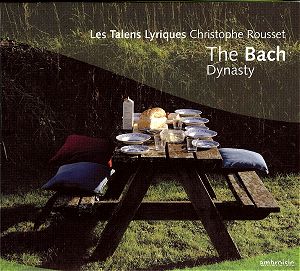
The Bach Dynasty Johann Sebastian BACH (1685-1750)
Concerto for harpsichord, strings and b.c. in d minor
(BWV 1059) [08:42] Carl Philipp Emanuel BACH (1714-1788)
Concerto for cello, strings and b.c. in A (Wq 172/H 439)
[20:12]
Symphony for strings and b.c. in C (Wq 182,3/H 659) [09:53] Wilhelm Friedemann BACH (1710-1784)
Concerto for flute and orchestra in D (BR WFB C15) [22:35] Jocelyn Sakaï (transverse
flute), Atsushi Sakaï (cello),
Christophe Rousset (harpsichord)
Les Talens Lyriques/Christophe Rousset
rec. January 2007, Temple Saint-Pierre, Paris, France. DDD AMBROISIE
AM125 [61:26]
The title of this disc is well-chosen: the Bachs were a
large family, and they were active as musicians for four generations.
The
fifth is represented by just one musician: Wilhelm Friedrich
Ernst, son of Johann Sebastian's second-youngest son, Johann
Christoph Friedrich. But he was of relatively little importance
and with him the name Bach disappeared from the music scene.
Reinhard Goebel once described Johann Sebastian Bach as "a great
German oak, who cast a mighty shadow – a shadow that enshrouded
not only his contemporaries but the rest of the Bach family
in darkness". That is certainly right in that for most
people 'Bach' means 'Johann Sebastian'. Even though the members
of the Bach family of previous generations and Johann Sebastian's
sons are getting more and more attention, they are still
in the oak's shadow. And Bach's sons Wilhelm Friedemann and
Carl Philipp Emanuel themselves felt being overshadowed by
their father too. The latter told Johann Sebastian's first
biographer, Johann Nikolaus Forkel, that they had "necessarily
to choose their own kind of style because they never would
have matched their father in his style".
This disc demonstrates the changes in style between the father and
these two sons. The programme opens with one of Johann Sebastian's
harpichord concertos. There are eight of them (apart from
six concertos for two, three or four harpsichords), and they
are mostly arrangements of concertos which Bach originally
wrote for, in particular, the violin and the oboe. The concerto
Christophe Rousset has chosen is the most problematic of
all, as the autograph is very incomplete: only nine bars
have been preserved. But those are enough to conclude that
Bach has arranged here the Sinfonia which opens his cantata
'Geist und Seele sind verwirret' (BWV 35), and there is general
agreement that the Sinfonia at the beginning of the second
part of this cantata has been the model for the concluding
fast movement. It is assumed Bach arranged the first aria
with obbligato organ from this same cantata as the slow second
movement, but as here too much reconstruction is needed,
in most modern performances a transitional cadence is played,
like in the 3rd Brandenburg Concerto. That is also the case
here.
Christophe Rousset is an accomplished harpsichordist and his ensemble
has demonstrated its quality in a number of fine opera recordings.
But in this work by Bach I find them disappointing. The main
reason is that the ensemble is too large: five first violins,
four second violins, two violas and four cellos. The harpsichord
concertos are assumed to be performed by Bach in Leipzig,
mostly in rather small venues, like the Café Zimmermann.
It is likely the number of players was generally very small,
probably just one player per part. The sound of the ensemble
is even further blown up by the large reverberation of the
church where this recording was made. I also find the playing
of Christophe Rousset too mechanical. Gustav Leonhardt, with
his Leonhardt Consort, still is the first choice here.
In the other works the size of the orchestra is much more appropriate,
but here the acoustics also have a negative influence on
the performance. Under such circumstances the articulation
has to be sharper than it is here. That is a general problem
in these performances anyway. That also means that the cello
concerto's performance is not ideal. It has a bit of a slow
start, as the first movement is too bland. The other two
movements are better, but even though Atsushi Sakaï plays
well, in particular in the last movement, Alison McGillivray
(with the English Concert on Harmonia mundi) is definitely
better, because of a clearer articulation, more differentiation
and a much better acoustical environment.
The best part of this disc is the performance of the third symphony
from a collection of six for strings with basso continuo.
These are very characteristic of Carl Philipp Emanuel's style.
Their influence went as far as Felix Mendelssohn in his symphonies
for strings. The twists and turns of this symphony are well
realised by Les Talens Lyriques.
The last piece is the least-known on this disc. It has been recently
discovered, as it was part of the archive of the Berlin Singakademie,
which disappeared during World War II and was located in
Kiev in 1999. Of all the sons of Bach Wilhelm Friedemann
remains stylistically most close to his father. His oeuvre
shows a kind of conflict between 'old' and 'new'. This concerto
is an example: the flute part is certainly not baroque anymore,
especially as it moves through two octaves within a short
span of time. But the thematic material isn't exactly easy
on the ear, as so much music of the time. The largo is unusually
long, and the players need great skills to keep the attention
of the audience. The players here don't quite succeed in
that, I'm afraid. Here again better recordings are available,
by Musica antiqua Köln ('Bachiana' – Archiv) or by the Freiburger
Barockorchester (Carus).
A programme like this would have been much more interesting if the
choice of compositions had been more adventurous, the music
had been recorded in a more suitable venue and the performance
had been more differentiated and rhetorical. Three of the
four works on this disc are available in better performances.
That is not a great score.
Johan
van Veen
Please support our advertisers below by clicking on the logos for further information.

























 Jocelyn Sakaï (transverse
flute), Atsushi Sakaï (cello),
Christophe Rousset (harpsichord)
Jocelyn Sakaï (transverse
flute), Atsushi Sakaï (cello),
Christophe Rousset (harpsichord) 
