Editorial Board
MusicWeb International
Founding Editor Rob Barnett Editor in Chief
John Quinn Contributing Editor Ralph Moore Webmaster
David Barker Postmaster
Jonathan Woolf MusicWeb Founder Len Mullenger
Claudio
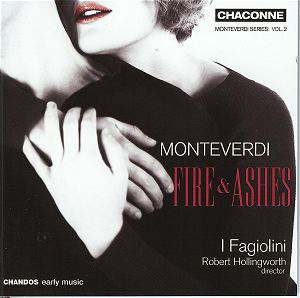
MONTEVERDI (1567-1643) Fire and Ashes Ballo delle ingrate: Sinfonia [1:30] Ardo, avvampo, mi struggo, ardo [3:47] Rimanti in pace a la dolente e bella [8:05] Ogni amante e guerrier [13:16] Si ch'io vorrei morire [3:40] Che dar piu vi poss'io? [2:57] E cosi a poco a poco [3:18] Vorrei baciarti, o Filli [4:54] Chiome d'oro [3:04] Batto, qui pianse Ergasto [3:48] Ballo delle ingrate: Entrata [1:44] Lagrime d'amante al sepolcro dell'amata [14:52] Tirsi e Clori [13:55] I Fagiolini/Robert
Hollingworth
rec. 26-27 February, 20 September 2007, St. George’s Church,
Chesterton, Cambridge, United Kingdom. DDD CHANDOS CHACONNE
CHAN0749 [78:55]
I Fagiolini under their wry director Robert Hollingworth
have a high reputation for insightful, trenchant and novel
interpretations of Monteverdi. Their approach is also most
often one that gets straight to the music as music
- to be enjoyed and revelled in. This excellent CD is no
exception. The dramatic, stylised world of the madrigal is
celebrated not as an ‘example’ of anything, or a moment in
the development of song. But as sensual, upbeat appreciation
of the highest confluence of words and music. It helps that,
for all their joy in deflating some accepted views of early
music, I Fagiolini are at heart authenticists. Again, this
very generous recording is the better for that.
“Monteverdi’s madrigals are a theatre of the senses: touches,
glances, scents, the textures of fabrics, of lips and skin…,” writes
James Weeks in his pithy introductory essay. So it can be
that we put on this CD and listen to a selection of carefully,
yet vigorously, performed madrigals with delight and a degree
of awe.
Not unfettered awe, because I Fagiolini have not gone for
an abandon in this recording. That would have contradicted
the idiom. This is not jazz, nor cabaret. For all their acknowledgement
of what are at times somewhat stock conventions, I Fagiolini
are quite aware that Monteverdi’s madrigals are full of genuine
passion and seriousness. Nymphs and shepherds are people!
So it behoves an accomplished presentation of such material
to uphold this respect. I Fagiolini do so on this record.
Their Tirsi e Clori is as sobre, unselfconscious
and hence as successfully communicative as can be. If an interpretation can convey the intensity
as much of the fears, longing, despair and anger of the music
as of its own virtuosity (the gestures, topoi and rhythms),
it has succeeded. Paradoxically – given the ardour and excitement
of Monteverdi’s style, and his texts – that’s exactly how
I Fagiolini succeed here.
Fire and Ashes is the second volume of Monteverdi’s madrigals by the
group. It is something of a box of treasures … there
are offerings from all but the composer’s first and second
books. The series is not progressing chronologically. This
way, the enterprise does allow us to get a sense of the variety
of the Monteverdi’s work. And some idea of his development
from the simply conceived a cappella madrigals written
in Mantua to the more sparse and searing later works.
If you want all the madrigals from all nine books, presumably
you’ll eventually get them as the Chaconne series progresses.
But you also seem unlikely to know which are coming when – and
why. There is something intentionally random about the plan.
If that, in fact, concentrates your mind more on the music
than on its context, and if you want that, the system has
worked. Some listeners will want a referenced collection
through which they can find their way. Any compromise that
this system makes is more than compensated for by the quality
of the performances.
To move about in time also allows us – significantly – to
appreciate how important was the text. The poetry was the
common factor for all these works. It was the basis, after
all, of the seconda prattica: audible and comprehensible
words place an emphasis on the sense, the ideas and the supremacy
of real, and really accessible, experience as represented
in music. I Fagiolini are as strong in this respect as any
recorded ensemble. Every syllable is translucent – if not
actually transparent. The singers’ articulation is exemplary.
But there is also some painting… E cosi a poco a poco, for example, is
theatrical in the extreme. A butterfly’s tiny wings beat.
The lover is consumed. The message is clear – you can’t ‘overcome’ your
desire. And in ten lines. To be effective and more striking
than staid, there needs to be real intensity and focus. Those
are qualities which these performers bring to the music in
good measure.
In
madrigals which postdate Monteverdi’s gravitation towards
opera - from the time of the fourth book onwards - there
is a leaner kind of attention to the passion and strain of
the situations explored. The famous Si ch'io vorrei morire can
actually leave more to innuendo than would have been possible
ten years earlier. I Fagiolini – for all their penchant for
the ribald – do this madrigal great service. By underplaying
it. Similarly, Ogni amante e guerrier is conveyed
with real subtlety despite the charged imagery and force
of the sentiment expressed. Again, it’s the group’s belief
in the words that counts and is so effective.
The
acoustic is clear and clean in support of this wonderful
music. The booklet carries the texts in Italian and English.
In his own note, Hollingworth explains how much the series
of live performances undertaken prior to the recordings helped.
He also offers a ‘justification’ for this series when three
Italian ensembles (Concerto Italiano under Alessandrini on
Naïve; La Venexiana with Claudio Cavina on Glossa; Delitiae
Musicae under Marco Longhini on Naxos) have recorded, or
are recording, the same repertoire. It is, to paraphrase,
that the music is so extraordinary, so profound, that there
is indeed a place for the care and vision of I Fagiolini.
On the evidence of this CD, it’s hard to disagree.
Mark Sealey
Please support our advertisers below by clicking on the logos for further information.

























 I Fagiolini/Robert
Hollingworth
I Fagiolini/Robert
Hollingworth 
