Recorded exactly a month after Columbia’s Il trovatore,
conducted by Karajan and, in the main, with the same principals,
this Ballo also finds Callas in uncommonly good voice.
The recording is what we have come to expect from La Scala of
this vintage, clear but not very atmospheric, the La Scala acoustics
being fairly dry. After Karajan’s alert conducting of Trovatore,
one would have thought that Antonino Votto might stand out as
reliable and rather routine. In fact he is better than his reputation.
The prelude is well-shaped – perhaps a bit laid-back – and the
opening chorus is rendered dark and ominous, laying bare the major
conflict of the drama. Likewise he handles the stormy prelude
to act 2 with the poignancy it needs. Both Amelia’s aria and the
ensuing duet with Riccardo are really ignited by the conductor.
So by and large Votto provides a fine canvas as backdrop before
which this taut masterpiece is to unfold.
The
La Scala Chorus and Orchestra – the chorus trained by legendary
Norberto Mola – are prime forces and the line-up of comprimario
singers boasts names like the reliable basses Silvio Maionica
and Nicola Zaccaria as the leading conspirators. Michael Scott’s
description in the liner-notes of Eugenia Ratti’s voice as
‘a typical steam-whistle like scream’ is to my mind rather
unfair. It is no doubt a bright voice but I hear it rather
as silvery and spirited – in other words what I expect from
an Oscar. Fedora Barbieri is also rather unflatteringly described
in the notes, but while she wasn’t quite in the Simionato
or Cossotto class she was a true mezzo-soprano in the old
Italian school and she is a strong and expressive Ulrica in
the sinister scene in her dwelling.
Tito
Gobbi, always responsive to words, the dramatic situation
and the state of mind of his characters, makes the most of
Renato, even though the first act aria Alla vita che t’arride
is a bit bloodless. At least partly the conductor is to blame
for not giving more positive support – Leinsdorf and Solti
in their 1960s recordings are much more vivid. As usual Gobbi
also has his moments of pinched tone. But in the first scene
of act 3 he really shows his mettle. His wrath and despair
at Amelia’s and Riccardo’s deceit is exposed in horrifying
terms and when he pours his contempt on Riccardo in the aria,
words initially almost fails him. Eri tu (It was you)
he whisper towards Riccardo’s portrait, and then the wrath
grows. Then, when he sings O dolcezze perdute! (O bliss
that I have lost!) his tone and expression becomes so loving.
The whole aria is a horrifying zooming-in on the soul of a
person whose whole world has been broken into splinters. This
is one of the great assumptions on record!
Callas
on top form never misses an opportunity to wring the last
drop of intensity out of her two arias and the act 2 scene
by the gallows is a masterpiece of visual singing. Her colouring
of the phrases is so expressive that we instinctively know
what she looks like. As a contrast the resigned Morrò,
ma prima in grazia in act 3 is eternally moving.
The
duet in act 2, Teco io sto, has a special affection
for me, since it was the first ever recording of the piece
that I bought 45 years ago on an LP ‘Callas in Duet’. Hearing
it in context it is even more obvious what a superb radar-couple
she and Di Stefano were at their best. Di Stefano’s ardent
and warm Riccardo is one of his best recorded roles and he
is hushed and mellifluous in Di tu se fedele in the
Ulrica scene but I wish Votto had speeded it up a bit – I
miss the bounce. È scherzo od è follia is much closer
to the mark and Di Stefano sings it with a chuckle in the
voice.
In
the last act Riccardo’s aria is warmly sung but there are
some unwelcome signs of pinched tone here that were to become
more prominent during the next few years. The death scene
is however soft and touching.
Un
ballo in maschera had few recordings during the first
two decades of the LP era. Besides a 1954 Cetra set with Tagliavini
as a good but slightly lachrymose Riccardo, there was Solti’s
on Decca with Birgit Nilsson and Carlo Bergonzi - it was to
have been Jussi Björling but the conductor and tenor ended
up on non-speaking terms during the sessions in Rome, and
when the recording was resumed Björling was already dead.
Then came an RCA set with Leontyne Price and again Bergonzi.
The latter has always been my favourite with Leinsdorf a more
positive conductor than either Votto or Solti, Bergonzi the
ideal Riccardo and Leontyne Price’s smoky-toned Amelia less
individual than Callas but still a splendid assumption. The
supporting cast is excellent and the sound is first class.
Of later essays first prize must go to Muti on EMI with Martina
Arroyo and Placido Domingo. Abbado on DG is a runner-up with
Ricciarelli and Domingo (again) and Bruson a fine Renato.
Whichever version one has or buys Callas’s and Gobbi’s contributions
to the Votto set will never be surpassed and Di Stefano is
up there among the best, too.
Göran
Forsling
























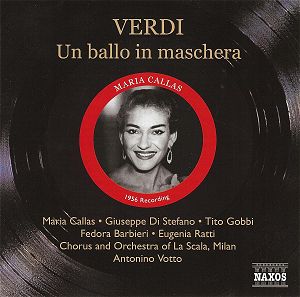
 Giuseppe Di Stefano (tenor) – Riccardo; Tito Gobbi (baritone) – Renato;
Maria Callas (soprano) – Amelia; Fedora Barbieri (mezzo) – Ulrica;
Eugenia Ratti (soprano) – Oscar; Enzo Giordano (baritone) – Silvano;
Silvio Maionica (bass) – Samuel; Nicola Zaccaria (bass) – Tom; Renato
Ercolani (tenor) – A Judge/A Servant of Amelia
Giuseppe Di Stefano (tenor) – Riccardo; Tito Gobbi (baritone) – Renato;
Maria Callas (soprano) – Amelia; Fedora Barbieri (mezzo) – Ulrica;
Eugenia Ratti (soprano) – Oscar; Enzo Giordano (baritone) – Silvano;
Silvio Maionica (bass) – Samuel; Nicola Zaccaria (bass) – Tom; Renato
Ercolani (tenor) – A Judge/A Servant of Amelia
