Tchaikovsky’s op., 37b is a suite of twelve pieces called “The
Seasons”. If this were April 1st I would go on to explain
that his op. 37a is a set of four pieces called “The Months”,
but nothing’s that simple. Back in my student days I picked the
suite up second-hand in a Polish edition. The fact that I couldn’t
understand the poetic extracts placed by Tchaikovsky at the head
of each piece – not that I would have understood the original
Russian either – was partially compensated by a series of pretty
line drawings that I have open before me as I write.
Geoffrey
Saba has had the bright idea of integrating the poetic extracts
into the cycle by calling in a distinguished actor to recite
them (in English). In a concert this might be a good idea
and no doubt David Baillie has sufficient stage presence to
make up for the fact that he has very little to do – his contributions
are tracked separately and vary from 00:17 to 00:06. On record,
one has just adjusted from a music-listening frame of mind
to a poetry-listening one when it’s over. Maybe it would have
been interesting to dig up the original poems – some by names
as distinguished as Pushkin and Tolstoy – and extend the extracts
a bit. Or, since they are also printed in the booklet, better
just leave them there. Possibly in an attempt to make his
mark with only a few words, Baillie seems to me to adopt an
over-dramatic delivery. Whatever the matter in hand, he always
sounds like King Lear cursing his daughters.
This
would be more serious, of course, if the musical side was
unmissable, or at least acceptable. Alas, no. On a purely
technical level, let me hasten to say, Saba has no difficulty
in playing all the notes in this hardly virtuoso but sometimes
tricky music. But that is not enough.
Almost
contemporaneously with this disc, I have reviewed a disc of
Brahms late pieces played by Miquel Farré. I felt obliged
to list a few very specific details, which may have appeared
too technical for some of my readers, to explain why I felt
that, while the disc wasn’t all that bad, it was out of the
running given the competition. Here I’m afraid the situation
is worse. If no other version of Tchaikovsky’s “Seasons” existed
my only advice to readers could be to remain without until
something decent came along. And I shall have to explain my
reasons, so once again I shall list a small number of specific
points. I could list a whole lot more for every piece with
the exception of “October” which, while lacking the ideal
intensity for its pools of gloom, is quite nicely managed,
as is the more taxing “Dumka”.
In
“February” – “Carnival” – the opening two bars are played
fast and furiously and separated slightly from the next two,
which are played in a slower tempo. Since the whole process
is immediately repeated – and is so every time this theme
reappears – the sense of a joyous dance is undermined. A bit
of rhythm is achieved from b.9 but the right-hand/left-hand
imitation at bb.27-28 is treated to a drastic accelerando
for the right-hand phrase and a drastic pulling back for the
left-hand one. Maybe the intention was a proper Peter-pays-Paul
rubato but the effect to my ears is just unsettled.
Then
in “April” – “Snowdrop” – the over-intrusive and fraught left
hand with its continual hurryings robs the music of its wistful
elegance. “Un poco rubato” doesn’t mean that, and if you think
it does there’s still the “dolce” marking to take into consideration
and there’s no “dolcezza” here. Nor is there any “grazia”
in the next section – from b.25 – as Saba whooshes up the
rising scale with a bang at the top.
In
“July” – “Reaper’s Song” – the melody in the middle of the
texture from bb.15-18 does not emerge properly and the music
degenerates into mere noise.
The
only other complete “Seasons” I had to hand was that by Xiang-Dong
Kong (RCA Victor Red Seal 09026 62520 2 if still available).
Without being exceptional this offers a very reasonable account
at least until the last two pieces where he, too, starts to
maul the music around. “Troika”, the best-known of these miniatures,
seems to have suffered from the shadow of Rachmaninov’s highly
personalized interpretation. Not even Richter could bring
himself to play the music as written, though I seem to remember
Michael Ponti did. Lack of imagination can have its advantages
at times.
The
really strange thing is that this chaotic, rhythmically messy
playing is followed by a performance of Mozart’s “Duport”
Variations which shows that Saba can play with real rhythmic
discipline and shapely phrasing. I would query the amount
of pedal he uses towards the end but some might prefer this
fairly full-blooded Mozart. The point is that this performance
is of a completely acceptable professional level – at the
very least – while the Tchaikovsky is not. Since Saba proves
to be capable of genuinely rhythmic playing I have to suppose
that he plays Tchaikovsky this way, not because he can’t do
it any other way, but because he has some sort of concept
of rubato which I am unable to share. I feel he should listen
again to his “Seasons” as coldly and critically as he can
and ask himself whether he has really achieved what he intended.
Alternatively, readers can check out “February” and “April”
in particular and see if the points I make worry them. If
not, though, I would beg them to hear a few alternatives too;
they may enjoy them even more.
Christopher
Howell
























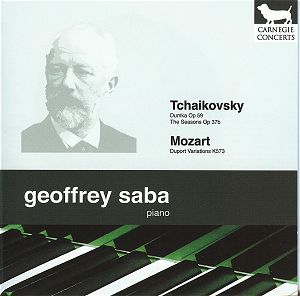

 Geoffrey Saba
(piano), David Baillie (speaker)*
Geoffrey Saba
(piano), David Baillie (speaker)* 