This is a very sensible coupling, the two composers were friends,
in later life, and the works date from exactly the same time.
But what different works they are!
Shostakovich’s Quartet was quickly denounced, after its première, for not glorifying Soviet participation
in the Great Patriotic War. Consequently, the composer gave
the five movements titles which, supposedly, showed that he
was presenting the various processes which lead to and from
war. Most sensibly, he dropped the titles as they were not
germane to the music. This is so obviously pure music, existing
for its own sake, and what a fine quartet it is; the spotlight
has tended to shine on the later quartets and the first four
have never received the attention they are due, which, when
listening to as good a performance as committed as this one,
is mystifying.
There is a feel of childish innocence in the first movement, but with
the tongue firmly stuck in the cheek for the odd moment when
Shostakovich launches himself into a fugue. The second movement
is in similar vein, and bridges the gap between first and
third movements with an easy-going feel, punctuated twice
by the stab of staccato chords and a cello ascent into its
uppermost register. The third is the only fast movement in
the work, a bluff, spiky, scherzo, which never rests. The
slow movement is stark, and all too brief, and gives way to
what starts as a typically disarming, innocent, moderato and
soon the tension is screwed up, but just as quickly we are
back in the innocent music of the opening, which leads into
a quiet, reflective coda – much in the manner of the finale
of the 8th Symphony.
This 3rd Quartet is a very personal document which
has, perhaps, been overlooked as being of insufficient stature
in Shostakovich’s output. Nothing could be further from the
truth – this is a fine piece of writing and is a deeply felt
work, its integrity being shattered only twice by disruptive
elements which are brought to book by the intense lyricism
of the body of the composition.
By
the time he came to write his 2nd Quartet,
Benjamin Britten was well established as a major talent in
British music; Peter Grimes had been premièred
in June 1945, and was soon to be performed in America (conducted
by Bernstein at Tanglewood), and The Young Person’s Guide
to the Orchestra was just round the corner. Written, partly,
to celebrate the 250th anniversary of the death
of Henry Purcell, a favourite composer of Britten’s, the Quartet
is in three movements, with a very large final Chaconne,
which Britten calls Chacony (the old spelling of the
word) interspersed with cadenzas for three of the four instruments.
This
is a much more complex work then the 1st Quartet,
stretching the performers to their limits and leaving you
gasping at Britten’s endless invention. The first two movements
are over before they have really begun but they preface, quite
perfectly, the magisterial Chacony which tops the work
with a powerful and decisive coda. Every time I hear an instrumental
work by Britten I lament that he gave so much time to the
voice and less and less time to absolute music. With a performance
of this stature one is left all the more bereft at the lack
of instrumental works in Britten’s output.
These are fine performances indeed. The Jupiter Quartet has won many
awards, perhaps most importantly the First Prize in the 8th
Banff International String Quartet Competition (2004), where
it was also awarded the Szekely Prize for the best performance
of a Beethoven quartet. This is its first recording and what
a disk it is. The players hit exactly the right tone for the
many and various moods of Shostakovich’s work and after the
quixotic and mercurial opening movements of Britten’s work
hold everything in check as they build the mighty structure
of the Chacony. This is superb music making and a sheer
joy to listen to, I found myself simply sitting back and enjoying
the disk instead of thinking of what I was going to write.
The recording is clear and precise allowing you to hear every inspiration
of composer and performer alike and the Quartet obviously
feels very strongly about these works; their passion, devotion
and respect for these works is conveyed to the listener.
Anton
von Webern, himself a cellist, said, “Quartet playing is the most
glorious music making there is” and there is no better proof positive
of that statement than this disk.
Bob Briggs
























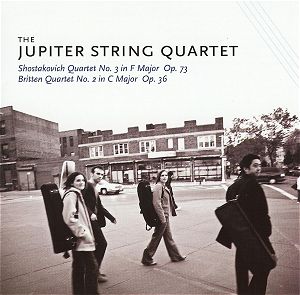

 Jupiter
Quartet (Nelson Lee (violin); Meg Freivogel McDonough (violin); Liz
Freivogel (viola);, Dan McDonough (cello))
Jupiter
Quartet (Nelson Lee (violin); Meg Freivogel McDonough (violin); Liz
Freivogel (viola);, Dan McDonough (cello)) 
