Editorial Board
MusicWeb International
Founding Editor Rob Barnett Editor in Chief
John Quinn Contributing Editor Ralph Moore Webmaster
David Barker Postmaster
Jonathan Woolf MusicWeb Founder Len Mullenger
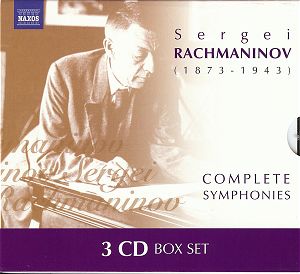
Sergei
RACHMANINOV (1873-1943)
CD 1 Caprice Bohémien op. 12 (1892/4) [19:31]
Symphony No. 1 in D minor op. 13 (1895) [49:34]
CD 2
Symphony No. 2 in E minor op. 27 (1906/7) [58:06]
CD 3
Symphony No. 3 in A minor op. 44 (1935/6) [41:32] Mélodie in E op. 3/3 (1892) [5:32] Polichinelle op. 3/4 (1892) [4:31] National Symphony
Orchestra of Ireland/Alexander Anissimov
rec. National Concert Hall, Dublin, Ireland, 6-7 May 1996
(op 12, 13), 24-25 March 1997 (op27), 22-23 April 1996 (op
3, 44), DDD NAXOS
8.503191 [3 CDs: 69:14 + 58:06 + 51:38]
Preconceptions
are great aren’t they? We all have them … and I had them
in spades confronted with this new set.
Sometimes
it’s my custom when reviewing to read through background
material provided before I begin to listen. At other times
I’m inclined to slip the discs in the machine without looking
at any of the notes, other than just enough to get my bearings.
I took the latter course on this occasion … and did I come
to the wrong set of conclusions!
I
began with disc 1, Symphony No. 1, and then proceeded through
the discs in sequence. The more I listened the more convinced
I became that Anissimov and his orchestra had recorded these
works in order of composition.
Whilst
I didn’t dislike the performance of the First it seemed somehow tentative to
me; not fully formed … as though the artists were coming
towards an understanding of the idiom … but hadn’t quite
got there yet. To be frank the finale, one of my key testing
points for any Rachmaninov cycle, paled against Ashkenazy
and the Concertgebouw (Double Decca 4481162). True few if
any interpretations can live with the older Russian and his
Dutch orchestra in this classic performance; quite riveting
in execution and splendidly recorded. Despite some decent
playing and sound, to be honest, Anissimov and the Irish
players are incinerated in its wake.
Symphony
No. 2 however showed distinctly more progress, and despite
some cuts (and no 1st movement exposition repeat)
there seemed to be more confidence. Moreover taking Ashkenazy
again as a comparison, the older Russian loses some ground
here with a rather unsympathetic interpretation of the lovely
slow movement.
By
the Third Symphony everything in the Naxos recording seemed
to be in place. Whilst there was still a tendency to a relaxed
approach to tempos, even to linger overmuch here and there,
the habit seemed much more integrated into the conception … indeed
the orchestra appeared beguiled into some deft and beautiful
playing and phrasing.
But … oooops! … one
look at the notes, and it confirmed almost the complete
opposite in terms of the sequence of recording. True the
time margins were not great; the whole enterprise being completed
in just under a year … yet there it was in black and white:
Symphony No. 3 was recorded first, followed shortly by
number 1, and then after a gap of approx 11 months came the
2nd.
The
First is a fine work. Indeed it is the contention of several
commentators, including Robert Simpson, that had it not endured
such a disastrous premiere Rachmaninov’s development as a
symphonist would have taken a quite different direction.
He remarks, “As a piece of symphonic composition the D
minor is much superior to the other two…( ).. if (he) had
followed this work with advancing successors, he would have
been one of great symphonists of the first half of the C20.”
(The
Symphony, vol 2, “Elgar to the present day”, Penguin 1971).
The
story of the first performance is important enough to bear
repetition. It was directed at the Moscow Conservatoire in
1897 by Glazunov. The older composer seems to have tackled
the task with marked incompetence, allegedly due to drunkenness.
Certainly in later life (the 1920s) Glazunov’s liquor problem
was marked – if Solomon Volkov’s “Testimony” is any guide.
Yet his mismanagement of the music may not have been driven
by a particular antipathy to the score … whereas Glazunov’s
friend Cesar Cui made it quite clear he was bitterly opposed
to his younger colleague. His review, including the remark
that Rachmaninov had attempted to “depict in music the seven
plagues of Egypt” did at least as much harm to Rachmaninov’s
fledgling symphony as any musicianly scramble at the premiere … probably
more.
Rachmaninov,
his confidence severely dented, eventually sought the help
of the hypnotherapist Dr Nikolai Dahl, who helped him regain
his compositional confidence, and eventually his triumphant
return to the concert stage with his 2nd Piano
Concerto.
It
was roughly at the point of this triumph that Rachmaninov
promised Alexander Siloti a new symphony, although it was
to take some six years to come to fruition. Dominated by
a strong lyrical feeling, it also makes extensive use of
the Dies Irae as an idée fixe. As I remarked earlier I felt
Anissimov and his orchestra seemed in greater sympathy with
Rachmaninov here, although the 1st movement exposition
repeat isn’t observed. To be fair it isn’t included very
often, and I can enjoy the work without it, although it isn’t
my preference. Incidentally he resists the temptation to
end the first movement with a pronounced timpani thwack.
However
move on to the scherzo (placed second) and try the first
few minutes to get a view in microcosm of the conductors
approach. After the initial galloping theme on the strings
and horns at approx 1.25min we slow down for a contrasting
subject….and we do slow down. Again Ashkenazy isn’t
that much quicker, but there is more sense of forward
motion. Anissimov lingers just that little bit more.
By
the third symphony my caveats tended to wilt beneath feelings
of sheer enjoyment. Here and there I registered a minor annoyance
at phrases played too quietly (the conductor does insist
upon … and get … some very quiet playing at times); for instance
at around 10:30 into the finale the little answering phrases,
in violins and horns, to the violas interjections are virtually
inaudible. But frankly there was so much delicate and beautiful
playing that I eventually succumbed to Anissimov’s view.
The “fillers” in
the set do not affect the issue much either way. The 2nd symphony
has nothing; the Third has orchestrations of two piano works – attractive
but slight. The 1st is paired with an interesting
rarity, the Caprice Bohémien, which has attracted
little attention from the record labels. After a long brooding
opening the music develops into an attractive characteristic
dance. Not a key work but well worth hearing.
In
all: Naxos are up against it in the Rachmaninov symphony
stakes, with plenty of competition from sets (several at
super-budget or near super-budget price), plus a number of
interesting separate discs. Yet I don’t think the casual
purchaser of this set would be disappointed. I’ve heard better
1st symphonies, but would (and will) hear Anissimov’s
3rd again … frequently.

























 National Symphony
Orchestra of Ireland/Alexander Anissimov
National Symphony
Orchestra of Ireland/Alexander Anissimov 