Editorial Board
MusicWeb International
Founding Editor Rob Barnett Editor in Chief
John Quinn Contributing Editor Ralph Moore Webmaster
David Barker Postmaster
Jonathan Woolf MusicWeb Founder Len Mullenger
Sergey
Sergeyevich PROKOFIEV (1881-1953)
Symphony No. 5 in B flat major, Op. 100 (1944) [43:22] Lieutenant Kijé suite, Op. 60 (1934) [21:03] Cincinnati
Symphony Orchestra/Paavo Järvi
rec. Music Hall, Cincinnati, Ohio, 18-19 March 2007 TELARC CD-80683 [64:25]
This
was always going to be an intriguing comparison:
a new Prokofiev Fifth recording conducted by Paavo Järvi,
in his father's repertoire (specifically against the Chandos
recording, CHAN 8450). Two very different bands as well, the
sumptuous Cincinnatians and the grittier Scottish National
Orchestra
(now the RSNO),
not to mention two labels known for their spacious, wide-ranging
recordings. A rare feast indeed.
Neeme
Järvi’s account of this wartime symphony comes from his much-praised
SNO cycle recorded in the 1980s. Those were halcyon days
for both conductor and orchestra, who produced some very
fine discs of Richard Strauss, Prokofiev and Shostakovich.
Now Paavo (born in 1962) seems to be following in his father’s
footsteps, especially when it comes to Russian repertoire.
Broadly,
timings are very similar but nothing quite prepares you for
how different the readings sound. In that remarkable opening Andante Paavo
is altogether cooler, more measured, whereas his father opts
for an unsettled, edgy approach, emphasised by the brighter,
more focused recording. It’s only when you hear the latter
that you realise just how bland Paavo’s reading really is.
Yes, it’s beautifully detailed but the famous Telarc bass
drum thuds rather than thwacks and the opening flute and
bassoon octaves are surely much too moulded, rather like
the movement as a whole. And the shattering cymbal-capped
climax that grows from dark, subterranean beginnings is simply
hair-raising on Chandos but fatally underpowered on Telarc.
The SNO even make that rhetorical coda sound convincing,
not the empty gesture that it can so easily become.
Now
for the later. I recently listened to Paavo Järvi’s recordings
of Stravinsky’s Petrouchka and Firebird and
Prokofiev’s Romeo and Juliet Suite No. 1 (Telarc
80587 and 80597 respectively) and while I enjoyed them both – albeit
fitfully – I felt they were far too cautious, every ‘i’ dotted
and every ‘t’ crossed. In particular the Firebird lacks
that essential electricity and the Romeo and Juliet – though
superbly played and recorded – seems curiously detached.
Back
to the Fifth and that strange Allegro marcato. The
opening staccato violin theme and syncopated clarinet figure
are neatly articulated on the Telarc disc and the music’s
errant, quicksilver quality is reasonably well captured.
That said, Järvi senior’s greater experience results in a
much more penetrating performance, full of manic chatter
and underpinned by a steady pulse that invigorates without
ever becoming breathless.
In
the Adagio Prokofiev weaves a lyrical thread into
the music’s rough cloth. The SNO’s massed strings are well-blended
and ardent, the sullen bass never too far away. And in those
great thumping perorations the Scots are beyond compare,
the 1985 recording yielding absolutely nothing to the more
modern one. Predictably the Cincinnatians major on warmth
and lyricism but miss out on the music’s bipolar elements.
The score really doesn’t respond well to Paavo’s carefully
wrought but annoyingly episodic approach; indeed, that all-important
pulse – when it’s discernible at all – is much too weak to
keep the music alive. Hugely disappointing.
The Allegro
giocoso begins with a reprise of the symphony’s opening
theme, this time for massed strings. The younger Järvi
coaxes some magical sounds from his orchestra but again
he follows the letter of the score and misses its abundance
of spirit. Admittedly the differences aren’t as extreme
in this movement but the Chandos engineers manage to pick
up much more instrumental detail than their American counterparts.
And even though Paavo loosens the reins in the finale he
must yield to his father in terms of sheer motoric thrust
and excitement.
No
contest, then, the elder Järvi still reigns supreme in this
symphony. But what of the fillers? Chandos offer the Waltz
Suite, Op.110, Telarc the Kijé suite. For comparison
I took down the Abbado/Chicago Kijé (DG Originals
447 4192), another of those great collaborations that yielded
some fabulous discs. Paavo doesn’t bring out the satirical
elements of Yuri Tinyanov’s tale as well as Abbado does,
although he does find plenty of warmth in the ‘Romance’.
And at the opening of ’Kijé’s Wedding’ Abbado is much more
bacchanalian, the crisp thwacks of the LSO bass drum superbly
caught.
Järvi’s ‘Troika’ is
a little more unbuttoned than I expected. The sleigh ride
in particular is beautifully articulated, a fast but elegant
dash across the snow. I was especially impressed by the Telarc
recording here, as it picks up plenty of detail and atmosphere.
I marginally prefer Abbado at this point but really there’s
not much in it. Regrettably Järvi loses out in the final
movement, which sounds curiously leaden. It may be dirge-like
but Abbado lifts the rhythms in a way that is altogether
more effective – and affecting.
This
simply isn’t a front runner in the Kijé stakes and
the sonics aren’t up to Telarc’s usual standards either.
What a pity they still insist on issuing CD and SACD versions
separately, as an A/B comparison of the two layers would
have been interesting. In any event recording repertoire
for which Järvi senior is justly famous was always going
to be a gamble. Regrettably, it hasn’t paid off.
Dan
Morgan
Please support our advertisers below by clicking on the logos for further information.
























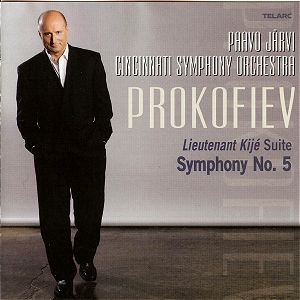

 Cincinnati
Symphony Orchestra/Paavo Järvi
Cincinnati
Symphony Orchestra/Paavo Järvi 
