Not a great deal
is known about Robert Parsons, beyond
the bare bones. He was appointed a
Gentleman of the Chapel Royal in 1563
but was linked to the Chapel before
this. He seems to have lived in Greenwich.
He was drowned at Newark. Much of
his music has survived, but in incomplete
editions. Barnaby Smith, in his booklet-notes
for this new CD, speculates that Parson’
tragic death might have led to his
music being neglected by the Chapel
Royal.
Undoubtedly much
of his music was written for this
institution and on this disc Barnaby
Smith and Voces Cantabiles give us
some of the grandest: the Latin Magnificat,
the largest-scale single work which
Parsons wrote, the English Great Service,
the Latin Responds for the Death and
the Ave Maria. This seems to be the
first disc for a very long time to
be entirely devoted to his music and
for that we must be very grateful
to Smith and his ensemble. Smith’s
aim, stated in his notes, is to ‘provide
Parsons with a memorial service he
never received and aid his return
to a place alongside the more recognised
English Renaissance composers.’
And to the group’s credit they largely
succeed.
The Latin Magnificat
probably dates from the reign of Queen
Mary. Parsons alternates the plainchant
with polyphonic verses set for six-voiced
choir. He displays great virtuosity
in the work using a variety of different
voice combinations in the verses.
With its high soprano lines, the work
links back to the tradition of Latin
Marian music in the Eton Choir Book.
Smith and his choir sing the work
with great clarity and a good sense
of line. They bring great enthusiasm
to it and whilst you could conceive
of a technically more perfect performance,
the choir’s response is infectious
and I came to love this lively performance.
The sopranos cope well with the high
tessitura of the upper reaches of
the part though their tone can get
a little hard.
When Edward VI ascended
the throne, Archbishop Cranmer instituted
a series of radical changes to the
English liturgy. This involved the
creation of an entirely new service
of Evensong. Tallis was the first
composer to set the Evensong Canticles.
But Parsons’ Great Service, a setting
of the canticles for Matins and Evensong
plus the creed, is far grander than
Tallis’s first setting. Whereas Tallis’s
Edwardian music seems to be carefully
negotiating the requirements of simplicity
and textual clarity which came from
the new regime, Parsons writes in
a modification of his Latin manner.
Thus he created an elaborate work
for two antiphonal choirs with musical
unification between the different
movements. Smith in his notes implies
that the service dates from the Edwardian
period but Grove says that the work
is clearly Elizabethan, thus aptly
demonstrating the difficulty of accurately
dating sacred music of this period.
Whatever the exact
date of composition, the work is wonderful
and receives a fine performance here.
I could have wished that Smith and
his choir made rather more of the
English words. Their diction is adequate,
but only just, and this was a period
when comprehension in service music
was very important. Occasionally individual
voices stand out rather too much,
but on the whole Smith has some impressive
singers at his disposal and the various
polyphonic groupings work pretty well.
Interspersed within
the Great Service are three pieces
from Responds for the Dead
- a collection of settings of Latin
texts from the Burial Service. This
may also date from Queen Mary’s reign
but could just as likely be Elizabethan
as the use of Latin texts was permitted
in Elizabeth’s Chapel Royal. I can
understand why Smith felt the need
to mingle the Great Service with other
items but personally I would have
liked the two groups of works to have
been kept separate. If anything these
Latin pieces are even stronger than
the English ones, with Parsons creating
distinctive and dramatic soundscapes.
Finally the choir
sing Parsons’ Ave Maria; perhaps
his best known piece. The work dates
from the late 1560s and Grove posits
that the piece may have a sub-text
relating to Mary Queen of Scots.
Barnaby Smith and
Voces Cantabiles have created an impressive
disc of Parsons’ music. The group
numbers some 22 singers which means
that the altos and tenors are singing
two voices to a part in the eight-part
music. This does not give us a luxuriantly
well upholstered sound, instead you
are aware of beautifully crafted vocal
lines and a good interplay between
individual voices. The group responds
to Parsons’ music with enthusiasm
and conveys this to their listeners.
This is an impressive
disc, and should go some way towards
rehabilitating Parsons' cause in the
recorded music industry. Newly created
editions for these pieces are used.
Whilst it would be possible to imagine
more technically sophisticated performances,
Parsons' cause is in good hands as
the choir deliver his music with enthusiasm,
lively vividness and fine musicality.
Robert Hugill
see also
review by Mark Sealey
























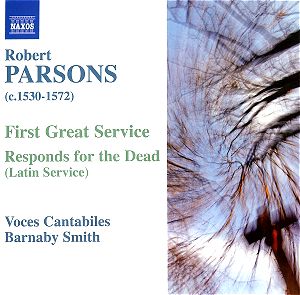

 Voces Cantabiles/Barnaby Smith
