In
the second half of the 18th century St Petersburg developed
into one of Europe's most prominent centres of music. It was
Tsarina Catherina II who was responsible for this, despite
her self-proclaimed deafness for music. Under her regime a
decree made it compulsory for the aristocracy to attend musical
and theatrical entertainments. Court musicians were ordered
to compose music for state occasions, birthdays and name-days.
The court choir, originally only singing religious music,
started to participate in theatrical productions, and came
under increasing Western influence. This influence is also
reflected in music by composers like Graun, Pergolesi and
Jommelli. Some prominent composers from Europe visited St
Petersburg and sometimes stayed there for a number of years.
Between 1758 and 1806 the position of maestro di cappella
was mostly held by Italian composers, among them Manfredini,
Galuppi, Traetta, Cimarosa and Sarti. Giovanni Paisiello was
amongst their number and stayed in St Petersburg from 1776
to 1784. It was also here that his oratorio 'La Passione di
Gesù Cristo' received its first performance, in 1783.
The
libretto dates from 1730 and was written by the famous librettist
Pietro Metastasio. The first composer to use it was Antonio
Caldara, maestro di cappella at the imperial court
in Vienna. Later his libretto was selected by Nicolò Jommelli
in 1749; his setting had also been performed some years before,
in 1779, in St Petersburg. Paisiello asked Metastasio for
an addition to the original text: between the last recitative
for the four singers and the closing chorus he wanted to include
a 'concertato' for the four singers. Metastasio bluntly refused
and made clear he didn't like the idea at all.
In
his libretto Metastasio completely avoids the biblical narration
of the Passion story. He rather concentrates on depicting
Jesus' agony in a very theatrical fashion. The story of the
Passion is told by three of the four characters in retrospect:
Mary Magdalene, John and Joseph of Arimathea. They were all
present at some of the events leading to the death and burial
of Jesus. The fourth character is Peter, who wasn't present
at either of them, as he fled from the courtroom while Jesus
was interrogated. It is Peter whom we meet at the beginning
of the first part, desperately asking himself: "Where
am I? Where am I going? Who guides my steps? After my failing
I can find no more peace". The first part is then devoted
to the other three protagonists telling Peter what has happened
since he left the scene. In the second part the four characters
talk about the coming resurrection and they look forward to
the way the Jewish people will suffer the revenge for Jesus'
death: "What terrible vengeance awaits you, faithless
Jerusalem!"
The
operatic character of the libretto is also reflected in Paisiello's
music, which isn't that different from the operas of the time.
The orchestra plays an important role in depicting the mood
of the respective characters. The oratorio begins with an
instrumental introduction which illustrates Peter's despair
as expressed in the following recitative. This section contains
a remarkable obbligato part for the clarinet. There are strong
dissonances in the passage: "Why does the sun fade and
become obscured in darkness?" The strings depict the
trembling in Peter's aria which follows ("Since you tremble
in my breast"). In Mary Magdalene's aria 'Vorrei dirti'
short pauses illustrate her sighs: "And my stricken breast
can scarcely gasp for breath". Paisiello isn't afraid
of expressing joy; in particular in Peter's aria 'Tu nel duol',
in which he says that John may consider himself fortunate,
as Jesus has called him 'son'. The content is expressed in
ascending figures. The second part also contains arias one
wouldn't expect in a Passion oratorio. As Carlo Vitali puts
it in his programme notes: "We should be tolerant when
other arias, particularly in the second part of the oratorio,
are packed with half-hearted flourishes or dance-elements
likely to conjure up the world of the opera buffa e sentimentale".
I can only agree with this, and I would personally expand
this to the oratorio as a whole. If one listens to this work
with the Gospels or with Bach's Passions at the back of one's
mind, it may be difficult to swallow. In order to appreciate
it one should try to put it into its historical perspective,
and listen to it as an opera with a religious subject rather
than as a piece of sacred music.
In
the performance the operatic character comes out well. The
soloists all give top-notch performances. Roberta Invernizzi
is the most impressive as she captures the moods - and in
particular the despair - of Peter brilliantly. Her role of
Peter and the role of Mary Magdalene are the most dramatic
in this oratorio, and the latter is given a fine account by
Alla Simoni. In comparison the tenor and bass are not quite
as impressive. Luca Dordolo is sometimes on the bland side,
but he sings the aria 'Ritornerà il voi' well. I find the
voice of José Fardilha not particularly pleasing, as it is
a bit harsh, something the role of Joseph of Arimathea doesn't
require. He does best in his aria 'All'idea de' tuoi perigli'
in the second part.
It
bears repeating: the orchestra has a very important role.
Several arias contain obbligato parts, in particular for wind
instruments. An example is Peter's aria 'Se a libarsi' in
the second part, which begins in the manner of a movement
from a clarinet concerto. The clarinet plays a solo which
ends with a cadenza - only then does the soprano enter. I
Barocchisti leave nothing to be desired. The playing is colourful
and dynamic, and the individual players give fine performances
of the obbligato parts. The wind section is especially impressive,
consisting of pairs of flutes, oboes, clarinets, horns, bassoons
and trumpets.
There
are only three choruses: two in the first part (one in the
middle and one at the end); the third concludes the oratorio.
Those in the first part are very dramatic, and Paisiello here
not only uses dynamics and instrumental colours to express
their content - the role of the clarinet in 'Quanto costa'
is remarkable - but also harmony. In the chorus which closes
the first part the word "trema" (tremble) gets a
special treatment, repeated time and again successively through
all four voices. In comparison the chorus which closes the
oratorio is quite different, much more introverted, reflecting
the text’s focus on faith, hope and love. The choir of Italian
Swiss Radio gives very impressive performances of all three
choruses.
One
needs to get used to an oratorio like this. But if you are
willing to be open to the particular character of this work
and are able to see it in its historical context you will
be rewarded with fine music. It is perhaps especially lovers
of the 18th century opera who will appreciate this work rather
than those who have a specific interest in religious music.
Diego Fasolis and his team of singers and players have delivered
a performance which reveals this work's strengths in a most
convincing way.
Johan van Veen
























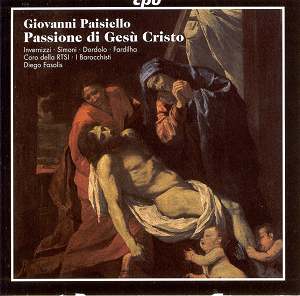

 Roberta Invernizzi, Alla Simoni (soprano), Luca Dordolo (tenor), José
Fardilha (baritone)
Roberta Invernizzi, Alla Simoni (soprano), Luca Dordolo (tenor), José
Fardilha (baritone)