Low Price £10 postage paid World-wide

Classical CD and DVD reviews. MusicWeb is not a subscription site and it is our advertisers that pay for it. Please visit their sites regularly to see if anything might interest you. Purchasing from them keeps MusicWeb free.

Classical Editor: Rob Barnett                               Founder Len Mullenger


CD REVIEW

Making a Donation to MusicWeb

About MWI

Site Map

More Reviews
How to find a review

Book Reviews

Film Music Reviews

Nostalgia

Comment
Arthur Butterworth Writes

Phil Scowcroft's Garlands

Classical blogs

Reviewers Logs

Announcements

Don't Go Here!

Community
Forum

Web Ring

Reviewers

Helpers invited!

Resources
How Did I Miss That?

British Composers

British Light Music Composers

Other composers

Indexes
   Label
   Masterwork

Discographies
   Composer
   National

Themed Review pages

Complete Books

Programme Notes

External sites
British Music Society
The BBC Proms
Performers
Orchestra Sites
Recording Companies & Retailers
Online Music
Agents & Marketing
Publishers
Other links
Newsgroups
Web News sites etc

Editorial Board
Classical Editor
   
Rob Barnett
Seen & Heard
Editor and Webmaster
   Bill Kenny
MusicWeb Webmaster
   Len Mullenger
Assistant Webmasters
   Patrick Waller
   David Barker

PotPourri
A pot-pourri of articles

MW Listening Room
MW Office
Helping MusicWeb
Advice to Windows Vista users  
Questionnaire    
Site History  
What they say about us
What we say about us!
Where to get help on the Internet
CD orders By Special Request
Graphics archive
Currency Converter
Dictionary
Magazines
Newsfeed  
Web Ring
Translation Service

Rules for potential reviewers :-)
Do Not Go Here!
April Fools

Would you like a hyperlinked weekly summary of the CDs we have reviewed?
Click for further details

Sample: See what you will get

Alternatively
AmazonUK   AmazonUS


Niccolò PAGANINI (1782–1840)
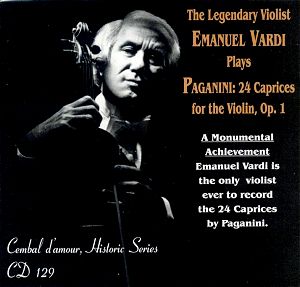
Twenty-Four Caprices Op. 1 (c.1805) (arranged for viola by Emanuel Vardi) [76:51]
Emanuel Vardi (viola)
rec. ca 1965
CEMBAL D’AMOUR CD129 [76:51]
Experience Classicsonline


These epoch-making performances were originally issued on Epic SC 6049 in 1965. They were recorded by violist extraordinaire Emanuel Vardi who performs his own arrangements of the Paganini Caprices playing one fifth lower than the original key. He remains, as Cembal d’amour reminds us, the only violist to have set down all twenty-four and an additional symmetry resides in the fact that Vardi was inspired to take up the viola after hearing William Primrose’s own viola performance of two Paganini caprices, recordings that the Scotsman made for Columbia in 1934.
 
After listening to Primrose play a couple of Caprices for him, Mischa Elman sat thoughtfully for a while then pronounced; “Must be easier on the viola.” Well, one wonders what he would have said to Vardi who plays all twenty-four; possibly he’d have been so astounded that he’d have said nothing at all. This feat of prodigious virtuosity and astonishing pluck – allied to a violist’s indomitable will – is one that set the standard for violists.  In this respect he followed his eminent predecessors Tertis and Primrose who both strove for greater renown and respect for their instrument through commissions and transcriptions. Primrose’s was the exemplar in Paganini; Vardi took things to their logical if perhaps extreme conclusion. 
 
Vardi had played all twenty-four caprices on the violin and had publicly played a number as a violist. But he’d avoided others, such as 1, 4 and 6 fearing them too demanding. It was George Ricci, Ruggiero’s cello playing brother, who encouraged Vardi to record the complete set. Clearly George shared his brother’s dare-devilry when it came to the repertoire. Thus the recordings were made in Vardi’s studio in his home in New Jersey. He says the tape was leased to Epic and released in the early sixties. Maybe they were recorded in the early sixties then; I’m pretty sure they were actually released in 1965. In any event in his notes Vardi’s happy to put some myths to rest. Yes, he did use his 17-inch Dodd viola and no he didn’t “cheat” with a smaller instrument. 
 
Vardi’s studio was a rather boxy sounding one – the sound is consequently rather cramped and brittle.  And had he had access to a professional studio and recording engineers of course the sound would have been more ingratiating. Time for retakes would have ensured that those moments when he’s out of tune would have been remedied. But against that this is really one of those “Giant Leaps For Man” recordings. No.4 is sustained with legato dignity and amazing depth of tone. The fanfares of Nine are strongly projected and bowed.  A retake may have compromised the rugged masculinity and fearless bravura of Sixteen, gloriously spontaneous sounding. The voicings of Twenty emerge intact. Comparison with his hero Primrose in 13 and 5 shows the different tonal qualities of the two men. In Thirteen Primrose’s bowing is much lighter and wristier – the articulation is considerably less pressured. Primrose is more elegant, daintier. Vardi by comparison favours a more rugged timbral terrain – his bowing is rougher, more plangent. In No.5 similarly he is slower and has greater tonal depth than Primrose’s lighter, by comparison almost Gallic playing.  This was of course the pre-Heifetz Primrose.

So a box of rugged delights here. The fingered octaves of No.17 are dealt with something approaching aplomb – outrageous - and the whole set, abrasions and all, is a testament to Vardi’s instrumental command and tightrope walking skills.
 
There is a small tracking problem with my copy – track 1 temporarily segues into track 2 but rights itself eventually.
 
This heroic undertaking returns to the catalogue more than forty years after first seeing the light. It stands as a beacon of daredevilry.
 
Jonathan Woolf


Advertising Rates
Visitor stats
MusicWeb International
has over 23,000 Classical CD reviews on offer


Gerard Hoffnung Concerts &
The Bricklayer Story

Naxos Classical


Australian Eloquence CDs on Buywell.com


New Releases

Hyperion
New Releases


Guild Music


MusicWeb sells the Polish
catalogue CDAccord
£10.50 post free W-W


MusicWeb sells the
Arcodiva catalogue
£12.00 post free W-W


Price Reduction: £11.00
post-free
world-wide
Try it and see - Sale or Return


MusicWeb can now offer you discs from the following catalogues:
Prices include postage

[Acte Préalable £13.50]
[Arcodiva £12.00]
[Avie from £6.25]
Brilliant Classics
[British Music Society £13.49]
[CDACCORD from £10.50 ]
[ClassicO £12.50]
[Hallé from £11]
[Hortus £14.99 ]

[Lyrita ONLY £11.00 ]
LYRITA Sale or Return
[Onyx £12.00
]
ONYX Sale or Return
[REDCLIFFE £11 ]
[Tactus £11.50 ]
[Talent from £12.00 ]
[Toccata Classics £12.50 ]


MusicWeb Recommended Recordings

DISCS OF THE YEAR 2008

Google Ads
The DoubleClick DART cookie is used by Google in the ads served this site. When users view or click an ad, a cookie may be dropped on that end user's browser. The data gathered from these cookies will be used to help AdSense publishers serve and manage the ads on their site(s) and across the web more effectively.


Users may opt out of the use of the DART cookie by visiting the Google ad and content network privacy policy.


Return to Review Index


Reviews from previous months
Join the mailing list and receive a hyperlinked weekly update on the discs reviewed. details
We welcome feedback on our reviews. Please use the Forum. To prevent spam you need to sign up for thid with a unique password. Please paste in the first line of your comments the URL of the review to which you refer..


You can purchase CDs and Save around 22% with these retailers: