Editorial Board
MusicWeb International
Founding Editor Rob Barnett Editor in Chief
John Quinn Contributing Editor Ralph Moore Webmaster
David Barker Postmaster
Jonathan Woolf MusicWeb Founder Len Mullenger
Organ Fireworks XII Dietrich BUXTEHUDE (c.1637–1707)
Prelude,
Fugue and Chaconne in C major BuxWV 137 [5:13]; Prelude and Fugue
in G minor BuxWV 148 [6:39] Petr EBEN (1929–2007)
Hommage à Buxtehude (1987)
[8:23] Niels Wilhelm GADE (1817–1890)
Tone
Piece in F major Op 22 No 1 from Tre Tonestykker (1851)
[5:01] Joseph RHEINBERGER (1839–1901)
Fantasia
on ‘Tonus Peregrinus’ from Sonata No 4 in A minor Op 98 (1876)
[7:50] Louis VIERNE (1870–1937)
Carillon de Westminster Op
54 No 6 from Pièces de fantaisie (c.1927) [6:28] Marcel DUPRÉ (1886–1971)
Prelude
and Fugue in G minor Op 7 No 3 (1914)[7:22] Johannes BRAHMS (1833–1897) Academic
Festival Overture Op 80 (1879-81) (arr. Edwin Lemare (1865-1934)) [10:28] Sigfrid KARG-ELERT (1877–1933)
Passacaglia
and Fugue on B.A.C.H. Op 150 (1931) [19:20] Christopher
Herrick (organ)
rec. Haderslev Cathedral, Denmark, 12-13 April 2007. DDD. Hyperion CDA67612 [76:47]
Christopher Herrick and
Hyperion have been casting their net far and wide for this
series of Organ Fireworks, which has now reached its 24th year
and its twelfth volume. A consistent feature has been the
choice of organs able to give forth resplendently, and the
tailoring of the programme to suit the capabilities of the
chosen organ.
Thus Volume X, recorded
on a “veritable beast of an organ”, the 96-stop, 6,551-pipe
2002 Letourneau organ of the Winspear Centre, Edmonton, Canada,
offers as its main work Liszt’s Fantasia on Ad nos, ad
salutaremundam. Volume XI is performed on the
Lay Family Concert Organ in Dallas, Texas, another very large
instrument on which Herrick plays Copland, the “French Americana
of Langlais and Widor ... [and] a selection of jazz-infused
works which allow both player and instrument to develop a
whole new aspect of the organ repertoire.” (All quotations
from Hyperion’s publicity material).
Now he turns his attention
to the Haderslev Cathedral organ and to repertoire deemed
suitable for it. Recorded in Buxtehude’s tercentenary year
and on a Danish organ, it is appropriate that the recital
should open with two of Buxtehude’s own pieces and that Petr
Eben’s musical tribute to him should be included, though
it interrupts the otherwise roughly chronological order of
the works on the CD. While Buxtehude’s connection with the
other composers here may not at first seem clear, the notes
in the booklet make the link, via Bach, Liszt and Reger,
to Karg-Elert whose death marked “the end of a great chapter
in the history of German organ music ... that began with
Buxtehude and the other north German masters who inspired
Bach.”
How appropriate, too,
that we should have Buxtehude performed on the cathedral
organ of a town which was once in Germany and now is in Denmark.
Buxtehude, despite his German surname, was born and possibly
died in Denmark but worked in Hamburg. The Hyperion notes
leave the question of his true nationality open.
The first two pieces,
by Buxtehude, feature on a 3-CD set of the organ music of
Buxtehude and his contemporaries, played on historic Danish,
Dutch and North German organs by Kei Koito, which I am currently
also reviewing (Claves 50-2704/06) Koito gives a fine account
of BuxWV137 on the organ of St Jacobi, Hamburg, and an equally
fine account of BuxWV148 on the organ of the Martinikerk,
Groningen, both of which would appear to have greater claims
to be historically more appropriate to the music of Buxtehude.
Herrick’s Haderslev organ is of no great antiquity, having
been built originally in 1863 by Furtwängler & Sons,
rebuilt in 1932 by Marcussen & Søn, and updated in 1977.
When one takes into account
the various rebuilds and restorations that the two ‘historic’ organs
have received, however, they are not particularly better
suited to Buxtehude than Herrick’s Danish organ. The Hamburg
organ has emerged from its latest rebuild at rather too high
a pitch for baroque music. Good as the Koito performances
are, Herrick’s are just that little bit more special; she
is light-fingered, he lighter still. His registration is
also a touch lighter and his slightly faster tempo benefits
the music. Where the ‘fireworks’ may be said to explode,
at the end of BuxWV137 and at the close of the fugue of BuxWV148,
both organists give it their all.
Despite the dedication
of the Eben work and its easily-recognised quotation of the
first Buxtehude piece here, BuxWV137, the comparative angularity
of this piece makes for an odd transition from Buxtehude
and to the following piece by Gade. To quote the excellent
notes, by Relf Clark, Buxtehude “would almost certainly have
been bewildered” by it. So would Gade. No doubt Buxtehude
would have appreciated “the highly inventive use it makes
of his own material”. It is an attractive piece, but I am
not convinced that this was the right place to put it – it’s
the most ‘advanced’ work on the CD, more modern in feeling
even than the Karg-Elert piece of four years later.
The Gade piece is an attractive
example of the music of this rather neglected contemporary
of Mendelssohn. Neither it nor the Rheinberger is especially
memorable but neither outstays its welcome. Vierne’s much
better-known Carillon de Westminster is dedicated
to the organ-builder Willis but it and the Dupré sound equally
well on the Haderslev organ. Herrick’s performances of these
French pieces are as good as any you are likely to encounter
on any organ. The end of the Carillon puts the organ
and recording – and one’s speakers – firmly to the test.
All come out with flying colours.
The arrangement of Brahms’s Academic
Festival Overture is interesting, and Herrick’s performance
would do credit to any conductor, but I am not sure that
I shall want to hear it too often. Perhaps it would have
been better to have included something by Max Reger, whom
the notes identify as one of the links in the chain from
Buxtehude to Karg-Elert.
The Karg-Elert Passacaglia
and Fugue, another Willis dedication, provides the real fireworks
of this recital – a splendidly large-boned piece in the late-romantic
style with which to round off an excellent CD. Its quotation
of the B.A.C.H. theme reminds us of the centrality of the
one North German composer conspicuous by his absence here,
whose presence would probably have detracted from the other
works by stealing the show.
Christopher Herrick really
is an organist for all seasons, equally at home with Daquin’s Noëls,
his recording of which I recently recommended (CDH55319 – see review)
and Buxtehude here and with the Dupré and Karg-Elert at the
other end of the chronological scale. My usual practice is
first to listen to every CD once without trying to reach
for pen and paper but the temptation to make one or two notes,
even at this stage, is usually irresistible. I listened to
this recording all the way through without once wanting to
write a single critical word – I just wanted to play the
whole thing through again.
The recording is excellent,
wide-ranging and with a good sense of the ambience of Haderslev
Cathedral, which is never allowed to swamp the recording.
The excellent notes include a detailed history and specification
of the organ, though not of the registration employed for
each piece.
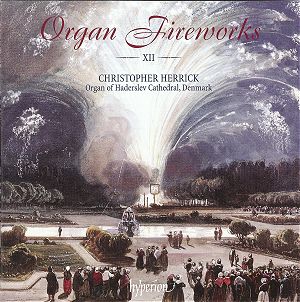
The attractiveness of
this recording is completed by the cover illustration of Fireworks
at Fontainebleau (1857). Like Naxos, Hyperion seem to
have an inexhaustible supply of appropriate cover illustrations.
I came very close to nominating
this CD as a Recording of the Month. Really the only
thing which prevented me was the fact that I thought that
the Brahms
transcription took up space which could have been better
allocated. That is probably unfair, since, with a generous
playing time of 77 minutes, even programming out the Brahms
leaves a 66-minute recording.
Brian Wilson
Please support our advertisers below by clicking on the logos for further information.

























 Christopher
Herrick (organ)
Christopher
Herrick (organ) 