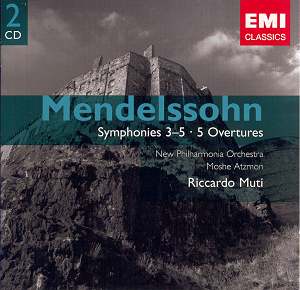
Veteran collectors, especially in the U.S., may be interested in this convenient "Gemini" twofer, including
as it does an overture collection that never saw Stateside
distribution, along with Riccardo Muti's Scottish Symphony,
which might as well not have.
Let me explain that last remark. The Scottish was originally
one of a clutch of EMI recordings introducing Muti as a symphonic
conductor -- he had, of course, previously recorded Verdi
operas for the label. All three recordings - the others were
Dvořák's New World and Tchaikovsky's First Symphony, Winter Dreams - reproduced
with a peculiarly murky, grainy aural image - the reviewer
for the late lamented High Fidelity described it as
"furry". I had hoped that the CD would restore some
of the missing sonic luster.
At first, the digital processing appears to help. The slow introduction
sounds smooth and bright enough; and while the exposition,
beginning with strings alone, turns dull - sounding much as
it did on the LP - each entrance of the wind instruments adds
plenty of overtones. But as the movement winds on, the dullness
comes to prevail no matter who's playing, and by the start
of the Scherzo, we hear not only the strings but the clarinet
as if from behind a scrim. If you crank up the volume, the
result is harsher but no clearer. The intrusion of a low-range
electronic buzz from 2:09
to 2:13 of the Scherzo suggests that technical problems may have dogged these
sessions; at any rate, the sonic anomalies were clearly not
exclusive to the U.S. Angel pressings - as we Americans had
hoped, or feared - but a problem inherent in the original
master-tapes.
Still, we hear enough to realize that the performance is mostly nothing
special. The first-movement introduction is straightforward
enough, though the basses swell at the climax in an ungainly
manner. Muti plays the second theme-group as if it were primarily
about the rhythm rather than about the interplay of melodic
fragments; it "dances," but it doesn't "sing."
On the exposition repeat, the principal clarinetist does find
the time to shape and color the theme, quite nicely at that
-- and it's good to know they really did play the music twice.
The Adagio slogs along, beat by ponderous beat: either
Muti had no sense of its long line, or it was stitched together
from too many short bits of tape. And patches of shoddy playing
expose the conductor's "Defender of the Score" reputation
as so much sham posturing. Rapid accompanying figures in the
Scherzo and Finale are messy; the horns lag unconscionably
behind the bass triplets at 4:42
of the Adagio -- this is not "good ensemble"
as I've understood it.
The companion symphonies are good but not great. The New Philharmonia
players have no trouble keeping up with Muti's brisk, buoyant
pace in the first movement of the Italian, but they've
no time to make the passagework graceful, and in the development
-- where the passagework pretty much takes over -- momentum
inevitably flags, picking up again only when the theme returns.
The closing Saltarello, however, is truly Presto,
lithe and athletic. The Reformation offers the occasional
freshly considered moment, as with the eerie, restrained reprise
at 9:20 of the first movement, and the scherzo's
easy, unforced swing. Otherwise, the predominantly moderate
tempi and heavyhanded manner leave a workaday impression,
exacerbated by dark, bass-heavy equalization. The reproduction
in both works, while better than in the Scottish, is
"canned" and unalluring.
Like Muti's Scottish, the overtures served as EMI's calling-card
for a young conductor - Moshe Atzmon in this case, who, like
Muti, had already recorded for the company (Rachmaninov concerto
accompaniments for Agustin Anievas, for those with long memories).
Once past the obligatory Hebrides - no more or less than the players
could have managed on their own: approximately executed, with
a wooden, unshapely second theme - Atzmon shows a nice feeling
for mood. Calm Sea and Prosperous Voyage begins spaciously,
with the chattering winds livening things up; Ruy Blas,
one of my own favorites, goes with hearty exuberance. In its
sturdy construction and appealing themes, Die Heimkehr
aus der Fremde recalls the Schumann concert overtures,
minus the Angst, while the little-played Athalie
persuasively projects that curious mixture of stately squareness
and operatic drama that marks the composer's oratorios. An
audible splice just before the fast section of Ruy Blas,
and a few random balances, suggest mild technical insecurities
on Atzmon's part; otherwise the orchestra sounds good.
Even at "twofer" pricing, I can't see getting the present
set just for four overtures. The principal competition - DG's
budget disc under Gabriel Chmura - is similarly unremarkable.
As for the symphonies, collecting them is not so easy: conductors
who give us a fine Italian (Szell/Sony, Colin Davis/Philips)
don't always proceed to the Reformation, while some
of those who excel at the latter (Gardiner/DG, von Dohnányi/Decca)
are less distinctive in the A major. Munch did both well enough,
with the Boston Symphony (RCA), but the fifty-year-old (!)
stereo has noticeably dimmed. His febrile, exciting Scottish
(RCA), however, recorded some years later, still comes up
vividly; so does Peter Maag's sensitive account (Decca). For
a coupling of the other two symphonies, I'd try for the early
Maazel/Berlin (DG).
Stephen
Francis Vasta
see also Review
by Patrick Waller