John Beard, the tenor who created the roles of Jupiter (in Semele),
Samson, Judas (in Judas Maccabeus) and Jephtha in Handel’s
oratorios, had a voice whose compass seems - according to Winton
Dean writing in Grove - to have been B to a’ … though parts written
for him rarely go below d. His strengths seem to have been expressiveness
and a firm mezza-voce rather than agility. This agrees with what
we know about the other oratorio singers who sang for and were
trained by Handel.
The other major
tenor associated with Handel comes from his Italian opera period;
Francesco Borosini created the roles of Bajazet in Tamerlano
and Grimoaldo in Rodelinda. For Handel, his range
seems to have been A to a’, but other composers wrote lower
parts and even notated for him in the bass clef. His ‘signature’
seem to have been a forceful style of singing with wide leaps
and energetic declamation.
I include these
two descriptions because in the booklet for his new disc of
Handel arias, Ian Bostridge refers to his desire to ‘rehabilitate
the Handel tenor’. Simply comparing Borosini and Beard,
and the parts written for them, make us realise that there was
never a single exemplar of a Handel tenor. Bostridge’s article
works a little hard to try and convince us that the Handelian
tenor repertoire is under-appreciated and that this new disc
is going to rehabilitate the Handelian tenor.
It would have been
preferable, I think, if Bostridge had simply issued a recital
of Handel arias without any special pleading. Critics would
then have assessed it on its own merits, whereas his understandable
didactic instinct has caused a degree of critical comment. This
is partly because Bostridge has indeed shot himself in the foot.
The only arias he
sings from Handel’s Italian operas are transpositions of well
known castrato pieces from Serse and Ariodante. In the
text Bostridge refers to the fact that Francesco Borosini sang
the castrato role of Sesto in a revival of Giulio Cesare.
But Handel gave him substantially new music and examples of
Handel’s transposing roles down an octave are so infrequent
that we must assume that he only did it in rare circumstances.
Bostridge sings
nothing that Handel wrote for Borosini. Of his own appropriation
of arias from the title roles in Ariodante and Serse
he says that there is a great deal of difference between
the transposition of a role into the bass register - as has
happened a lot in the past (Norman Treigle singing the title
role in Giulio Cesare to Beverly Sills’s Cleopatra) -
and singing the role in the tenor register. All we can do at
this point is to listen to the disc and see whether we agree!
Bostridge sings
Ombra mai fu with its preceding accompagnato from Serse
and Scherza infida and Dopo notte from Ariodante.
In all these he sounds uncomfortable with the tessitura and
the lower third of his voice is forced so as to accommodate
the unusually low (for Bostridge) part. He tends to compensate
by being overly dramatic and interventionist; you feel he wants
to keep doing something with the music rather than simply letting
it be.
As an example of
what Bostridge is truly capable of take his singing of a part
in the correct vocal range, as in San Giovanni’s aria, Cosi
la tortorella from La Resurrezione. This is lovely
and I wish we had more of it on the disc. The part sits well
with him and he sounds more relaxed and commensurately tries
to do less with the music, to the aria’s great benefit.
The duet As steals
the morn from L’Allegro and three items from Acis
and Galatea show Bostridge similarly in fine form. They
show what he can do with Handel. He remains an interventionist
at heart. Though he sings with an elegant line, he has a tendency
to shape each note individually, to throb and croon. You must
set this against the fact that he sings with superb diction
and his usual musical intelligence.
If we turn to the
tenor parts written for John Beard then the results are mixed.
Bostridge sings the items from Samson and Jephtha
with a rather soft-grained tone, crooning the quieter bits.
He seems to have taken the Grove Dictionary’s description of
Beard’s voice rather too much to heart. I wanted far more edge
to the voice in these items. Overall his delivery was too soft-grained
for my taste. That this is a deliberate choice is indicated
by his way with Ev’ry Valley from Messiah, where
he delivers the aria with all the edge, firmness and power I
would have liked in the Samson and Jephtha items.
The selection of
arias on the disc is, overall, rather unimaginative. Bostridge
has included nothing which is in the slightest way unusual or
out of the way, simply giving us a sort of 'greatest hits' disc.
Bostridge is well
supported by Harry Bickett and the Orchestra of the Age of Enlightenment,
whose members contribute some fine solo playing.
In addition to the
article by Bostridge the booklet include all the song texts
and English translations where necessary.
This is a mixed
disc. Bostridge’s admirers will undoubtedly enjoy his performances
but other listeners might be less convinced by his rather personal
take on Handelian performance. I would like to think that this
disc might win new audience for the repertoire, but I am not
at all sure.
Robert Hugill
























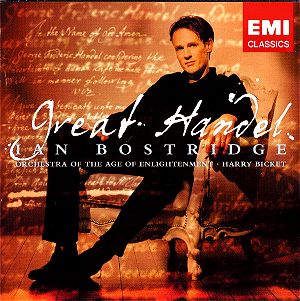

 Ian Bostridge
(tenor)
Ian Bostridge
(tenor) 