Hexen
(The Witch) and Den lille pige med svovlstikkerne (The
Match Girl) after H.C. Andersen were two early successes by
the Danish composer August Enna.
He
was born on the island of Lolland to a family with Italian
roots and learnt the shoemaker’s trade, as did his father
and elder brother. Music was central in the family but it
was not until he was eighteen that he was able to get some
formal training, in violin and later in piano. He started
composing with little theoretical background but still managed
to attract Niels W. Gade’s attention with a Symphony in
C minor and through further contact received a fellowship
which enabled him to write Heksen, which within a few
years was performed on forty stages throughout Europe. In
total he composed fourteen operas, eleven operettas, five
ballets and some incidental music. Stylistically he is rooted
in Central European late- romantic ideals; Wagner is easily
discernable but there is also a Nordic tone but hardly as
prominent as to make him a national-romantic composer. He
seems not to have been able to develop his tonal language
along the new paths that were being trodden around the turn
of the last century and his later works were not received
with much enthusiasm, even though Carl Nielsen, when evaluating
his score of Gloria Arsena, wrote: ‘As always from
Enna’s hand, excellently instrumented, with vocal cantability,
etc. Certainly no new values added in this opera, but I can
most warmly recommend this Danish work for acceptance.’ This
was in 1912. The work was premiered in 1917.
What
Nielsen wrote could just as well be applied to Heisse Liebe.
The opera was composed 1900-1901 but was in fact a thorough
reworking of an earlier work. It was first performed in Weimar
on 6 December 1904 but was not much of a success. The Royal
Theatre in Copenhagen mounted the opera in 1912 under the
title Ung Elskov. The libretto by P.A. Rosenberg is
based on a novella by the Hungarian author Kálmán Mikszáth.
The plot briefly:
Arota,
daughter of estate administrator Matthäus, has fallen in love
with Andreas, who turns out to be the son of the estate owner,
who has recently passed away. Her love seems to be reciprocated.
But Matthäus’ foster son Janos regards himself as betrothed
to Arota and when she turns him down his jealousy turns into
blind hate. In the second act Andreas talks Arota into following
him and leave her father, against his consent. Janos follows
them and kills them both, thus saving Arota from sin. “She
stands before God as a pure maiden.”
The
overture is well-wrought and melodious, Wagner’s voice permeating
the score in slightly diluted form. The first act takes some
time to build the tension. It is filled with beautiful, lyrical
music but it is of uniform density and where Wagner often
illuminates the score with chamber-like transparency, Enna
tends to over-employ the French horns and create a rather
compact sound. Arota’s opening aria could be said to have
something of the simple folk-like melody of Nielsen’s Danish
songs, which also play a central part in his opera Maskarade.
Nielsen, although just a few years younger than Enna, is harmonically
and rhythmically and in matters of orchestration, a man of
the 20th century. Enna remains firmly rooted in
the 19th century, and it should be remembered that
the two operas are almost contemporaneous. As time goes by
the drama gathers momentum and towards the end of the long
encounter between Arota and Janos the temperature for the
first time rises to something close to boiling point (CD1
tr. 5). Thereafter it seems that Enna found the ebb and flow
that makes a piece of music drama live, and even though it
is basically a lyric tale it grows. The peasant chorus (CD1
tr. 6) is jolly and idyllic and not far removed from Smetana
(The Bartered Bride). There is some really efficient
powerful choral writing later in this scene.
Act
2 opens with a dark, chromatic prelude, quite evocative and
this is a signal that the intensity is to thicken. This act
is much more tense and also filled with glowing passion, where
the strings reveal Andreas’ feelings. To me it seems that
Enna becomes much more involved, much more personal when he
gives the strings free rein. There is a coherence and inevitability
in this act that I wish had been there from the beginning.
In the first act there are several highly attractive passages
but it is the second act that convinces me of Enna’s capacity
as a dramatist. I suspect that this is where I will most readily
return. The duet between Arota and Andreas (CD2 tr. 4) can
stand comparison with, say, Goldmark or Humperdinck. A real
highlight is the following aria for Andreas (CD2 tr. 5), where
und Küsse selig von meinem Lippen saugen! is as impassioned
as anything in Germanic opera of the time. This also inspired
the admirable Lothar Odinius to singing with a glow and beauty
reminiscent of Fritz Wunderlich.
Odinius
made a very good impression on a Schubert recital some while
ago and here he confirms that in the field of lyric German
tenors he is one of the top contenders. The other tenor, Korean
born Alfred Kim, has a larger voice with heroic ring. He is
much in demand on the continent in roles like Cavaradossi,
Don José, Rodolfo and Faust, but his tone is not always ingratiating.
Johanna Stojkovic is a good Arota and her lyric soprano has
character, while Egbert Junghanns as Matthäus is expressive
but rather weak.
The
chorus and orchestra from the North German Radio are excellent,
the ladies’ voices in particular. Hermann Bäumer sees to it
that the climaxes, mainly in the second act, are given true
impact.
There
is a good essay on Enna and bios on the singers and conductor.
There is both a synopsis and full texts, which are a necessity
with a little known work.
Heisse
Liebe is no lost masterpiece and I doubt that it will
be performed very often but it is still good to have a recording
of it. In particular the second act has a great deal to offer.
I see in the booklet that the same company offers a recording
of The Little Match Girl. Why not hope for The Witch?
Göran
Forsling
























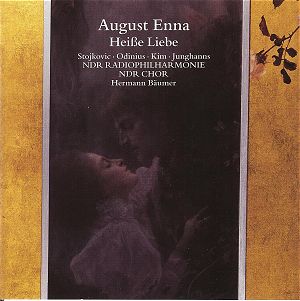

 Johanna Stojkovic
(soprano) – Arota, daughter of the estate administrator; Lothar
Odinius (tenor) – Andreas, son of the duke; Alfred Kim (tenor) –
Janos, Arota’s betrothed; Egbert Junghanns (baritone) – Matthäus,
ducal estate administrator
Johanna Stojkovic
(soprano) – Arota, daughter of the estate administrator; Lothar
Odinius (tenor) – Andreas, son of the duke; Alfred Kim (tenor) –
Janos, Arota’s betrothed; Egbert Junghanns (baritone) – Matthäus,
ducal estate administrator 