The particular nature of Elgar’s orchestral output means that
it come on CD in all sorts of couplings. It would not be all that
easy to assemble a complete series of the major works in good
performances without several duplications on the way. Since the
music lends itself to a wide number of interpretative stances,
perhaps this is all to the good. However, anyone starting a collection
who bought, on my recommendation, the 2-CD set of Boult’s
performances of the symphonies and a few other works may be
encouraged to know that the present issue doesn’t duplicate anything
at all and also offers a quite different angle on the music. If
you’re after basic Elgar you’ll still need, as far as the orchestral
side goes, Falstaff, the Violin Concerto and Cockaigne.
It
is possible, of course, that EMI will gradually bring out
the rest of their Boult/Elgar recordings. Since I have all
the present works under Boult in LP or CD format – except
“The Starlight Express” which he didn’t record – I’ll make
him my point of reference.
In
a long career, Sir Charles Mackerras has amassed a staggering
discography covering most musical periods and styles. Probably
more of his recordings than those by any other conductor have
remained front-runners for the work in question. Even when
not, I don’t remember ever reading a review which suggested
he was right off the beam for that particular piece, or that
he just wasn’t on form. Yet he has never been particularly
associated with Elgar and I was rather curious as to how he
would approach him.
The
secret of Mackerras’s success perhaps lies in his ability
to penetrate a wide range of musical styles. While in Mozart
he may seem something of a strict-time conductor, in Elgar
he understands perfectly the continual ebb and flow of the
music, the flexibility within a phrase. Though he can summon
up swagger and vitality when called for, what I find memorable
here is his evocation of Elgar’s nostalgia. If this differentiates
him from Boult’s more structural approach, the actual sound
he draws from the orchestra is generally delicate, luminous,
even diaphanous. As a result he is equally distant from Barbirolli’s
“con amore” manner.
His
one miscalculation seems to me to come very near the beginning
of the first disc. Adopting a “living for the moment” method
in “Froissart” means that the music practically stops within
a minute of its beginning when the chorale-like theme is introduced.
This is the sort of moment where Boult tends to be supreme.
He gives this new idea all the character it needs but in parenthesis,
as it were, without stopping the flow. Since this early work
is teeming with ideas but inclined to sprawl I feel that Boult
is more effective in holding it together. I recognize, though,
that Mackerras gets more pointed playing and characterizes
certain moments more vividly. I am speaking of the 1972 Boult,
there’s one from 1956 that I don’t know.
At
the beginning of the Cello Concerto both Cohen and Mackerras
announce a very expansive manner, with expressive pauses before
sinking into each new idea. It’s impossible to know if this
is Mackerras’s own view or whether he is just being a sympathetic
accompanist, but he certainly sounds as if he believes in
it. This is very much a post-Du Pré/Barbirolli performance,
even managing to add a further minute-and-a-half to the role-model
and about six to Elgar’s
own recording with Beatrice Harrison. Here, I think, lies
the problem. Since the fast music goes at about the same speed
in all performances, extending the slow parts by six minutes
alters the proportion of slow music to fast, as well as practically
creating a further slow movement by treating the first movement
as one, rather than “Moderato” as marked. However beautifully
the individual moments are managed, and they certainly are,
the work seems to me to be pulled out of shape. Possibly the
Harrison/Elgar recording despatches certain sections somewhat
briskly, but the Anthony
Pini/Van Beinum and Tortelier/Boult, which both add just
about a minute, seem to have all the time in the world to
express the music. Still, as I say, the present performance
is obviously a most deeply-felt affair.
Certain
parts of Mackerras’s “Enigma” came as a revelation to me.
He probes continually into the texture, bringing out single
strands that are often passed over, his flexible phrasing
sometimes lingering on small phrases or even single notes,
yet never with any suggestion of wallowing for its own sake.
I am grateful for the experience, yet I feel I would return
to it only rarely, since a performance like this has to be
taken as a commentary on more basic ones. Boult’s 1962 recording
– I don’t know the later one – is certainly a basic interpretation
but maybe a bit too plain-sailing. Back in 1936 Boult was
amazingly electric and taut with a timing of only 26:08. Like
certain Toscanini recordings, I find myself a bit breathless
listening to it. But, whatever you think of the Mackerras
for a basic interpretation, I think all Elgarians will find
it richly rewarding. This is actually his second recording
of the work; slightly earlier (1985) he coupled it with “Falstaff”
for EMI.
If
“Enigma” was perhaps not one of the Elgar works where Boult
was supreme, his LP based around the “Wand of Youth” Suites
was one of his finest. At first it seemed that Mackerras would
be a little too bright and chirpy. Boult finds a Schubertian
melancholy in the “Serenade” which Mackerras misses, for instance.
But then Mackerras draws out the two slow numbers – “Fairy
Pipers” and “Slumber Scene” – tenderly and exquisitely and
it is as though he has now twigged on to the fact that this
is not just pretty light music but great music. No less than
Boult his fairies are mysterious and his giants frightening
in the last piece of the First Suite. Moreover, he draws out
the disturbing undercurrents of the march which opens the
Second Suite as effectively as Boult. But it is in “Little
Bells” and “Fountain Dance” that I find Mackerras has special
insights. Perhaps it his operatic experience which allows
him to paint vivid, imaginative little scenes by the side
of which Boult seems a touch too literal. So it would seem
a case of even honours – Boult preferable in the First Suite,
Mackerras in the Second. If you have a taste for historical
recordings, don’t miss Van Beinum in this music either (see
link above).
One
characteristic which Mackerras shares with Boult is that,
when he records little-known music, it sounds as if he has
known it all his life. I can’t think Mackerras has had many
encounters with “The Starlight Express”, but he shows the
same confident control of Elgarian ebb and flow as he does
in “Enigma”. Terfel is in splendid form. Elgar sets up an
unenviable challenge to the soprano in “I’m everywhere” with
which Alison Hagley battles manfully; thereafter she is warm
and sympathetic with a bright quality well suited to the music.
The two are well matched in the final duets, magically paced
by Mackerras. The excellent notes by Raymond Tuttle do not
spoil the fun by telling you what very famous tune is going
to well out of the orchestra just before the end, so I won’t
either – there’s no enigma about this one!
And
so to “Dream Children”. Mackerras is about 50% slower than
Boult in the first piece, quite a bit slower in the second.
I’m inclined to think these must be the outside tempi – in
either direction – at which the music will work. Boult’s mastery
of phrasing shows he can find tenderness, mystery and depth
at a flowing pace, Mackerras shows he can savour every moment
without getting stuck. If you have both you’ll certainly have
a three-dimensional view of the music.
It
looks as if Mackerras might be a more important interpreter
of Elgar than is normally supposed. He also set down the Symphonies
at this time; probably the uncertain survival of the Argo
label reduced their circulation. Maybe Eloquence are eyeing
these too?
Christopher
Howell
























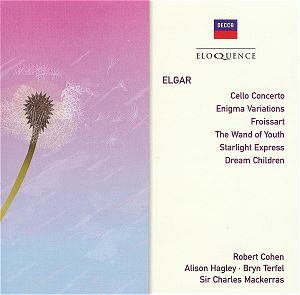

 Alison Hagley
(soprano) (5), Bryn Terfel (bas-baritone) (5), Robert Cohen (cello)
(2), Royal Philharmonic Orchestra (1-3), Welsh National Opera Orchestra
(4-6)/Sir Charles Mackerras
Alison Hagley
(soprano) (5), Bryn Terfel (bas-baritone) (5), Robert Cohen (cello)
(2), Royal Philharmonic Orchestra (1-3), Welsh National Opera Orchestra
(4-6)/Sir Charles Mackerras 
