Hard on the heels
of the superb complete Manon
(DVD review) and La sonnambula
comes this recital, which challenges
similar efforts by some of the greatest
divas of the past decades – and in
some respects surpasses them. What
divas do I refer to? Maria Callas
of course, but she was unique and
so controversial that you either love
her or hate her. She had also sung
in more heavyweight repertoire of
a type that none of my select group
of sopranos would ever contemplate.
Joan Sutherland belongs in that company.
Beverly Sills and Mady Mesplé
should also be included. From roughly
twenty years later, and still active,
Edita Gruberova is a candidate and
even younger is Sumi Jo. Diana Damrau,
whose recent disc with Mozart, Righini
and Salieri rarities I praised not
long ago, is a present day competitor.
I am sure that many readers would
be prepared to make their own lists.
Let’s make a thumbnail
sketch of each of these divas and
see what pros and cons there are:
- Maria Callas frequently sacrificed
tonal beauty for dramatic truth,
she wasn’t always technically so
assured and her vibrato could be
terribly ugly but she could also
spin a serene silver thread of tone
that was angelic.
- For Joan Sutherland no technical
hurdles existed, she had a breath
control that was more or less superhuman
and the tone was bright and beautiful
in the upper regions, but she was
dramatically rather lax, her articulation
was notoriously non-existent, in
the lower register the tone could
be hooty and as time passed she
developed a heavy beat in the voice
that could be mistaken for a wobble.
- Beverly Sills was as technically
expert as Sutherland but had a thinner
voice, which could be strident in
the upper register and many felt
that she lacked warmth. On the other
hand she was dramatically vivid
and convincing and her enunciation
excellent. On later recordings she
tended to be rather strained but
her involvement was never in question.
- Mady Mesplé had a typically
light, fluent French high soprano.
No one could sail as effortlessly
up in the stratosphere and her coloratura
was pinpoint clear and accurate.
She was a charming interpreter but
her voice could be slightly acidulous
in the middle register. Hers was
the smallest voice of these sopranos.
- Edita Gruberova has, like Sutherland
before her, shown a marvellous longevity
and now in her sixties she is still
singing her signature roles. Her
technical proficiency has never
been in question but sometimes a
certain unsteadiness and hardness
of tone has crept in. Her readings
have always been well considered
though somewhat generalized.
- Sumi Jo’s voice is even smaller
than that of Mady Mesplé
but extremely beautiful and agile.
From being primarily a Queen of
the Night and Olympia she has widened
her scope and some years I saw her
in all three soprano roles in Les
contes d’Hoffmann. As an interpreter
she is affecting but a bit small-scale.
- About Diana Damrau it is too early
to give a general verdict since
I have so far only heard her in
Mozart and his contemporaries, but
in such repertoire she has demonstrated
a willingness to go into her characters
and reveal what is behind those
pure canary-like notes.
Now, where does Natalie
Dessay stand in comparison? She lacks
something of the absolute purity of
Mesplé and Jo, she has less
roundness of tone and volume than
Sutherland and she has more warmth
than but the same interpretative insight
as Beverly Sills. Like Gruberova she
can sometimes be slightly unsteady
but she has a willingness and capacity
to sing softly with penetrating intensity
or disarming vulnerability that puts
her on a par with Callas. It seems
that she often, like Callas, manages
to cut out a believable portrait of
her character that can’t be mistaken
for another role.
Her Violetta is a
cardinal example of an intelligent
– and emotional – reading, graphically
illustrating her shifting moods up
to an almost ecstatic end of the act.
There is luxury casting, by the way,
of Alfredo, whose few phrases offstage
are sung by Roberto Alagna, no less.
He also appears in an even more peripheral
cameo role as Borsa in the excerpt
from Rigoletto. The long scene
from I puritani feels dramatically
true and Qui la voce is ravishingly
beautiful. Maria Stuarda is
lean and vulnerable, more in the Sills
and Gruberova mould than the heavier
reading by Sutherland. Her Gilda is
simple and innocent, just as the other
portraits in this gallery of wronged
women. It’s a touching impersonation
and so is her Giulietta, where the
plangent tone feels so appropriate.
Maybe the greatest
challenge is Lucia di Lammermoor,
a role Natalie Dessay has already
recorded complete in the French version.
Here we get it in the original, so
original in fact that a glass harmonica
plays the obbligato instead of the
flute to which Donizetti later changed
it. This lends the aria an eerie quality
that I suspect Donizetti was aiming
at. Sills and Thomas Schippers also
opted for this strange instrument
in their complete recording and, if
I remember correctly, Anna Netrebko
has a glass harmonica on her recital
from a couple of years ago. All through
this horrifying scene Natalie Dessay
is so vocally vulnerable that as a
listener one has to struggle with
the tears.
I won’t say that
Natalie Dessay is superior in every
respect to the illustrious predecessors
I have taken into account but she
has nothing to fear from a close comparison.
Both Sills and Gruberova recorded
all the roles on this disc, while
Sutherland never sang in I Capuleti
e I Montecchi. Interpretatively
she comes closest to Sills but is
even more sensitive to the finest
nuances and has more warmth while
Gruberova is, as I have already intimated,
excellent but more generalized. Sutherland
may have been ‘La Stupenda’ but her
lack of consonants and characterization
rule her out, however superb her Qui
la voce is in her first recording
of the aria in the album ‘The Art
of the Prima Donna’.
The disc as a whole
is a high quality product with sensitive
conducting by Pidò, good participation
from chorus and orchestra and excellent
contributions from the comprimario
singers. It is hard to imagine better
singing in this repertoire.
Göran
Forsling
























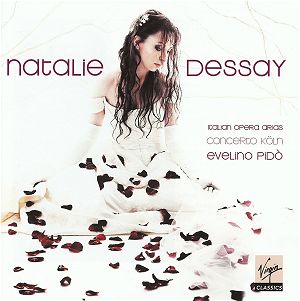

 Natalie Dessay (soprano)